
Melomania
Bojan Čičić & Stéphanie Brochard
Oxford Festival of the Arts
Festival Hall, Magdalen College School. 10 July 2025

melos = music | mania = madness
It was Goethe who suggested that “Music is liquid architecture and Architecture is frozen music”. Something very similar could be said of the link between dance and music. From medieval times up to the present day, most music has been linked in some way to dance, with many pieces directly related to a specific dance form. For example, the well-known Baroque Suite genre with an opening Prelude followed by a sequence of dance movements, traditionally allemande, courante, sarabande, and gigue. The traditional musical forms of Passacaglia and Ciacona are both dance-based. This extraordinary duo performance between violinist Bojan Čičić and dancer and choreographer Stéphanie Brochard, commissioned by the Oxford Festival of the Arts, presented a unique combination of music for violin and a range of dance movements. It was called Melomania and was described as neither a dance performance nor a concert but a “danced concert that embodies an intense passion for music, awakening the senses”.
Friedrich Wilhelm Rust (1739-1796): Partita for violin solo in D minor
Johann Sebastian Bach: Sonata No 2 for violin solo A minor BWV 1003
Sally Beamish (1956-): Intrada e Fuga for violin solo
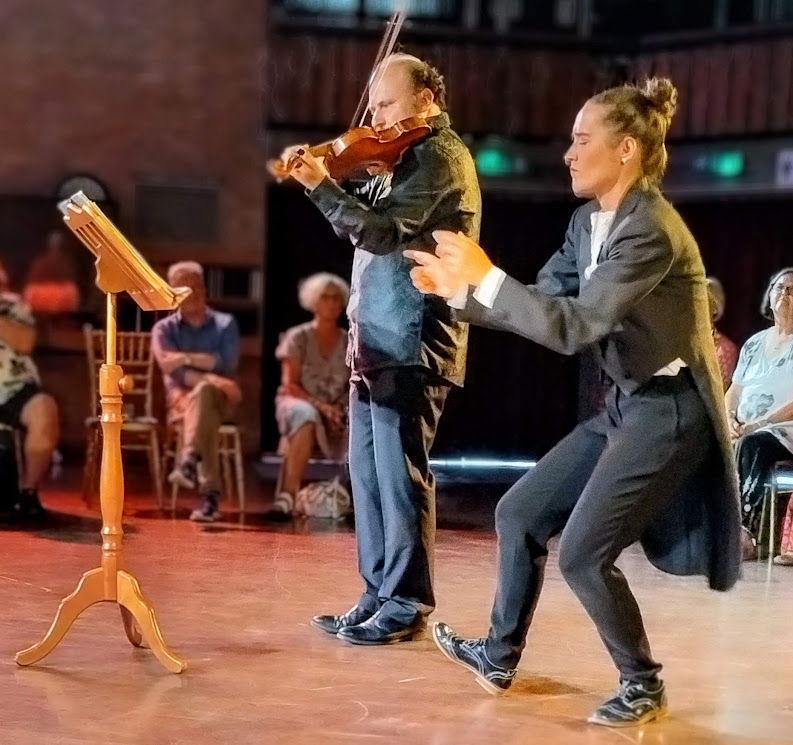
The solo violin music ranged from the 18th century to around ten years ago, opening with a composer I wasn’t familiar with, Friedrich Wilhelm Rust. His five-movement Partita consisted of a grand opening Prelude with florid scale passages and a complex fugue with frequent double stopping, followed by what sounded like a Gigue, a Ciaconna and a Courante. But what the dances Rust was inspired by is not as important as what Stéphanie Brochard did with them, in a choreographed sequence that relied much on humour as she acted as a sort of incompetent music monitor, fussing around with the music, missplacing it, and eventually dropping it all on the floor. This early introduction of humour, which also directly involved Bojan Čičić, was a clever way to start what might have seemed to be a fairly intimidating evening.
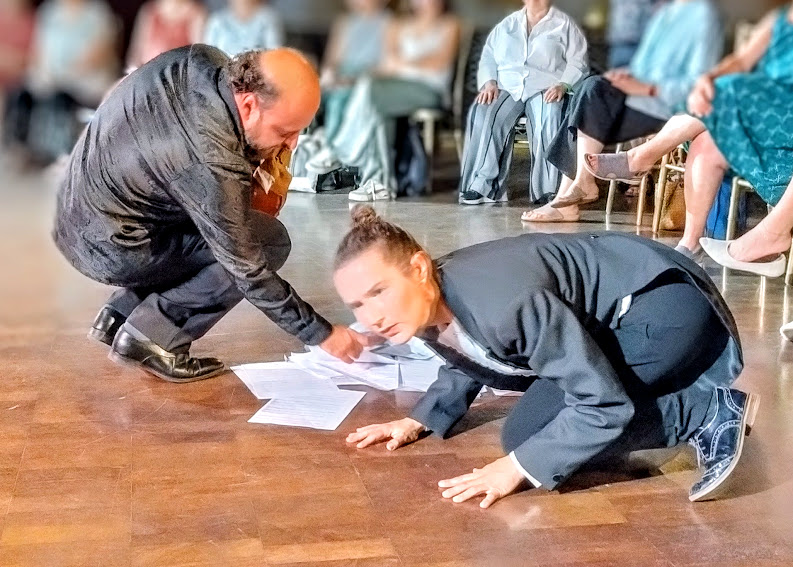
It was followed by one of Bach’s well-known Sonatas for solo violin, with Stéphanie now adding baroque bits and bobs to her formal suit, all made from music paper. The dance movements owed a lot to traditional baroque gestures and formalities, as befitted music composed for a princely court, and reflected the musical structure of the Grave, Fuga, Andante, and Allegro. The funny bits included Stéphanie imitating playing the violin, aided by a real violin bow, and a clever sequence of elaborate bows (of the bending-over variety) as a commentary on the fact that it can sometimes be difficult to know exactly when Bach was about to end a piece.

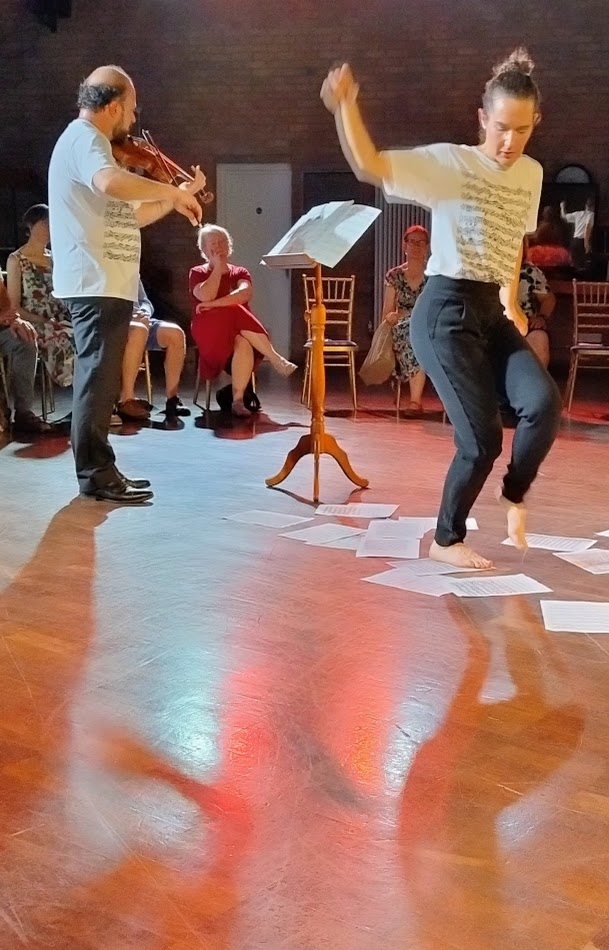
Because of the sparse programme notes, I suspect many in the audience didn’t realise the relevance of the last piece, Sally Beamish’s Intrada e Fuga for violin solo. It was composed as a direct response to the Bach Partita just played/danced, notably the Fuga movement, which is reworked in a contemporary idiom but using the same three-voice texture, time signature and the fugal devices of Bach’s Fuga. It was composed for a performance in the Norwegian-built St Magnus Cathedral in Orkney, and the Intrada refers to the music of the traditional Norwegian Hardanger fiddle. Its ethereal strains, with its long-held high starting note, brought a moment of calm and reflection to an otherwise busy occasion for the violinist and dancer. The Fuga builds to a powerful climax before reverting back to the music of the Intrada, bringing the show to a beautifully delicate high-note end. Stéphanie Brochard and Bojan Čičić both wore T-shirts emblazoned with the music of a Double from a Bach solo violin Partita.
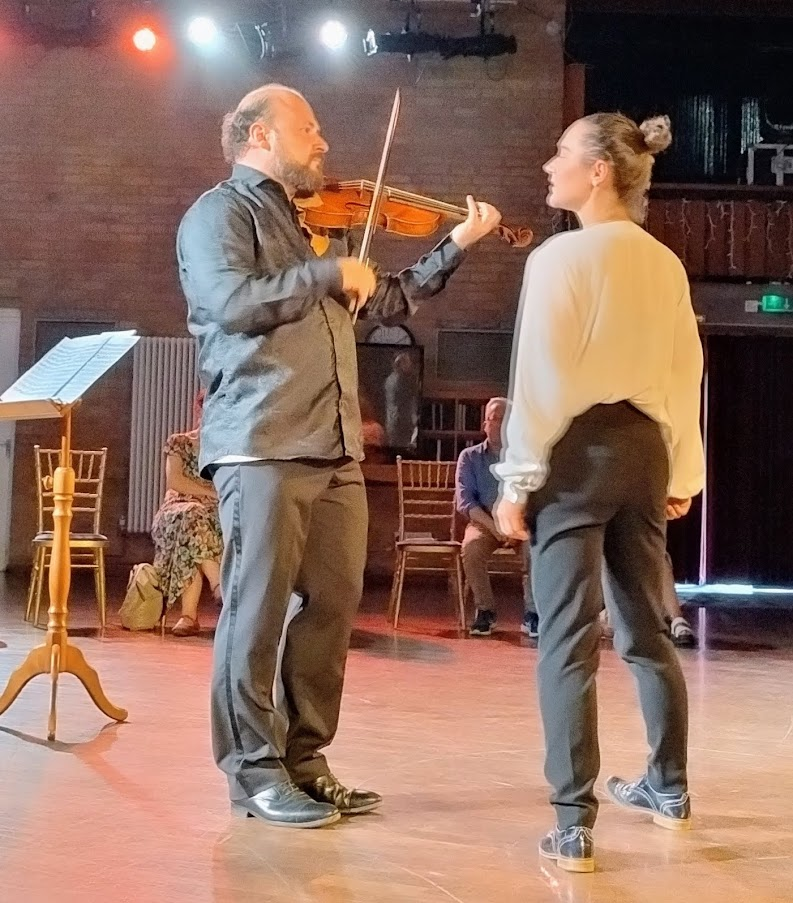
This was an inspiring occasion, bringing together outstanding proponents of their own different art forms. Clearly a collaborative project, credit must go to Stéphanie Brochard’s brilliant choreography, which combined many different techniques and dance genres and revealed an obvious understanding of the music played. As lovely and compelling as the dance moves were, it was also good that there were several times when Stéphanie left Bojan alone on stage so that we could focus on the music. His playing, despite all the goings-on around him, was, as ever, impeccable. This two-hander show deserves to be seen more than once. It should be an easy event to tour, so I hope others get the chance to watch it. In the meantime, you can get a feel for the occasion from the rehearsal preview video, which can be viewed here.
I had hoped for some professional photos of the performance from the organisers, but as they haven’t arrived, I include some taken on my mobile phone.
 Andrew Benson-Wilson : Early Music Reviews +