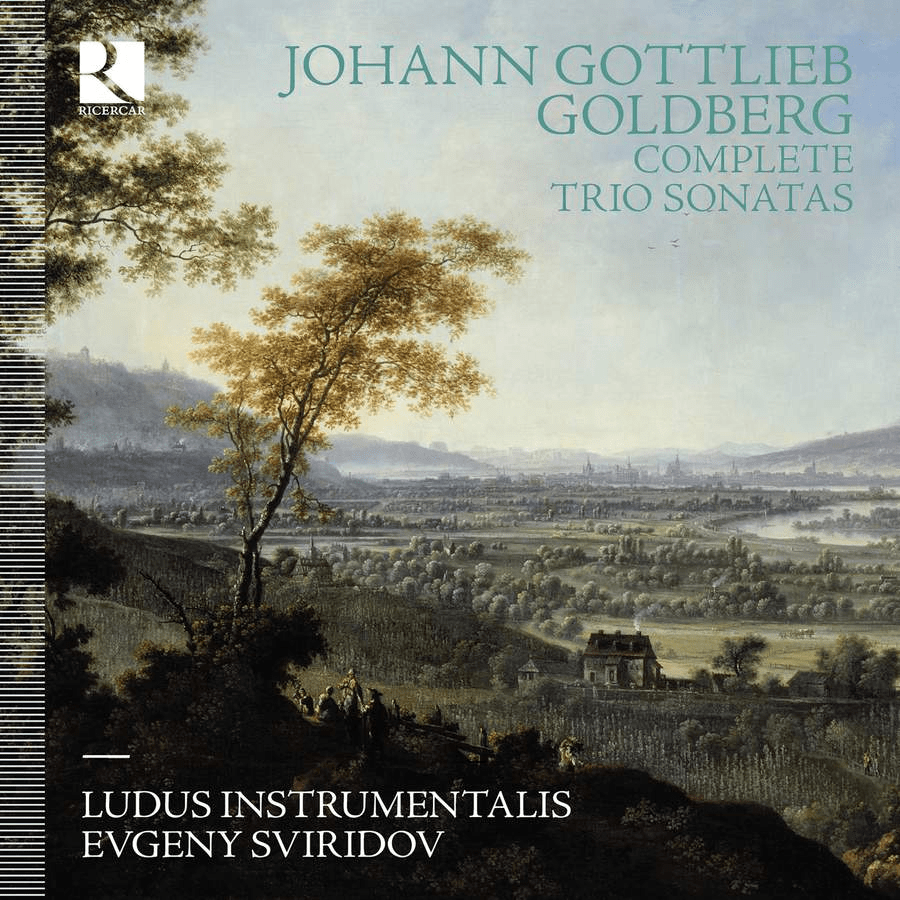
Johann Gottlieb Goldberg: Complete Trio Sonatas
Ludus Instrumentalis, Evgeny Sviridov
Ricercar RIC 426. 69’57
Trio Sonata in C, DürG 13 (was BWV 1037)
Trio Sonata in A minor, DürG 11
Trio Sonata in G minor, DürG 12
Trio Sonata in B flat, DürG 10
Prelude and Fugue in g, arranged from Dür G 5
Sonata for 2 violins, viola & continuo in C minor, DürG 14
Johann Gottlieb Goldberg (1727-56) has been overlooked as little more than the name attached to the famous JS Bach variations, rather than a respected composer in his own right. This excellent recording from Ludus Instrumentalis should help to set the record straight. Goldberg was born near Danzig. In 1737 he met Wilhelm Friedemann Bach in Dresden, a trip instigated by the art-loving Count von Keyserlingk who was impressed with the 10-year old’s musical skills. After initial studies with WFB in Dresden, he moved to Leipzig in 1746, perhaps to study with JS Bach. The Bach variations were later composed for Goldberg to play for the insomniac Keyserlingk. Goldberg died aged 29 of consumption but, despite his young age, was described by a writer at the end of the 18th century as being on the same level as Bach and Handel.

 The Brook Street Band, named after the London street where Handel lived for the last 36 years of his life, celebrate their 20th anniversary this year. As well as his well known Opus 2 and 5 sets of Trio Sonatas, Handel left a number of isolated examples of the genre, three of them normally referred to as the ‘Dresden’ sonatas where the manuscript is housed. To these three (HWV 392-4), are added two other proper trio sonatas (386a and 403) and two other pieces arranged by the Brook Street Band in a trio sonata format, the early Sinfonia and an early version of the overture to Esther, both of which helpfully lack an viola part. Many of the movements are examples of Handel’s re-use of material, and there are a number of familiar melodies that crop up with an otherwise lesser known group of pieces. Notable amongst
  What a delightful CD. Part of the ’eeemerging’ (Emerging European Ensembles) project led by the Ambronay cultural centre, it selects promising young musicians and helps them set up their careers, including the chance to make their first CD – like this one, from L’Aura Rilucente, a five-strong group formed in 2011 in Milan. Their fascinating programme includes three Trio Sonatas by Nicola Francesco Haym, usually only known (if at all) as the librettist for some of Handel’s operas (for example, Ottone, Flavio, Tamerlano, Rodelinda. Also known as a cellist, Haym’s composing activities have been almost entirely overlooked, so his inclusion on this CD is a real musical service.
  Andrew Benson-Wilson : Early Music Reviews +