
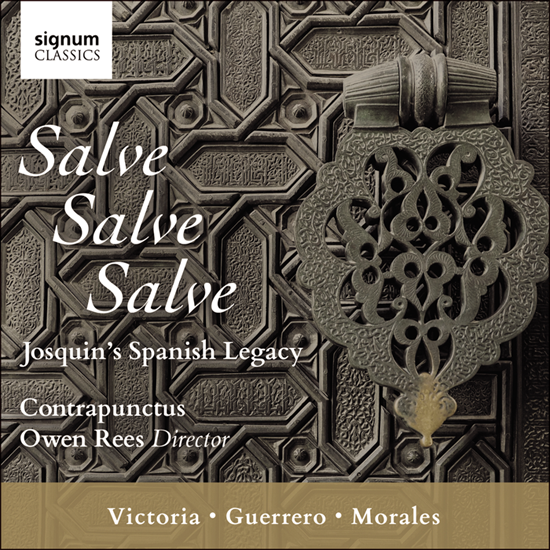
Salve, Salve, Salve
Josquin’s Spanish Legacy
Contrapunctus, Owen Rees
Signum SIGCD608. 71’02
Cristóbal de Morales: Jubilate Deo omnis terra
Tomás Luis de Victoria: Missa Gaudeamus, Salve regina
Francisco Guerrero:Ave virgo sanctissima, Surge propera, amica mea
Josquin Desprez: Salve regina
Some of the most interesting recordings and performances of early music in the UK over the past decades has come from (generally Oxbridge) scholars whose academic research interests led them into (or kept them in) academia, many achieving high academic office. One such is Owen Rees, like many such, a former Oxbridge organ scholar. He is now Professor of Music at Oxford University and Fellow and Director of Music at The Queen’s College. His research interests are Iberian and English vocal music of the Renaissance, and his professional vocal group Contrapunctus allows this research to be presented to a wider musical audience. Their latest recording explores the influence of Josquin Desprez on Morales, Guerrero, and Victoria, the rather disparate composers united by their use of ostinato (the repetition of a motif throughout a piece), a technique inspired by Josquin.


 Matthias Weckmann
 The start of the Renaissance is difficult to define. In organ music, around 1450 seems a reasonable date, with music from the likes of the Buxheimer Orgelbüch and the Faenza Codex combining elements of Medieval and Renaissance styles. By this stage, the organ had a fully chromatic keyboard, sometimes more than one manual, and independent stops were beginning to be separated out from the Medieval ‘Blockwerk’ – the equivalent of single mixture where one note plays a chorus of ten or more notes.
 Andrew Benson-Wilson : Early Music Reviews +