
Senza Basso — Auf dem Weg zu Bach
Music by Baltzar, Matteis, Westhoff, Torelli, Corelli,
Vilsmayr, Pisendel, Purcell and Biber
Nadja Zwiener, Violin
Genuin GEN 21728. 65’57
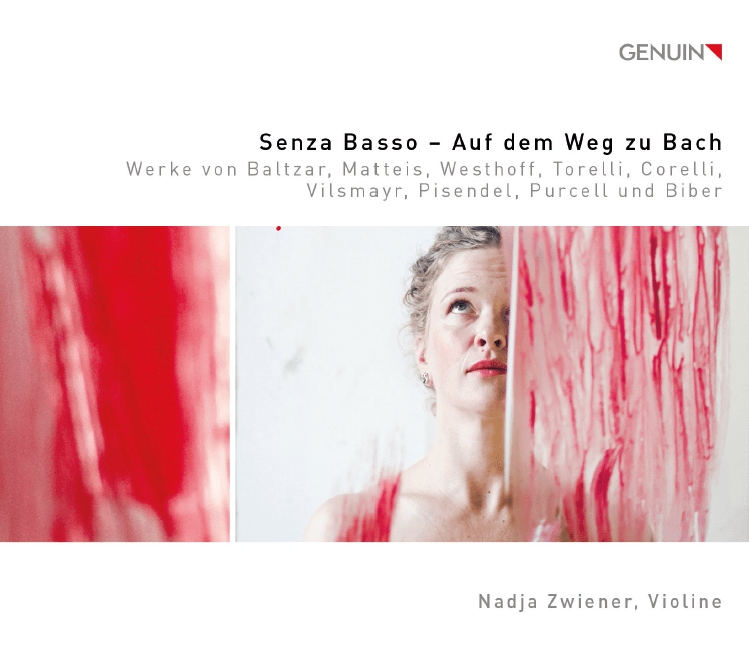
Well known in the UK as the leader of The English Concert and in Germany as leader of the Bachakademie Stuttgart, Senza Basso — Auf dem Weg zu Bach (Without bass — on the way to Bach) is violinist Nadja Zwiener‘s first solo CD. It explores a fascinating genre of music for solo violin preceding Bach’s famous 1720 Six Sonatas and Partitas for solo violin. In his programme essay ‘Melodic polyphony, polyphonic melody – composing senza basso in the Baroque era’, Michael Maul points out the challenges of composing, playing and listening to music with a normal bass line, describing it as “an art of omission and of sensing the unplayed”.
 I have been watching violinist Johannes Pramsohler make his mark in the world of period violin playing over the past few years, and this CD shows that his growing reputation is well deserved. This well-chosen programme of relatively unknown Sonatas from the Bach circle, is a telling reminder that although his later fame came from his organ playing, Bach’s early childhood was spent learning the violin from his violinist father. As Pramsohler’s notes point out, it was only when the 10 year-old Bach, now orphaned, moved into his organ-playing elder brother’s house, that he started to focus on the organ. But he kept his father’s violin, his only inheritance, all his life. Although only one work is definitely by Bach, with two possibly Bach’s, Bach is suffused throughout the other works, by Pisendel, Graun and Krebs, representing the extraordinary flowering of musical talent in 18th century Weimar, Leipzig and Dresden. The Graun and Krebs works are world premiere recordings, taking us into a slightly later musical period. The CD ends with Bach’s extraordinary Fugue in g (BWV 1026).
  Andrew Benson-Wilson : Early Music Reviews +