Bach: Christmas Oratorio 1-3, Singet dem Herrn
Choir & Orchestra of the Age of Enlightenment, Masaaki Suzuki
Cadogan Hall. 9 December 2016
Bach’s Christmas Oratorio was originally performed as six separate cantatas on the major feast days of the Christmas Day, starting on 25 December. Unlike present day marketing operations and shops, Christmas in Lutheran Leipzig started on Christmas Day, not sometime in late-October. The first three cantatas were performed on the successive days, 25, 26, and 27 December 1734, with performances in both the Thomaskirche and Nicolaikirche. The last three cantatas were performed on 1, 2, and 6 January 1735, again with performances in both churches (with the exception of Part 3 and 5, which were only performed at the Nicolaikirche).
Notwithstanding the separate nature of the six cantatas, Bach clearly saw them as a unified whole, grouping them together under the single title of Weihnachts-Oratorium, and giving the whole set a logical key structure and theme development. As in many of his major works, Bach borrowed from his previous compositions (including three entirely secular cantatas), making for fascinating thoughts about the creation of a religious masterpiece balanced against the practical considerations of coming up with so many cantatas in such a short space of time and Bach’s allocating of religious texts to music composed for secular purposes. It is a shock to realise that, despite the importance that this work apparently meant to Bach, the Christmas Oratorio was not performed again until 1857.
Shorn of the setting of a Lutheran service in wintry Leipzig, present day performances are inevitably compromises. The Orchestra of the Age of Enlightenment came up with the sensible plan of splitting the piece over two successive evenings, Continue reading →
 the sons of his brother Egitto, King of Egypt. As it happened, Danao had 50 daughters, so married them all off to his nephews with the instruction that they must all murder their husbands on their wedding night. With one exception, Danao’s plan worked, the exception being his daughter Hipermestra and her new husband Linceo, who had fallen for each other. The subsequent plot of Cavalli’s 1658 opera is based on the complex series of events that occurred after the 50 potential murderous nephews were now reduced to a more manageable one. Continue reading
  The Orchestra of the Age of Enlightenment have been celebrating their 30th anniversary year with a remarkably wide range of music, culminating with this Birthday Concert performance of Weber’s Der Freischütz. Perhaps most noted for their exploration of Baroque and Classical music, it can be forgotten that the OAE have also performed many pieces from the Romantic era, with remarkable success – indeed, their second concert, 30 years ago, under Roger Norrington, was devoted entirely to Weber. And so it was with this powerful semi-dramatised performance.
 The evening started, slightly unfortunately, with the Tragic Overture of Brahms, the bête noire of Bruckner and Hans Rott (pictured), and several others of a progressive ilk, such as Mahler. Unfortunate, because of the effect that Brahms’ withering comments on Hans Rott’s First Symphony had on the young composer. The unfortunate Rott (1858-84) was a student contemporary of Mahler and Hugo Wolf at the Vienna Conservatory, and studied organ with Bruckner, who saw him as his ‘favourite pupil’. Although Rott hadn’t impressed a conservatory competition panel with a piano reduction of the first movement, he went on to expand it into a four movement symphony. For reasons unknown, and certainly ill-advised, the then 22 year-old Rott showed the score to Brahms, an enemy of anything musically progressive, and of Bruckner and the Vienna conservatory. Brahms advised the already vulnerable young man to ‘give up composing’, leading to a possibly hallucinatory incident that resulted in him being committed
  opening with Bach bustling Sinfonia from the cantata Am Adend aber desselbigen Sabbats, composed in 1725, the lengthy instrumental opening (pictured) was apparently intended to give the singers a bit of a break after a busy week. It has a jovial, extended and rather convoluted initial theme which bubbles along until a concluding, and very clever, skipped beat. A conversation between strings and two oboes and bassoon, this is the type of piece that Bach probably scribbled down before breakfast but, 300 years later, stands as an extraordinary example of his genius and skill at turning a string of notes into something inspired and divine.
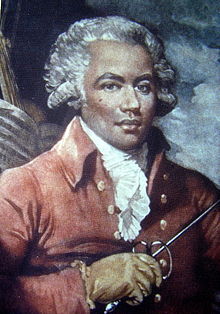 centred on the fascinating character Joseph de Bologne, Chevalier de Saint-George (b1745), the son of a wealthy French plantation owner in Guadeloupe, and his African slave. Educated back in France from the age of 7, he first became known as a fencer, graduating from the Academy of fencing and horsemanship aged 21 and somehow collecting the title of chevalier (knight) on the way. Quite how he achieved his skills in music is not known, but the composers Lolli and Gossec had already dedicated works to him before he was 21. He quickly became one of the leading Parisian violinists and orchestra leaders. He briefly lived in the same house as Mozart (the mansion of his mentor, the Duke of Orléans in Paris), and was leader of the enormous Masonic Loge Olympique orchestra, for which Haydn wrote his Paris Symphonies.
 Andrew Benson-Wilson : Early Music Reviews +