AAM. Bach: Art of Fugue

Bach: Art of Fugue
Academy of Ancient Music, Concert Theatre Works
Laurence Cummings, Bill Barclay
Peter Bray, Steffan Cennydd, Imogen Frances, Simon Slater
Milton Court, 15 May 2025

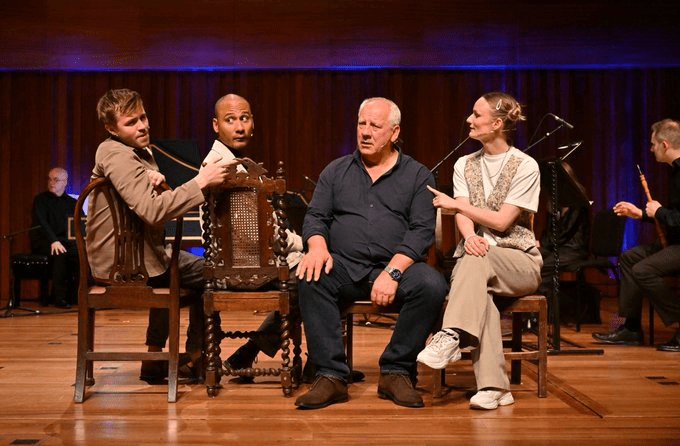
Photo: Mark Allan

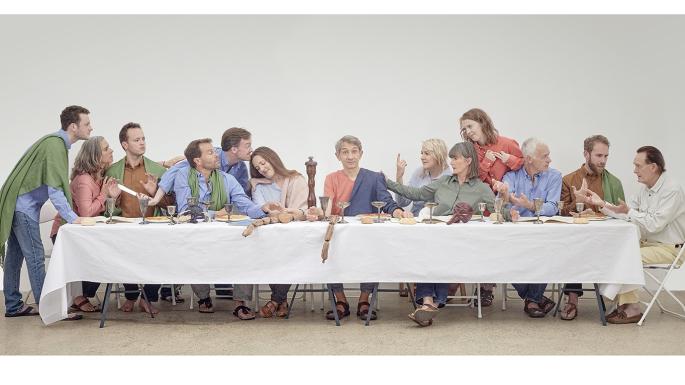
Johann Sebastian Bach’s Art of Fugue (Die Kunst der Fuge) is one of the greatest monuments of Western music. You mess with it at your peril. And mess with it at their peril is just what writer and director Bill Barclay with Concert Theatre Works did with the connivance of Lawrence Cummings and the Academy of Ancient Music (AAM), who commissioned this particular messing.

The Art of Fugue was composed during the last decade of Bach’s life, although the spurious accounts of Bach dying while composing the final fugue, on which much of the plot of this concert-theatre production relies, have long since been discredited. It was not published until shortly after Bach’s death, although autograph manuscripts of most of it survive. It consists of fourteen fugues (each called Contrapunctus) and four canons, all in D minor, and all using the same main theme, albeit in many varied forms. With the exception of the final fugue, which is written in conventional two-stave keyboard format, each piece has a separate line for each of the four voices (open-score) in a similar fashion to several learned musical works of the previous century or more. There is no indication of which instrument Bach intended or, indeed, if he intended it for performance at all, using it as an example of his skill in contrapuntal composition. There are no orchestral instruments of the time that could play all the lines on the same instrument, leading to the assumption that it was intended for the harpsichord. Performance on the organ is common, although there are many questions to be considered, not least the choice of registrations.

Continue reading

AAM. Transatlantic: Classical Masters

Transatlantic: Classical Masters
José Maurício Nunes Garcia, Haydn, Mozart
Academy of Ancient Music, Laurence Cummings, Katherine Spencer, clarinet
Milton Court, 13 March 2025

Nunes Garcia: Overture in D major; Dilexisti justitiam
Mozart: Clarinet Concerto in A major
Nunes Garcia: Tantum ergo
Mozart: Ave verum corpus
Haydn: Notturno in G major
Nunes Garcia: Litany for the Sorrows of Our Lady

The Acadamy of Ancient Music (AAM) continues its Transformation season with the programme Transatlantic: Classical Masters, focusing on the Brazilian composer José Maurício Nunes Garcia (1767-1830) and his heroes Haydn and Mozart. Nunes Garcia was born in poverty in Portuguese Rio de Janeiro to Afro-Brazilian parents, both seemingly the children of slaves, courtesy of their respective slave owners. An early musical talent was recognised, and Nunes Garcia was soon singing in Rio’s cathedral and, by the age of 12, was teaching music and learning keyboard instruments at the homes of his wealthy pupils. He was composing by the age of 16, and just a year later was sufficiently recognised as a music teacher to be a founding signature to the Brotherhood of Saint Cecilia. His wish to take Holy Orders was finally achieved at age 25 after being excused from the requirement to be “free from any colour defect” and becoming the required “estate owner”, courtesy of the father of one of his students. Shortly afterwards, he was appointed as “public music instructor” and set up a free music school for local children in his newly acquired house.

Continue reading

Italian Legacies: Geminiani and his English Contemporaries

Italian Legacies: Geminiani and his English Contemporaries
Academy of Ancient Music, Bojan Čičić, Anna Devin

Milton Court, 7 February 2025

Arne Overture in G major No. 3
Mudge Concerto No. 1 in D major
Geminiani Concerto Grosso in C major Op. 7 No. 3
Linley Music for The Tempest
Boyce Overture from Peleus and Thetis
Linley Violin Concerto in F major
JC Bach La Tempesta

Billed as “Swinging London meets Italian flair, 18th-century style”, this imaginative concert from the Academy of Ancient Music, directed from the violin by Bojan Čičić, took us on a tour of the music scene in 18th-century Britain: a place where “everything was up for grabs”. The blurb continued – “A nation was remaking its identity – embracing global fashions and diverse cultures, and locked in passionate debate about its relationship with Europe. English composers wrote Italian operas, the spirit of Shakespeare met the inspiration of Corelli and Vivaldi, and Bach’s youngest son carved out a musical niche that was entirely his own”.

Continue reading

Renaissance Moderns: Britten Sinfonia, Marian Consort

Renaissance Moderns
Britten Sinfonia, Marian Consort, Lisa Illea
Milton Court, London. 11 May 2024

Binchois (arr. for strings by Lisa Illean): Two chansons
Dunstable: Regina Caeli
Thomas Adès: Darknesse visible
Lisa Illean: Arcing, stilling, bending, gathering (UK premiere)
Lusitano: Heu me Domine; Allor che ignuda
Gesualdo: Moro lasso; Hei mihi Domine; Sparge la more
Brett Dean: Carlo

This cleverly designed concert from the Britten Sinfonia and The Marian Consort was built around the music of Gesualdo and his influence on present-day composers, notably the Australian composer Lisa Illean whose compositions were a feature of the evening, including the European premiere of her Arcing, stilling, bending, gathering, a co-commission of the Britten Sinfonia.

There aren’t many concerts where the programme has a content warning “contains references to violence, murder and rape”. This one did, in reference to the pre-concert showing of Werner Herzog’s 1995 German television film “Gesualdo: Death for Five Voices“. It was a rather curiously stylised and imaginative depiction of the life of Gesualdo (1566-1613), shot in the locations in which his life unfolded including the Palazzo San Severo in Naples, where the famous double murder of his wife, Donna Maria d’Avalos, and her lover took place (shortly before he succeeded as Prince of Venosa), and one of the family estates, the Castello di Gesualdo, where he spent most of the rest of his life in a state of declining mental health, employing a servant to apply daily flogings.

Continue reading

Academy of Ancient Music: Il Trionfo del Tempo

’Tis Nature’s Voice
Handel: Il Trionfo del Tempo e del Disinganno (HWV46a)
Academy of Ancient Music, Laurence Cummings 
Milton Court, 11 May 2023


Il Trionfo del Tempo e del Disinganno was Handel’s first oratorio. It was composed a year after his 1707 arrival in Italy after three years in Hamburg where he exchanged his early career as a cathedral organist (in Halle) to that of a fledgling opera composer. He quickly fell in with an influential group of patrons in Rome, including Cardinal Pamphili who provided the libretto for Il Trionfo del Tempo e del Disinganno. Usually translated as The Triumph of Time and Disillusion, the alternative option of Time and Enlightenment was used for this excellent performance from the Academy of Ancient Music.

Continue reading

AAM New Worlds Travelogue: Nicholas Lanier

New Worlds: TravelogueNicholas Lanier
Academy of Ancient Music
, Laurence Cummings
Anna Dennis, Thomas Walker
Milton Court & AAM LIVE stream. 18 February 2022

As part of their New Worlds series, the Academy of Ancient Music explored the life and times of the much-travelled lutenist, courtier and musical adventurer Nicholas Lanier in their Milton Hall and AAM LIVE streamed concert New Worlds | Travelogue. Lanier was from a French Huguenot family with an Italian mother. He was a court musician and composer to both King Charles I and Charles II, becoming the first Master of the King’s Music in 1625. He made several visits to Italy to acquire paintings for Charles I, during which he experienced the new style of Italian secondo pratica music from the likes of Claudio Monteverdi. He subsequently introduced the recitative style to England. He was painted by van Dyck in Antwerp and persuaded the King to bring Van Dyck to England.

Continue reading

Aminta e Fillide & Venus and Adonis

Aminta e Fillide & Venus and Adonis
Guildhall School of Music & Drama
Milton Court. 3 June 2019

In a double bill of operas, the Guildhall School of Music & Drama puts its Opera, Music, and Production Arts students through their paces. Directed by Victoria Newlyn with designers also from Guildhall teaching staff, it featured an enormous number of students covering all aspects of opera. The two operas were well-chosen, contrasted John Blow’s English High Baroque opera (semi-opera/masque) Venus and Adonis, composed in 1683, just before Handel was born, and Handel’s youthful cantata Aminta e Fillide written when he was 22 during his Italian years in the style that would change English music for much of the 18th-century. Continue reading

Leonardo: Shaping the Invisible

Leonardo: Shaping the Invisible
I Fagiolini, Robert Hollingworth, Martin Kemp
Milton Court Concert Hall, 28 April 2019
CD Coro COR16171. 71’34
I Fagiolin Leonardo.jpg

The latest I Fagiolini touring concert programme and CD is based on the Leonardo da Vinci 500th anniversary.  They launched the CD in London’s Milton Court with a talk by Martin Kemp, Emeritus Professor in History of Art at Trinity College Cambridge illustrated by examples of Leonardo’s work and extracts from the I Fagiolini CD. The title ‘Shaping the Invisible’ comes from Leonardo’s own description of music. It is often forgotten how important music was in his life – indeed, despite his achievements as a painter, sculptor, architect, engineer, pioneer of flight, anatomist, scientist, Vasari records that music was probably the focus of his first job outside Florence when he moved to Milan.  ‘Shaping the invisible’ is also the title of the new commissioned piece by Adrian Williams and poet Gillian Clarke, reflecting Leonardo’s scientific investigations and fascination with flight. Continue reading

French Baroque music meets Indian Classical Dance

French Baroque music meets Indian Classical Dance
BBC Singers, Academy of Ancient Music, Sofi Jeannin
Sanskriti UK & Ankh Dance
Milton Court, 19 October 2018

Lully: Te Deum 
Rameau: In convertendo Dominus;
extracts from 
Les Indes galantes, Les fêtes d’Hébé Castor et Pollux 

In what was a rather brave bit of programming for a live BBC Radio 3 broadcast, the BBC Singers and the Academy of Music, directed by Sofi Jeannin, the new Chief Conductor of the BBC Singers, presented an evening of French Baroque music, the second half of which was accompanied by two contrasting forms of Indian dance. The first half was of liturgical pieces, starting with Lully’s jubilant 1677 setting of the Te Deum. This was first heard at Fontainebleau and later became the piece that led to Lully’s death after he stabbed himself in the foot with his conducting baton during Chapel Royal celebrations for the Sun King’s recovery from surgery – surgery that Lully decided, fatally, to refuse. No such calamity occurred here as Sofi Jeannin demonstrated her commendably straightforward style of conducting, her focus clearly on the music itself rather than on any sense of self-aggrandisement. She coped well with the complications of this particular occasion, which included a late start after an overrun of the previous Radio 3 show, and complicated coordination between dances, singers, instrumentalists, a BBC announcer and the paraphernalia of a live BBC broadcast.  Continue reading

Purcell and Michael Nyman

Purcell & Michael Nyman
Iestyn Davies & Fretwork
Milton Court, 28 May 2018

Michael Nyman: No Time in Eternity
Purcell: Two Fantazies in four parts; Music for a While
Michael Nyman: Music after a While (world premiere)
Purcell: An Evening Hymn
Michael Nyman: Balancing the Books; The Diary of Anne Frank: If; Why
Purcell; Fantazy in four parts; Fantazy upon one note
Michael Nyman: Self-laudatory hymn of Inanna and her omnipotence

Many early music period instrument groups play and commission contemporary works, but the viol consort Fretwork is one of the most active in this field, with over 40 commissions over their 32-year life. Their latest commission is from Michael Nyman with Music after a While, an instrumental response to Purcell’s Music for a While, and given it’s world premiere during this concert. Early music, and particularly the compositions of Purcell, have been life-long influences on Nyman, as reflected for example, in his Purcell-inspired score for the film The Draughtsman’s Contract. A student of Thurston Dart, Nyman’s early career including editing Purcell and Handel, and his performing band combined period and modern instruments. He has worked many times before with Fretwork. Continue reading

François Couperin: Lumière et Ombre

François Couperin: Lumière et Ombre
Les Talens Lyriques, Christophe Rousset
Barbican/Milton Court. 14 January 2018

IMG_20180114_151717705.jpg

We are used to hearing French Baroque music in the grand style of the likes of Lully and Rameau, but the more delicate and sensitive music of François Couperin (referred to as le Grand to differentiate him from the rest of his extended musical family) is often overlooked. 2018 is the 350th anniversary of his birth, so is a good time to reassess his music. These two concerts in Milton Court, together with a panel discussion, explored some of his chamber and harpsichord music, concluding with his three Leçons de ténèbres. The two concerts were titled Lumière and Ombre, each containing solo harpsichord, vocal and instrumental music. Continue reading

Christopher Purves sings Handel

Christopher Purves sings Handel
Arcangelo, Jonathan Cohen
Milton Court, 7 January 2018

Distinguished bass/baritone singer Christopher Purves has long been a mainstay of the opera and concert stage. His broad repertoire perhaps evidenced by the fact that my last three reviews of him were in operas by Mozart, George Benjamin, and Georga Enescu. On this occasion, he was the focus of the evening. But this wasn’t one of the usual, and rather predictable, ‘star singer and backing orchestra’ events. Purves and Arcangelo shared the honours in a well-planned partnership of vocal and orchestral music. Purves remained on stage throughout, sitting at the side during Arcangelo’s moments. His jovial introductions to the pieces were relaxed and approachable, not least his opening comment that we were about to hear music for some “complete and utter bastards as well as a couple of real sweeties”. Although many of the protagonists in the programme were clearly in the former category, there were enough of the latter to bring some relief to the bluff and bluster of many of Handel’s music for bass.

Continue reading

AAM: Italy in England

Italy in England: When Handel met Corelli
Academy of Ancient Music, Bojan Čičić, Frank de Bruine,
Milton Court. 19 October 2017

Corelli Concerto Grosso in D major Op. 6 No. 4
Handel Concerto for Oboe No. 3 in G minor
Geminiani Concerto Grosso Op. 5 No. 3 (after Corelli)
GB Sammartini Sinfonia in G major
Avison Concerto Grosso in D minor No 3 ‘The garden of harmony’ (after Scarlatti)
G Sammartini Concerto for Oboe in E flat major
Handel Concerto Grosso Op. 6 No. 5

Aided by some excellent programme notes by Lindsay Kemp, we were led gently through an exploration of the influence of Italian musicians, notably Corelli, on performers and composers in England during the 18th century, many of whom were themselves, immigrants. The opening Corelli Concerto Grosso demonstrated the influence of the concerto grosso form. The opening Adagio is written in the score as nine simple chords, but Bojan Čičić’s beautifully elegant violin flourishes turned it into a complete musical experience and demonstrated the importance of ornamentation in music of this period. Directing the Academy of Ancient Music from the leader’s position Čičić demonstrated his extraordinary musicianship, the delicacy of his violin tone always blending with the orchestral timbre, even when in a clear solo role – a very welcome change from violinist directors whose sound dominated their companions. As a director, his sense of timing and the cooperative way he worked with his companions were an inspiration. An example was the timing of the final ‘that’s it folks’ cadence of the opening Concerto grosso – a lovely moment after a frenetic movement where all the players seemed to be bowing as fast as they possibly could.  Continue reading

Handel: Radamisto

Handel: Radamisto
Guildhall School of Music and Drama
Milton Court Theatre. 12 June 2017

Watching people watching opera was the premise behind John Ramster’s production of Handel’s Radamisto at the Guildhall School of Music and Drama’s Milton Court Theatre. A Heads of State meeting has been arranged in a museum, displaying artifacts from the ancient kingdoms of Armenia and what is now eastern Turkey. As they take their seats on opposite sides of the stage, the bristle between them is palpable. A crusty army figure on one side, and a thrusting young woman on the other, with the museum and security flunkies flitting about between them. And then the entertainment begins, in the form of Radamisto. The interaction between the two VIPs, as well as their own interaction with the opera, became key to the development of this production. Continue reading

James Gilchrist Directs: Bach and Purcell

James Gilchrist Directs: Bach and Purcell
Academy of Ancient Music
James Gilchrist, Pavlo Beznosiuk, Rachel Brown
Milton Court, 19 October 2016

The Academy of Ancient Music’s 2016-17 London and Cambridge concert series features two occasions when guest directors are being invited to plan programmes and direct the orchestra. The first of these was with the tenor, James Gilchrist. Renowned as a Bach performer (most notably in the role of Evangelist in the Passions) Gilchrist has been a regular soloist with the AAM. After a musical grounding as a boy chorister at New College, Oxford and a choral scholarship at King’s College, Cambridge, Gilchrist helped to pay his way through the rest of his medical training by singing in professional choirs such as The Sixteen, Tallis scholars and Cardinall’s Musick. He moved from his earlier career as a doctor to become a full-time musician twenty years ago.

On this occasion, the word ‘curator’ rather than ‘director’ is more appropriate. Gilchrist selected the vocal works from Purcell and the two Bach cantatas, handing over to the AAM’s leader, violinist Pavlo Beznosiuk, to select Continue reading

Ex Cathedra: Gaudete!

Gaudete!
Ex Cathedra Consort, Jeffrey Skidmore
Milton Court. 5 December 2015

Ex Cathedra Consort - credit Paul Arthur
Photo: Paul Arther

Under the inspired leadership of their artistic director Jeffrey Skidmore, Ex Cathedra has, since 1969, excelled in bringing the highest quality of choral music and related educational projects to the Birmingham area, only occasionally making very welcome visits to London. They run several youth choirs, the main Ex Cathedra choir and the fully professional Ex Cathedra Consort, and also work in schools and hospitals. Many top professional singers have come through their ranks. They continue to combine musical excellence with programmes based on research by their director, notably into South American music of the Baroque era.

Their latest venture down south was to Milton Court with their programme Gaudete!. The first half was Continue reading

The Baroque Trumpet  

As if to counter the normal accusation that trumpeters sidle on stage towards the end of the evening to take the bulk of the applause for their brief, but usually spectacular, contribution (to the chagrin of the violinists and continuo players who have laboured away all evening for a great deal less recognition), the Academy of Ancient Music devoted a whole evening to music for trumpets (Milton Court, 18 Feb).   It turned out to be a curious affair, starting with the (unusually) far from note perfect little opening fanfare from the evening’s director, David Blackadder.  A suite of three Bach Cantata Sinfonia’s followed (from cantatas 29, 150 & 249), my principal gripe being that Alistair Ross, the organ soloist in the opening Sinfonia, was not acknowledged as such in the programme.  A related gripe was that the weedy little box organ was more-or-less inaudible above the over-strong string playing, a question of balance that should have been sorted out in rehearsal or at the previous day’s concert in Cambridge.  It is a major failing of most Bach performances (not just in the UK) that the sound of the organ is not heard as it would have been in Bach’s day, when the organ accompaniment would usually have been a full-scale church, rather than tiny continuo, organ.  The evening continued with a range of music for up to three trumpets (played by David Blackadder, Phillip Bainbridge and Robert Vanryne) by the likes of Biber, Corelli, Vivaldi, and Telemann, with the Bach Concerto for two violins thrown in for balance, the latter played by Bojan Čičić and Rebecca Livermore.  The trumpet focus seemed to be on the spectacular, rather than the melodic, which was a shame as one of Blackadder’s greatest achievements is often in the gently melodic moments that the baroque trumpet can excel in.  Overall, the programme didn’t really hang together as a musical unity.  Perhaps trumpeters are better off wandering in towards the end?

[https://andrewbensonwilson.org/2015/03/30/the-baroque-trumpet/]

Mozart 250 – ‘Capricious Lovers’ & ‘An Exotic and Irrational Entertainment’

Mozart in London Festival
Classical Opera, Ian Page

Classical Opera launched their ambitious ‘Mozart 250’ project with a ‘Mozart in London’ Festival weekend of events at Milton Court.  The 250 of the project’s title refers to the years since Mozart’s childhood visit to London (23 April 1764), during which he composed his first significant works. The plan is to “follow the chronological trajectory of Mozart’s life, works and influences”, culminating in 2041, the 250th anniversary of Mozart’s death. The weekend included talks, discussions and concerts over a three-day period.  I attended the events on Saturday 21 February, starting with the discussion on Mozart in London between Cliff Eisen, Ian Page, David Vickers and Andrew McGregor.

The first of the two Saturday concerts was ‘Capricious Lovers’, a look at English opera at the time of Mozart’s visit. Extracts from six operas (performed between 2 November 1764 and 15 February 1765) gave a fascinating insight into London musical life over this very brief period.  The first half concentrated on works given in Drury Lane, with George Rush’s The Capricious Lovers, Michael Arne & Jonathan Battishill’s Almena and William Bates’. PharnacesThe second half focussed on Covent Garden, with Thomas Arne’s The Guardian Outwitted, Thomas Arne’s Artaxerxes and the pasticcio Maid of the Mill.  Under the baton of Ian Page, sopranos Rebecca Bottone & Sarah-Jane Brandon, mezzo Samantha Price and tenor Robert Murray were joined by The Orchestra of Classical Opera in a well-chosen range of arias, duets, trios, together with overtures from Capricious Lovers and The Guardian Outwitted.  The highlight was the delightful duet ‘O dolly, I part / with a hole in my heart’ from The Guardian Outwitted sung by a coquettish Rebecca Bottone & Robert Murray.

Drury Lane and Covent Garden were the two London theatres licensed to stage plays and operas in English – the reserve for Italian opera was the King’s Theatre, Haymarket.  Under the title of ‘An Exotic and Irrational Entertainment’, the evening concert looked at the music performed there between 24 November 1764 and May 1765.  Alongside J.C.Bach’s Adriano in Siria and Mattia Vento’s Demofoonte, we heard extracts from the pasticcio operas Ezio, Berenice and Solimano, including pieces by Pescetti and Perez as well as Bach and Vento. As in the earlier Handel days, the King’s Theatre attracted some of the finest singers of the time.  Sopranos Martene Grimson & Anna Devin and mezzo Samantha Price were the very impressive representatives of the original singers, soprano Teresa Scotti and the castrati Ferdinando Tenducci and Giovanni Manzuoli.  It was immediately apparent that the Italian style came with harmonically and instrumentally richer accompaniments than their English cousins in the other place.  This concert was preceded by a talk from Daniel Snowman on ‘A Night at the London Opera in Mozart’s London’, reflecting a rather different interpretation of the period and the life of the Mozart family than that expressed in the earlier discussion.

This is an extraordinary project, not least for the length of programme through to 2041. On the basis of this one day, Ian Page and Classical Opera have set themselves an enterprising and important sequence of events, running through to 2041.

[https://andrewbensonwilson.org/2015/03/30/mozart-250-capricious-lovers-an-exotic-and-irrational-entertainment/]