Mayfair Organ Concerts – The Grosvenor Chapel
17 March 2026
Andrew Benson-Wilson
Early Music Day recital
Francisco Correa de Arauxo (1584–1654)
Libro de tientos y discursos de musica practica y theoríca de organo (1626)
Tiento de Quinta Tono 6′
Tiento de Quarto Tono 4’30
Segundo Tiento de Quarto Tono – a modo de canción 5’30
Quinto Tiento de Medio Registro de Baxones de Primero Tono 4’30
Tiento de dos tiples, de Septimo Tono 7′
Tiento de medio registro de tiple de Sexto Tono – a modo de Batalla 10′
Mayfair Organ Concerts
Organ Recital. Schlick: Tabulaturen etlicher lobgesang (1512)
Andrew Benson-Wilson
The Grosvenor Chapel
South Audley Street, Mayfair, London W1K 2PA
Tuesday 5 August 2025, 1:10
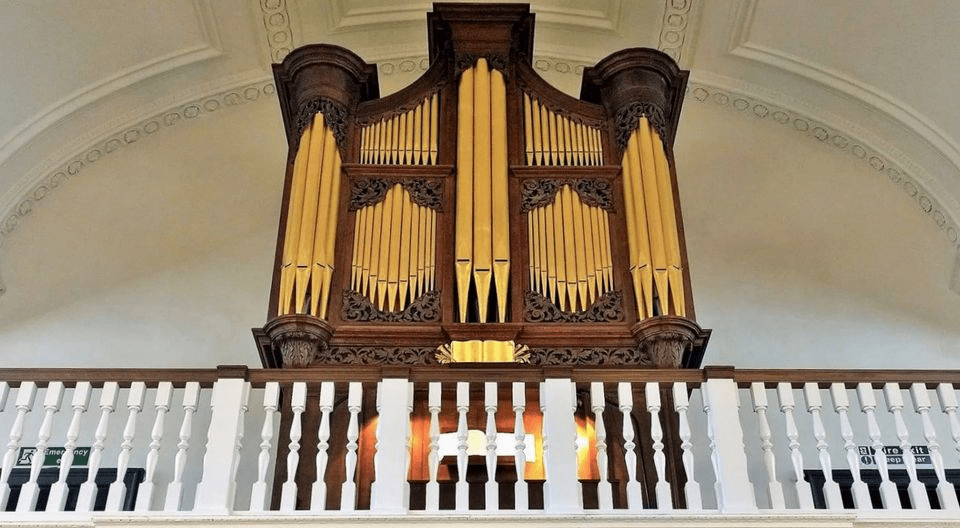
Arnolt Schlick
Tabulaturen etlicher lobgesang (1512)
Salve Regina (5 verses)
Pete quid vis, Hoe losteleck, Benedictus, Primi toni, Maria zart, Christe
Da pacem (3 settings)
Described as “one of the greatest masters who have left their imprint on the history of organ music”, Arnolt Schlick (c1455-c1525) was one of the most important members of the influential group of late Renaissance German organ composers known as the Colourists, together with Conrad Paumann and Paul Hofhaimer. He lived and worked in the important university city of Heidelberg. In his late 20s, he was appointed court organist to the Palatinate Elector. In 1486 played the organ for the coronation of the future Holy Roman Emperor, Maximilian I, as King of the Romans.
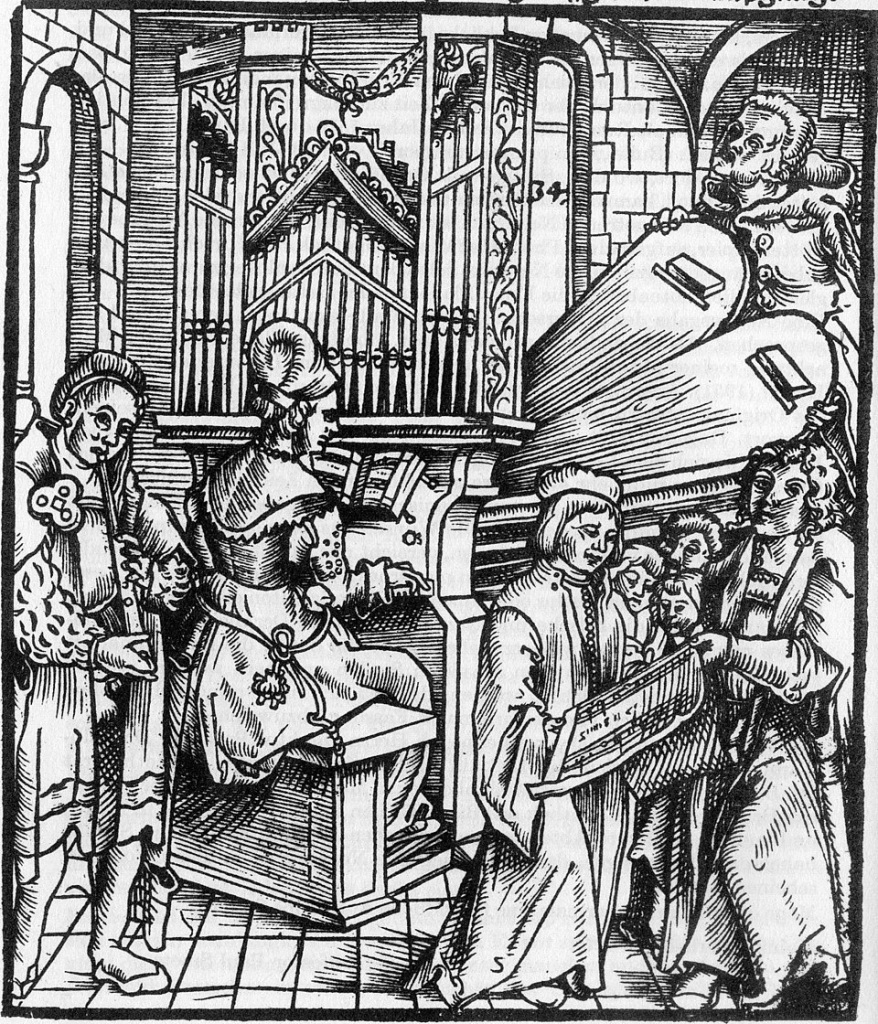
Title page of Spiegel der Orgelmacher und Organisten, 1511
Audition for the first organist, on the 300th anniversary of St George’s, Hanover Square
Early Music Day 2025
Mayfair Organ Concerts
St George’s, Hanover Square
Tuesday 11 March 2025, 1.10pm
Andrew Benson-Wilson
Audition for the first organist
on the 300th anniversary of St George’s, Hanover Square

The church of St George’s Hanover Square was consecrated by the Bishop of London
on March 23rd, 1725. The three-manual organ was built by Gerard Smith, nephew and successor of the famous Father Smith. The case of his organ remains as the central part of the current organ case. This recital will reflect the audition for the first organist, with music by the four assessors (Pepusch, Croft, Handel and Geminiani) and the successful candidate, Thomas Roseingrave, chosen for his ability to improvise fugues.
Johann Christoph Pepusch (1667-1752) Lesson in D (Two Aires)
William Croft (1678-1727) Voluntary IX in d; Voluntary X in D;
Handel (1685-1759) Fugue in B flat; Fugue in a (HWV607/609)
Francesco Geminiani (1687-1762) Duo in F
Thomas Roseingrave (1690-1766) Voluntary & Fugue in f; Fugue in d
Details of the 2012 Richards, Fowkes & Co organ in St George’s Hanover Square organ can be found here and here.
Admission is free, with a retiring collection.
The programme notes can be read here.
Recital programme notes: The 1725 audition for the first organist of St George’s, Hanover Square
Mayfair Organ Concerts
St George’s, Hanover Square
11 March 2025
St George’s, Hanover Square 300th Anniversary
The 1725 audition for the first organist

Johann Christoph Pepusch (1667-1752) Lesson in D (Two Aires)
William Croft (1678-1727) Voluntary IX in d; Voluntary X in D;
Handel (1685-1759) Fugue in B flat; Fugue in a (HWV607/609)
Francesco Geminiani (1687-1762) Duo in F
Thomas Roseingrave (1690-1766) Voluntary & Fugue in f; Fugue in d.
This recital celebrates the 300th anniversary of St George’s, Hanover Square. The church was consecrated on 23 March 1725. It was designed by the architect John James, the son of the head of the Holy Ghost School in Basingstoke where a plaque in his honour has been unveiled. He was architect for two other London churches with an organ interest, St Mary’s Rotherhithe and St Lawrence Whitchurch. The 1725 Hanover Square organ was built by Gerard Smith, nephew and successor of the famous ‘Father’ Smith. Its case remains as the central part of the current organ. A panel of Pepusch, Croft, Handel and Geminiani choose Thomas Roseingrave as organist, noting that he was best able to improvise a fugue on the given subject. This recital includes music by the four assessors and concludes with fugues by Roseingrave.
Programme Notes: Two German Anniversaries: 1624 & 1674
Mayfair Organ Concerts
St George’s, Hanover Square, 2 July 2024
Two German Anniversaries: 1624 & 1674
Samuel Scheidt and Matthais Weckmann
Andrew Benson-Wilson
Samuel Scheidt (1587-1654)
Tabulatura nova, 1624
Echo ad manuale duplex forte et lene
Fantasia super Io son ferito lasso
Modus pleno Organo pedaliter: Benedicamus à 6 Voc
Matthias Weckmann (c1616-1674)
Canzon in G
Nun freut euch, lieben Christen gmein
Praeludium A.5 Vocem
This recital celebrates the 400th and 350th anniversaries of two of the most important German composers of the early to mid-17th century: Samuel Scheidt’s seminal three-volume 1624 Tabulatura nova and Matthias Weckmann, who died in 1674.
Two German Anniversaries: 1624 & 1674
Mayfair Organ Concerts
St George’s, Hanover Square
Tuesday 2 July 2024, 1.10pm
Two German Anniversaries: 1624 & 1674
Samuel Scheidt and Matthais Weckmann
Andrew Benson-Wilson

This concert celebrates the 400th and 350th anniversaries of two of the most important German composers of the early 17th century: the publication in 1624 of Samuel Scheidt’s seminal three-volume Tabulatura nova and the death in 1674 of Matthias Weckmann.
Samuel Scheidt (1587-1654)
Tabulatura nova, 1624
Echo ad manuale duplex forte et lene
Fantasia super Io son ferito lasso
Modus pleno Organo pedaliter: Benedicamus à 6 Voc
Matthias Weckmann (c1616-1674)
Canzon in G
Nun freut euch, lieben Christen gmein
Praeludium A.5 Vocem
Early Music Day recital, Grosvenor Chapel, 19 March 2024
Andrew Benson-Wilson, organ
Mayfair Organ Concerts
The Grosvenor Chapel
South Audley Street, Mayfair, London W1K 2PA
Tuesday 19 March 2024, 1:10

BEFORE BACH
Andrew’s annual Early Music Day recitals are usually focussed on the music of JS Bach, reflecting the fact that Early Music Day is on 21 March, the date of Bach’s birth under the current calendar. This year, Andrew is giving two Early Music recitals, with the titles of BEFORE BACH and AFTER BACH. This first recital traces the history of German organ music from the Buxheimer Orgelbuch c1460 to Johann Pachelbel, the teacher of Bach’s older brother, Johann Christoph Bach. It seems likely that the 9-year-old Bach met Pachelbel at his older brother’s 1694 wedding.
Other composers represent the south, centre and north of Germany, including Hans Buchner (1483-1538), Hieronymus Praetorius (1560-1629), Mathias Weckmann (1617-74) in his anniversary year, and Samuel Scheidt (1587-1654)) in the 400th anniversary of his Tabulatura nova (1624).
The recital focussed on music written for the Catholic and Lutheran service of Vespers, notably the Magnificat, one of the key musical moments of the service in both churches. We hear versions from five composers, concluding with Scheidt’s Modus Pleno Organo Pedaliter Benedicamus à 6 Voc, composed for the conclusion of a Vespers Service as well as being the final piece in the Tabulatura nova.
Conrad Paumann (c1410-1473) Incipit Fundamentum m.C.p.C;
Magnificat Octavi Toni.
(From the Buxheimer Orgelbuch, c1460)
Hans Buchner (1483-1538) Magnificat anima sexti Toni.
Hieronymus Praetorius (1560-1629) Magnificat Tertii Toni.
Mathias Weckmann (1617-74) Magnificat II. Toni.
Johann Pachelbel (1653-1706) Fantasia in G; Three Fugues from the Magnificat tertii Toni
Samuel Scheidt (1587-1654) Benedicamus à 6 Voc. 1624
Early Music Day concert – Bach & Böhm

Andrew Benson-Wilson, organ
Mayfair Organ Concerts
The Grosvenor Chapel
South Audley Street, Mayfair, London W1K 2PA
Tuesday 21 March 2023, 1:10
Bõhm: Partita Freu dich sehr, o meine Seele
Trio Freu dich sehr, o meine Seele
Bach: Fantasia in c BWV 562i
Bõhm: Vater unser Im Himmelreich
Bach: Praeludium con Fuga in c BWV 546
This recital is a contribution to Early Music Day, the international celebration of early music that takes place annually on 21 March, the anniversary of Bach’s birth. The programme contrasts the music of one of Bach’s earliest influences with two of his mature organ works. When he was 15, Bach became a student at the Michaelisschule in Lüneburg. Georg Böhm was organist of the nearby Johanniskirche, the principal town church. The organ there was built in 1553 by Hendrik Niehoff, and is pictured below.
There is clear evidence that the young Bach knew Bõhm, and may have been a pupil of his. One of the earliest Bach manuscripts is a copy of a piece by Reinken owned by Bõhm. The two Bach pieces are powerful examples of his mature style, the first demonstrating the clear influence of French music, that he may have first experienced in Lüneburg and nearby Hamburg. The monumental Praeludium et Fuga in c shows the influence of Italian music, notably in the concerto-like Praeludium. Both Bach pieces were played as final voluntaries during the late Queen’s funeral and committal.
Andrew Benson-Wilson – two Baroque giants
Two Baroque Giants – Buxtehude & de Grigny
Andrew Benson-Wilson, organ
The Grosvenor Chapel
South Audley Street, Mayfair, London W1K 2PA
Tuesday 9 August 2020, 1:10

Music by Dietrich Buxtehude (1637-1707) and Nicolas de Grigny (1672-1703).
Although Buxtehude and de Grigny were born 35 years apart, the music played in this recital was composed at about the same time, around 1690/1700. They were composed for very different social, religious and musical settings, Buxtehude for Lutheran Lübeck, North Germany, and de Grigny for Catholic Reims, France. The organs they played were also very different, but one of the joys of English 17th/18th organs is that they include elements of both the German and the French instruments.
The overriding figure in the music of these two is JS Bach. He knew their music and owned manuscripts of both composers, even adding some of his own ideas to de Grigny’s 1699 Premier livre d’orgue. Bach’s youthful walk to Lübeck to hear the ageing Buxtehude is well known.
Andrew Benson-Wilson plays Sweelinck
Mayfair Organ Concerts
The Grosvenor Chapel
South Audley Street, Mayfair, London W1K 2PA
Tuesday 24 August 2020, 1:10
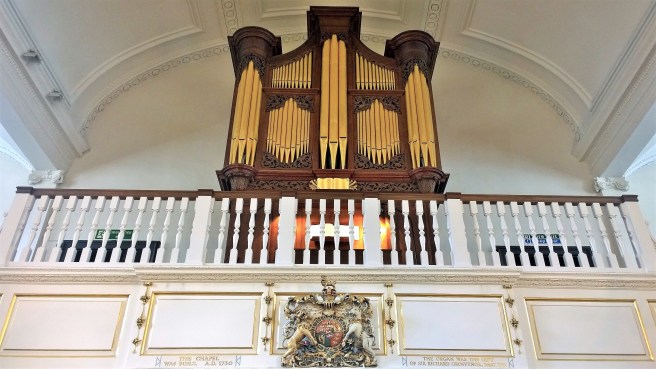
Andrew Benson-Wilson
plays music by
Jan Pieterszoon Sweelinck
Commemorating the 400th anniversary of the death of the famed ‘Orpheus of Amsterdam’, Jan Pieterszoon Sweelinck (1562-16 October 1621), Andrew Benson-Wilson gives an organ recital of pieces reflecting the different styles and genres of Sweelinck’s music. He was the most influential teacher of his day, attracting many students from German-speaking areas. Several of them went on to create the Hamburg school of organ composition which culminated in the music of Buxtehude and Bach.
Andrew Benson-Wilson plays Bach: influenced by Reincken
Mayfair Organ Concerts
The Grosvenor Chapel
South Audley Street, Mayfair, London W1K 2PA
Tuesday 13 August 2019, 1:10
Andrew Benson-Wilson
plays music by
J S Bach
influenced by Johann Adam Reincken
Johann Adam Reincken (1643-1722) was organist of Hamburg’s famous Katharinenkirche and a close friend of Buxtehude. This recital is linked to a recital of his music given earlier this year at St George’s, Hanover Square. That recital included his monumental chorale fantasia on An Wasserflüssen Babylon composed around 1650. At around 20 minutes long, it the longest known piece of its type in the whole 17th century North German repertoire. It was known by Bach who, while at school in Luneburg, aged around 15 copied the entire piece out from a copy owned by Georg Böhm. It is believed that he also travelled to Hamburg to hear Reincken play. In 1720, shortly before Reincken’s death, Bach visited Hamburg and improvised a lengthy fantasia on the same chorale in homage to Reincken, who commented: “I thought that this art was dead, but I see that it lives in you”. Bach also transcribed several of Reincken’s instrumental pieces for keyboard.
This recital includes one of Bach’s Reincken transcriptions, a Toccata that is clearly influenced by Reincken’s dramatic style, and Bach’s chorale prelude on An Wasserflüssen Babylon, which includes a very obvious reference to Reincken’s chorale fantasia. It ends with Bach’s giant Fantasia in G minor, which may have been played during Bach’s 1720 visit to Hamburg. The accompanying Fugue is based on a popular Dutch tune and might have been Bach’s homage to Reincken, who was born in The Netherlands.
Toccata in D minor BWV 913
An Wasserflüssen Babylon BWV 653
Sonata in A minor (after Reincken Hortus musicus) BWV 965
Fantasia in G minor BWV 542i
The organ is by William Drake
Admission is free, with a retiring collection
Andrew Benson-Wilson plays Reincken
Mayfair Organ Concerts
Andrew Benson-Wilson plays Johann Adam Reincken (1643-1722)
St George’s, Hanover Square, London W1S 1FX
30 April 2019 @ 1:10pm

Toccata in G (Andreas Bach Book)
Toccata in A (Anon?)
Chorale Fantasia: An Wasserflüssen Babylon
Johann Adam Reincken was one of the most important and influential 17th-century North German organist-composers. He forms a unique link between the Sweelinck influenced organists of the earlier part of the century and JS Bach. Little is known about his life, and very few of his organ compositions survive. He was born to North German parents in Deventer in The Netherlands around 1643. An earlier supposed birthdate of 1623 is now accepted as incorrect. He moved to Hamburg in 1654, aged just 11, to study with the famed organist of the Katharinenkirche, Heinrich Scheidemann, a pupil of Sweelinck. After a brief return to Deventer, he came back to Hamburg in 1659 as Scheidemann’s assistant, replacing him as organist in 1663 on Scheidemann’s death. As was the custom of the time, he married one of Scheidemann’s daughters in 1665. He remained there for 60 years until his death in 1722. As well as his church duties, he co-founded the Hamburg Opera and was involved in the city’s musical life. He is known from two pictures dating from around 1674; the portrait painting and the now well-known ‘Musical Company’ painting by Johannes Voorhout.
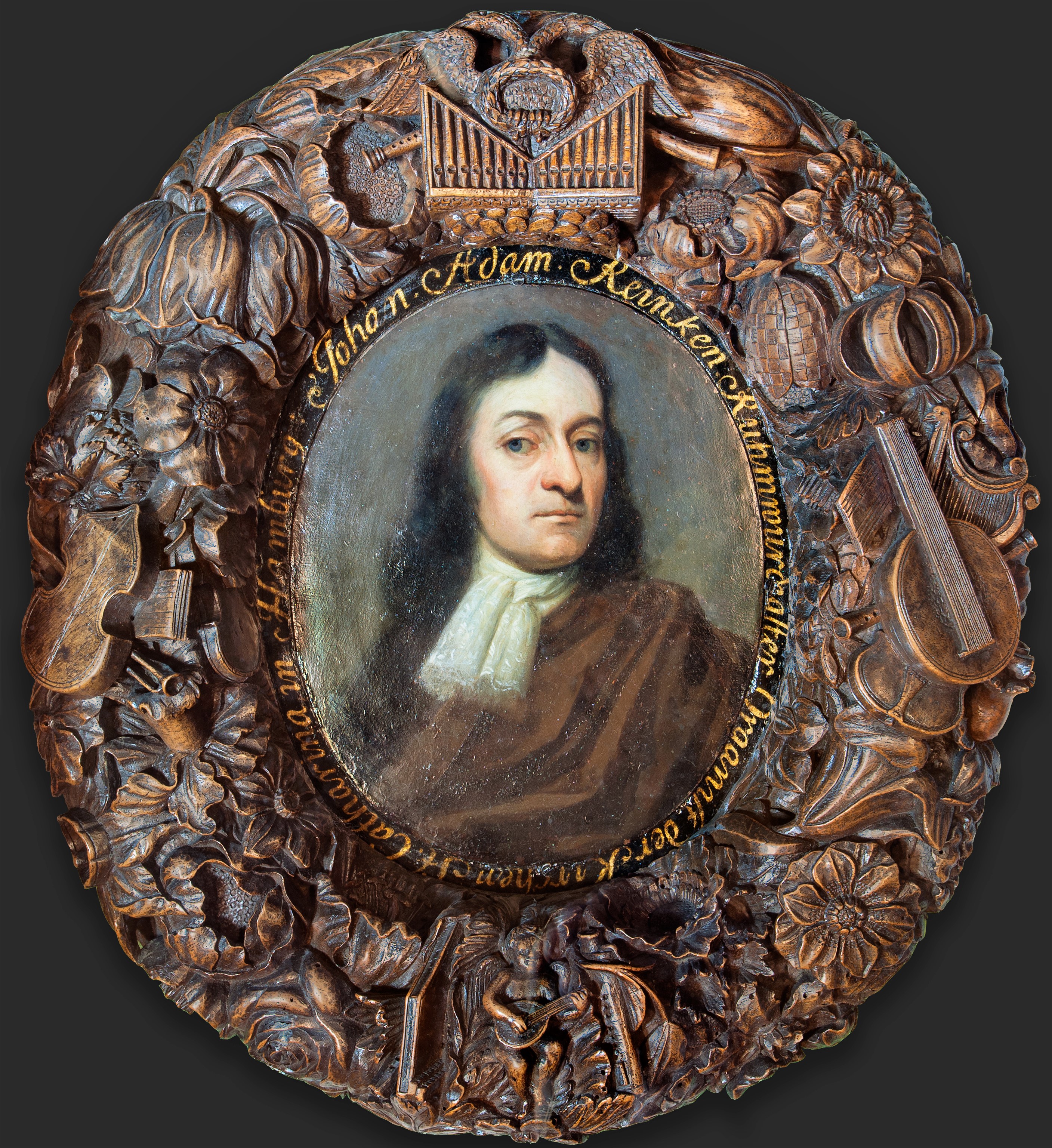
Organ music by Tunder (d1667)
Organ music by Franz Tunder (1614-1667)
St George Hanover Square (Mayfair Organ Concerts)
Tuesday 9 May 2017, 1:10
Andrew Benson-Wilson
Franz Tunder was one of the most influential organists and composers of the early to mid 17th century in North Germany. Along with a group of Hamburg organist composers, including Jacob Praetorius, Scheidemann, and Weckmann, he created the musical development that culminated in Dietrich Buxtehude, Tunder’s son-in-law, and successor at the Lübeck Marienkirche. He was key to the development of the extended Chorale Fantasia and the dramatic Stylus Phantasticus.
In 1646 Tunder founded the famous Abendmusiken series of concerts in the Marienkirche. These were funded by, and performed to, Lübeck businessmen, and were continued by Buxtehude and then well into the 18th century. In Tunder’s day, the Abendmusik concerts were usually organ recitals. In this programme, you will experience some of the organ music that could have been heard during these concerts, which were very much in the tradition of today’s London lunchtime concerts.
The 2012 Richards, Fowkes & Co organ in St George’s, Hanover Square (Handel’s church) is eminently suitable for music of this period.
Praeludium in g
In dich hab ich gehoffet, Herr
Jesus Christus wahr’ Gottes Sohn
Auf meinem Lieben Gott (manualiter)
Praeludium in g
Komm, Heiliger Geist, Herre Gott
Admission is free, with a retiring collection.
Programme notes: Weckmann recital
The Grosvenor Chapel, Mayfair
Tuesday 1 November 2016
Andrew Benson-Wilson
Matthias Weckmann (1616-1674)
Praeludium A . 5 . Vocum
Canzon in G
Nun freut euch, lieben Christen gmain
Fantasia ex D
Toccata ex d
Komm, heiliger Geist, Herr Gott
Matthias Weckmann is one of the most influential 17th century organist composers of the North German school. He was born in Thuringia, studied in Dresden with Schütz, a pupil of G. Gabrieli, and in Hamburg with Jacob Praetorius, a Sweelinck pupil. He settled in Hamburg in 1655 as organist of the Jacobikirche where he remained until his death. He is buried beneath the Jacobikirche organ. It was said that Weckmann “moderated the seriousness of Praetorius with the sweetness of Scheidemann, and also introduced many new elegant discoveries“. After Andrew’s Benson-Wilson’s performance of his monumental set of chorale variations on Es ist das Heil kommen her at St George’s, Hanover Square (on 11 October), today’s programmes looks at a selection of Weckmann’s free works, together with two contrasting three-verse works based on chorales.
The Praeludium A . 5 . Vocum is anonymous in the original manuscript, but there are stylistic reasons why it is likely to be by Weckmann, Continue reading
Grosvenor Chapel: Weckmann (b1616)

Mayfair Organ Concerts
The Grosvenor Chapel, South Audley Street, Mayfair , London W1K 2PA
1 November 2016, 1:10-1:50
Matthias Weckmann (1616-1674)
In the last of his three recitals of the organ music of Matthias Weckmann (in his anniversary year), Andrew Benson-Wilson plays the William Drake organ in the Grosvenor Chapel, South Audley Street, Mayfair in a programme of a Praeludium, Toccata, Canzon, Fantasia and two contrasting chorale-based works.
Review: Weckmann ‘Es ist das Heil’ recital
Review from Classical Events
Andrew Benson-Wilson
Organ recital at St George’s Church Hanover Square, London
Tuesday 11 October 2016 13:10
This is one of series of the Mayfair Organ Concerts. The lunchtime concert was given by Andrew Benson-Wilson who specialises in the performance of early organ music, ranging from 14th century manuscripts to the late Classical Period. The original organ at St George’s was built in 1725 by Gerard Smith. The old case has been extended to contain a new organ which was completed in 2012.
The concert consisted of one work: Matthias Weckmann’s (1616-1674) monumental seven verses on the choral melody ‘Es ist das Heil kommen her’. At a playing time of about 35 minutes it is perhaps one of the longest and most extraordinary works of its time. The story follows that Luther, on hearing the melody sung by a beggar, was reduced to tears.
Salvation has come to us
from grace and sheer kindness
Works never help,
they cannot protect us.
Faith looks towards Jesus Christ
who has done enough for all of us.
He has become our mediator
Although the hymn has 14 verses there is little correlation with the seven organ verses. This evidences a performance as an individual work rather than part of a church service.
Andrew provided ample programme notes to describe the treatment of the chorale theme and gave a short introduction to the lunchtime audience. The performance had a confident and assured touch of someone who understood the musical style. His clarity of counterpoint allied to the programme notes helped the listener to identify the processes and individual lines of the music.
The original Classical Events review is here.

Weckmann – ‘Es ist das Heil’

Mayfair Organ Concerts
St George Hanover Square, St George Street, London W1S
11 October 2016, 1:10-1.50
Matthias Weckmann (1616-1674)
‘Es ist das Heil kommen her’
Andrew Benson-Wilson plays the monumental set of 7 verses on the Lutheran chorale ‘Es ist das Heil kommen her’ written by Matthias Weckmann (1616-1674). Lasting about 35 minutes, it is the longest such organ work from the whole of the 17th century. It includes, as the sixth verse, the most extensive and most complex Chorale Fantasia of that era.
It is played on the 2012 Richards, Fowkes & Co organ in St George’s Hanover Square, based on North German 17th/18th century organs.
Admission free – retiring collection.
Programme notes below
Programme notes below

 Andrew Benson-Wilson : Early Music Reviews +