Hasse: Demetrio
Opera Settecento, Leo Duarte
Cadogan Hall, 21 September 2016
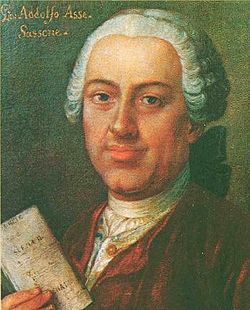 Johann Adolph Hasse (1699-1783) is one of those historically unfortunate composers who achieved great fame during their lifetimes but have since been more-or-less forgotten. A prolific composer of opera, he was hailed by Charles Burney as being superior to all other lyric composers. Married to the famed soprano Faustina Bordoni, the couple became the Posh and Becks of their day. Usually based in Dresden in the Court of the Saxon Elector Frederick III, Hasse had special dispensation that avoided the need to travel annually to the Polish Court, where Frederick was also the elected King. He also maintained a post in Venice at the Ospedale degli Incurabili. He lived long enough to have performed in front of Bach and the young Mozart.
This was the modern première of the opera Demetrio, presented by the musically adventurous Opera Settecento. Although the publicity suggested that we would hear the original 1732 Venice version, it was the later 1740 Dresden version that was performed. This included several new arias, but Continue reading
 returned to Dresden where he became more involved in composing for the Court Church(left), which had taken on a new significance after the closure of the city opera house in 1720. His career path didn’t go quite to plan. Having been temporary Kapellmeister for a short period of time, he was pipped to the post of Senior Kapellmeister by JA Hasse in 1733. He was then appointed as a church composer. A few years later JS Bach, who knew and admired Zelnka’s compositions, was appointed as an (honorary) Royal Court Composer as a result of his well-known petition accompanying his 1733 ‘Dresden Mass’ – the Kyrie and Gloria of what later part of the Mass in B minor (See PS below). On his death, his compositions were purchased by the Saxon Court as valuable objects rather than performing scores, and remained hidden away in their archives until the 1950s.
 Andrew Benson-Wilson : Early Music Reviews +