Crickhowell Music Festival: The Courts of Earth and Heaven
Crickhowell Choral Society, Stephen Marshall
St Edmund’s, Crickhowell, 30 April 2017
Handel: Eternal source of light divine (Birthday Ode for Queen Anne)
Delalande: Regina coeli
Campra: Quam dilecta
Vivaldi: Gloria (RV588 – the ‘other’ Gloria!)
A walking weekend in the Brecon Beacons happened to coincide with the annual Crickhowell Music Festival. I have reviewed the whole Festival in the past but, on this occassion, could only manage one performance, given in St Edmund’s Church, Crickhowell by the Crickhowell Choral Society and a ‘festival’ orchestra, together with a very impressive group of soloists. One of the things that most impressed me on my earlier visit was the ability of their director Stephen Marshall to attract outstanding and international renown singers such as, on this occasion, Grace Davidson, Nicholas Mulroy, and Catherine King.
The ambitious programme featured music from England, France, and Italy. It opened with Handel’s 1713 Birthday Ode – a homage to Queen Anne, and indeed, to Purcell, whose style he so perfectly absorbed. The opening arioso ‘Eternal lource of light divine’ is one of the most beautful musical creations of all time, with Handel’s understanding of Purcell’s style made obvious. It makes for a very exposed start to a concert, and one which tenor Nicholas Mulroy coped with magnificently. His high lyrical tenor voice hasn’t quite the timbre of a countertenor that Handel intended, but was nonetheless quite exquisite, in this, and in later movements. Grace Davidson’s soprano aria ‘Let all the wingéd race’ was similarly impressive. Both of these key singers demonstrated their excellent ability at singing Baroque ornaments properly, rather than using the often heard reliance on vibrato alone. Continue reading
 Preceding the two recordings of Handel in Italy (reviewed
  The completion of the restoration of the famous 1735 Richard Bridge organ in Hawksmoor’s Christ Church, Spitalfields was one of the most important musical events in London during 2015. My review of John Scott’s opening recital, and details of the organ, can be seen
 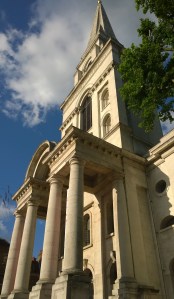 designed by the famed Baroque architect Nicholas Hawksmoor. The organ was built in 1735 by Richard Bridge, who became one of the leading organ builders of the day. Spitalfields seems to have been only his second commission, perhaps explaining the comparatively low price of £600 for such a substantial instrument. For the following 100 years or so, it was the largest organ in the country. It suffered the inevitable changes over the years, but retained enough of its original pipework to form the basis for a historically based reconstruction, returning it broadly to its original specification and construction. It was dismantled in 1998 while the church was being restored and was then restored to its 1735 specification, with very few concessions. Its completion in 2015 makes this by far the most important pre-1800 organ in the UK.
 Over the years, William Christie has done much to introduce French baroque music to British ears, and has opened our ears to Purcell. But I had not heard his take on Messiah live before. It was bound to be rather different from the usual variety of British interpretations, and it was. We are increasingly used to lightly scored performances with moderately sized choirs, in contrast to the cast of thousands of yesteryear, but this very Gallic interpretation added a layer of delicacy and dance-like joie de vivre to Handel’s music, all done in the best possible Bon Goût. Les Arts Florissants fielded a choir of 24 (quite large, by some standards today, and in Handel’s time) and an orchestra with 6, 6, 4, 4, 2 strings, together with five soloists. Both instrumentalists and the chorus were encouraged to keep the volume down, usually by a finger on the Christie lips. This seems to be in line with Handel’s intentions, as indicated by his scoring and, for example, his very limited use of the trumpets. When things did let rip, there was still a sense of restraint amongst the power.
  Unless you have been weaned on the sound of brass bands (which I wasn’t) the sounds and the instruments on this recording might appear rather unusual. It features no fewer than seven saxhorns, ranging from contralto to contrabass, along with five different cornets, and a ventil horn, all dating from around 1850-1900 (pictured below). The five players of the period brass ensemble, The Prince Regent’s Band, share these out amongst themselves as they explore the music of the extraordinary Distin family who, between 1835 and 1857, journeyed around Europe and North America performing and promoting new designs of brass instruments. They were instrumental, so to speak, in the development of new valved instruments, one being the saxhorn, designed by Adolphe Sax (who they met in Paris in 1844) but improved by the Distins, who gave the instrument its name.
 Handel’s early works, particularly those written during his period in Italy have a very special vitality, musical elegance and sense of melodic delight. The secular cantata Apollo e Daphne is one such, started in Venice in 1709. but not completed until he briefly moved to Hanover, in 1710, as Court Kapellmeister to the Elector of Hanover. It is the music performed during his time in Hanover that is the focus for this recording from the Irish/Scottish Ensemble Marsyas. Apollo e Daphne lacks an overture, so the curiously lengthy example from Il pastor fido has been included here, although at more than half the length of the cantata it makes for an unnecessary imbalance to the following cantata. That imbalance is further exaggerated by adding two curious Arias in F for wind band between the overture and cantata (here with added percussion), with a segue between the second Aria and the opening recitative of Apollo e Daphne. It’s a rather odd musical construction, but that should not detract from the many delights of this recording.
 English Touring Opera (ETO) has built a solid reputation for their two annual opera tours around England. In their most recent season, they visited 91 venues, with two groups of fully-staged operas (sung in English) plus various wider educational and community projects. It is a remarkable organisational undertaking and a tough call for the singers in each tour, with many singing in two operas and covering a role in the third. Usually touring two or three operas in the spring and autumn, they open with one-off autumnal London showings before hitting the road. Their choice of operas usually has a theme, or is otherwise related in style and period. This year’s autumn focus is on early operas written in, or inspired by, Venice, with Handel’s 1738 Xerxes, Cavailli’s 1651 La Calisto, and Monteverdi’s 1639 “Ulysses’ Homecoming” (Il ritorno d’Ulisse in patria), performed in reverse order to the dates of composition, and premièring in the magnificent surroundings of the Edwardian Hackney Empire.
  As part of the Kings Place ‘Baroque Unwrapped’ season, the Newcastle-based Avison Ensemble explored the world of the 18th century concerto, and the equally interesting world of English provincial musical life. Charles Avison (pictured) was a Newcastle born organist and composer who absorbed the musical style of Geminiani and Scarlatti during a short period in London before being enticed back to Newcastle with the promise of prestigious organist post complete with a new organ. He made a handsome living through teaching and arranging subscription concerts. He was also a fierce reviewer of other composers, including Handel.
 Some of Handel’s most exciting and dramatic music was composed during the three short years he spent in Italy, starting when he was just 21. Despite offers of financial assistance from a Medici Prince, Handel famously ‘made his way on his own bottom’, as his biographer Mainwearing put it. Mainwearing suggests that prior to his visit, Handel ‘could see nothing’ in Italian music which, if it is true, is rather surprising, as Italian music had been at the forefront of much of the European Baroque, not least because of the developments in opera, oratorio and cantata. Handel very quickly absorbed the taste and style of Italian musicians both from Rome and also from his shorter visits to Venice, Florence and Naples. In his compositions from this period, he often outdid the Italians in writing in their style – as he did in England later in his life.
 Jean-Christophe Dijoux was the winner of the harpsichord category of the 2014 Leipzig International Bach Competition, and this CD stems from that success. Born in Réunion, Dijoux studied in Paris, Freiburg and Basel, spent a year touring with the European Union Baroque Orchestra (EUBO), and won awards for continuo playing at the 2013 International Telemann Competition. Using two harpsichords (built by Matthias Kramer of Berlin after 1701 and 1754 originals) and four different temperaments, he explores music with a connection to Hamburg. Both instruments have 16’ stops, adding an impressive gravitas to the sound.
 The players of the Early Opera Company, directed by Christian Curnyn, stepped out of their more usual orchestra pit for an almost instrumental evening of music making at St John’s, Smith Square, with music generally representing the Concerto Grosso format.
 The Brook Street Band, named after the London street where Handel lived for the last 36 years of his life, celebrate their 20th anniversary this year. As well as his well known Opus 2 and 5 sets of Trio Sonatas, Handel left a number of isolated examples of the genre, three of them normally referred to as the ‘Dresden’ sonatas where the manuscript is housed. To these three (HWV 392-4), are added two other proper trio sonatas (386a and 403) and two other pieces arranged by the Brook Street Band in a trio sonata format, the early Sinfonia and an early version of the overture to Esther, both of which helpfully lack an viola part. Many of the movements are examples of Handel’s re-use of material, and there are a number of familiar melodies that crop up with an otherwise lesser known group of pieces. Notable amongst
  Corelli: Concertos grosso Op6/4 and Op6/8 ‘Christmas Concerto’; Handel: Gloria; Arvo Pärt arr Frank Agsteribbe: Fratres; A Scarlatti: Cantata ‘O di Betlemme altera’
 The European Union Baroque Orchestra was formed in 1985, and has recently successfully negotiated its way through a difficult period of financial uncertainty. It celebrated its renewed, if short term security with the first short series of concerts for the newly formed orchestra of young musicians. They are selected anew each year through combined educational and selection courses and then usually meet five or six times a year to rehearse and then tour a new programme. One of the key features of EUBO is giving the musicians the chance to experience life as a touring orchestral musician, evidenced on this occasion by
  This recording comes with several health warnings, not least the fact that none of the five featured Sonatas are quite what they seem. The three Bach sonatas were, as the CD title implies, intended for the viola da gamba. The Scarlatti Sonata was probably intended for solo harpsichord although there is an argument that it, and some of its fellow sonatas, could have been performed as a violin sonata. The Handel Sonata was originally for oboe but was transcribed for the violin with a scribbled note that it could be played on the viola da gamba. None were intended for the cello.
 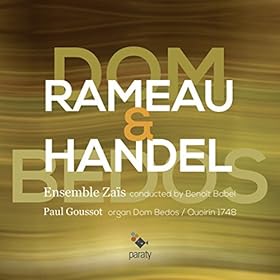 Handel and Rameau are both frustrating composers for organists. Both were very keen organists throughout their life, but Rameau left no organ music, and Handel very little. I have given many organ recitals solely devoted to Handel’s music, but only by drawing on music almost certainly intended for harpsichord. It works well, but I would love to have heard Handel (and Rameau) improvising on the organ. This CD is something of a nod towards that very happening. The unspoken premise of this recording seems to be that Handel and Rameau (born two years apart) meet near the west coast of France (which Handel certainly never ventured even close to) in a church housing one of the largest and most comprehensive French baroque organs ever built – the 1750 Dom Bedos organ of Saint-Croix in Bordeaux. There happens to be an orchestra present. They set about a run-through of some of their pieces, Handel expanding on his Organ Concertos and Rameau transcribing some of his orchestral and harpsichord ensemble works for organ and orchestra. Both improvise at will.
  What a delightful CD. Part of the ’eeemerging’ (Emerging European Ensembles) project led by the Ambronay cultural centre, it selects promising young musicians and helps them set up their careers, including the chance to make their first CD – like this one, from L’Aura Rilucente, a five-strong group formed in 2011 in Milan. Their fascinating programme includes three Trio Sonatas by Nicola Francesco Haym, usually only known (if at all) as the librettist for some of Handel’s operas (for example, Ottone, Flavio, Tamerlano, Rodelinda. Also known as a cellist, Haym’s composing activities have been almost entirely overlooked, so his inclusion on this CD is a real musical service.

 The Sam Wanamaker Playhouse, part of the Shakespeare Globe on London’s South Bank, has come up with an enterprising series of candlelit musical events and, increasingly, theatrical events using music as an integral part of the production. The latest of the latter genre is ‘All the Angels: Handel and the first Messiah, a play by Nick Drake that explores Handel’s visit to Dublin where the first performance of Messiah took place on 13 April 1742.
 Andrew Benson-Wilson : Early Music Reviews +