he KingMonteverdi ‘The Return of Ulysses’
Royal Opera House, Early Opera Company, Christian Curnyn
The Roundhouse. 10 January 2018
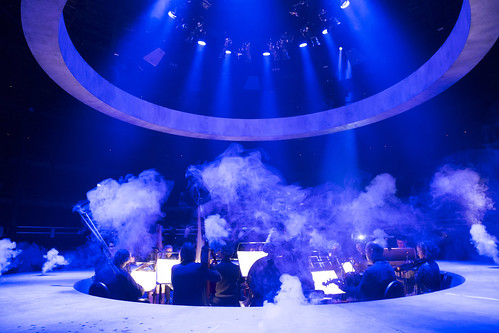
After the success of their 2015 production of Monteverdi’s Orfeo at the Roundhouse (reviewed here), the Royal Opera House returned with an English language version of Il ritorno d’Ulisse in patria, under the title of ‘The Return of Ulysses’. As its name suggests, the Roundhouse is a large circular building in Camden, North London, built in 1854 by a railway company as the Great Circular Engine House and used, albeit only for a few years, as a maintenance depot. It had a central turntable to switch engines into the surrounding maintenance bays. John Fulljames’s production for the Royal Opera House maintains the link with this central turntable with a doughnut-shaped staging with an outer raised ring for the singers with the orchestra in the central circle. Both rotated, the instrumentalists going very slowly clockwise (a bit slower than the hour hand of a watch) and the singers intermittently rotating anti-clockwise. on their circular stage.
 After reforming, renaming, and regrowing itself from the long-running Lufthansa Festival, the London Festival of Baroque Music has become, phoenix-like, one of the most important early music festivals in London. Under the banner of ‘Baroque at the Edge: pushing the boundaries‘, this year’s LFBM used the music of Monteverdi and Telemann, from either end of the Baroque (and both with anniversaries this year) to explore ‘some of the chronological, geographical and stylistic peripheries of Baroque Music’. With one exception, all the concerts were held in the Baroque splendour of St John’s, Smith Square.
  Since 1996, the cloister has been home to summer opera productions, presented by Iford Arts. Their latest season concluded with ‘A Fairy Queen’ presented by Iford Arts and their regular orchestra from Christian Curnyn’s Early Opera Company.
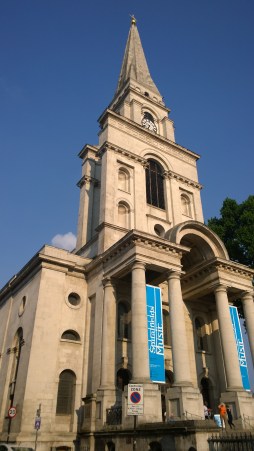 Spitalfields Music has been an extraordinary musical and community success since its foundation 40 years ago. Starting life with a 1966 concert to help save Nicholas Hawksmoor’s architecturally important Christ Church Spitalfields (which was then, unbelievably, under threat of demolition) it soon grew into a ‘Summer Festival of Music’ led by Richard Hickox. Initially under the auspices of the Friends of Christ Church, it became an independent organisation and charity in 1989, setting up their continuing community and education programme two years later. Under the artistic and managerial leadership of the likes of Judith Serota, Michael Berkely, Judith Weir, Jonathan Dove, Diana Burrel, Abigail Pogson and the current Chief Executive, Eleanor Gussman, it has grown into an major musical and community force in London, sharing their passion for music with nearly half and million people, attracting more than 325,000 audience members to events in more than 70 venues in the Spitalfields and Tower Hamlets area. Alongside their Summer and Winter Festivals, they run an enormous Learning & Participation programme involved more than 125,000 people.
 The players of the Early Opera Company, directed by Christian Curnyn, stepped out of their more usual orchestra pit for an almost instrumental evening of music making at St John’s, Smith Square, with music generally representing the Concerto Grosso format.
 Composed in 1647 (to a libretto by fellow Italian Francesco Buti), Rossi’s Orpheus is generally acknowledged to be the first opera specifically commissioned for France – one outcome of the appointment of an Italian Cardinal as the Prime Minister to Queen Anne of Austria, the Regent to the young Louis XIV, and his attempts to introduce Italian culture to the French Court. Buti’s libretto is a curious affair, adding a bewildering array of miscellaneous characters to the story together with extended
  Andrew Benson-Wilson : Early Music Reviews +