Handel: Israel in Egypt (original 1739 version)
Orchestra & Choir of the Age of Enlightenment, William Christie
BBC Proms, Royal Albert Hall. 1 August 2017
A combination of Handel, the Orchestra of the Age of Enlightenment, and William Christie is bound to sell out the vast auditorium of the Royal Albert Hall, but the first performance of Handel’s Israel in Egypt, in 1739, was not so successful. Many stayed away because of the biblical context of the work, and those that came were not overly impressed. The reasons are complex, but are generally to do with Handel’s move from opera to the new musical form of oratorio. The slightly earlier oratorio Saul, written just before Israel and Egypt, was a great success, no doubt because the musical style included more elements of opera. Israel in Egypt was far more hard-core, not least in the use of choruses. The first part, nearly always omitted in present day performances, is a continuous sequence of 12 choruses. Part Two has 7 and Part Three 8, but these are broken up by a few arias, duets, and recitatives. Handel made many subsequent changes to the score, and it is usually now performed in the 1756 version, with its odd recitative start (which refers back to the non-existent Part One) and no Symphony. It was the inclusion of Part One, and what was supposed to be (but I think was not quite) the original 1739 version, that made this Proms performance so special. Continue reading
 Handel’s early works, particularly those written during his period in Italy have a very special vitality, musical elegance and sense of melodic delight. The secular cantata Apollo e Daphne is one such, started in Venice in 1709. but not completed until he briefly moved to Hanover, in 1710, as Court Kapellmeister to the Elector of Hanover. It is the music performed during his time in Hanover that is the focus for this recording from the Irish/Scottish Ensemble Marsyas. Apollo e Daphne lacks an overture, so the curiously lengthy example from Il pastor fido has been included here, although at more than half the length of the cantata it makes for an unnecessary imbalance to the following cantata. That imbalance is further exaggerated by adding two curious Arias in F for wind band between the overture and cantata (here with added percussion), with a segue between the second Aria and the opening recitative of Apollo e Daphne. It’s a rather odd musical construction, but that should not detract from the many delights of this recording.
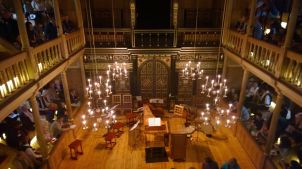 the new Globe management, those events seems to have ground to a halt, with only one listed in the current season – and that a hang-over booking from the previous management. So it was fortuitous that the BBC Proms chose the theatre for one of its ‘BBC at …’ events (alongside such venues as a multi-story car park in Peckham), not least because it enabled people to see the inside of this fabulous, but very uncomfortable, theatre for just £14, rather than the up to £62 the Globe are asking for their own next concert there.
  Andrew Benson-Wilson : Early Music Reviews +