Katharinenkirche Hamburg

Katharinenkirche Hamburg
Sietze de Vries, organ
Fugue State Records/JSB Records FSRCD007. 79’37

Jacob Praetorius, Reincken, Bach and improvisation

The recent reconstruction of the famous Hamburg Katherininkirche organ was major landmark in the organ world. Its nickname of the ‘Bach organ’ (or ‘ an organ for Bach’) is misleading, and relates to the visit of Bach in 1720. But it could equally, and with far more accuracy, be described as the ‘Scheidemann’ or ‘Reincken’ organ (Katherininkirche organists for nearly 100 years from 1629-1722), both of whom had far more influence on its development, and whose music it better represents. Its roots go back to about 1400, and it had reached an advanced state by 1605 when Continue reading

Bach at Martinikerk, Groningen

Bach at Martinikerk, Groningen
Wim van Beek, organ
Fugue State Records/Helior FSRCD003. 2 CDs. 51’12+57’41

Bach: Clavierubung III

This is a recording made in 2006 of the famous organ in the Martinikerk, Groningen, one of the famous North German Baroque organs. Its roots lay in the mid-15th century 1450 with a rebuilding around 1482 by Johan ten Damme. The Gothic organ was rebuilt in Renaissance style in 1542 and further enlarged in 1628, 1690, 1691/2 (by Arp Schnitger), by Frans Caspar Schnitger and Hinsz in 1729/30 and 1740. After many poor re-buildings in the early 20th century, it was finally restored back to a 1740 state in 1984 by Jürgen Ahrend, retaining most of its early pipework, some dating back to 1542. It is seen by many as an ideal ‘Bach organ’, although more recent thinking has recognised that the very different Saxon and Thuringian organs are closer to the sound world of the mature Bach. But he was certainly influenced by these more northern instruments, particularly in his youth. Continue reading

Koororgal Martinikerk Groningen

Koororgal Martinikerk Groningen
Wim van Beek, organ
Helior HGWB02. 77’08.

DuMage, Clérambault, JS Bach, Mozart, CPE Bach, Zipoli, Daquin, Paradisi.

Although the Martinikerk choir organ was only acquired in 1939, it has a much earlier history. There are no records, but is seems that it was originally built around 1742 for the St Elisabethsdal cloister in the south Netherlands, probably by Jean-Baptiste Le Picard, the best known of the French family of organ builders. In 1799, during the French occupation, the cloister was closed, the organ and other furnishings sold off, and the church demolished. The two-manual organ was divided between two churches, Continue reading

Songs of Love, War and Melancholy

Songs of Love, War and Melancholy
the operatic fantasies of Jacques-François Gallay
Anneke Scott, natural horn, Steven Devine, piano, Lucy Crowe, soprano
Resonus Classics. RES10153 66’41 

Fantaisie brillante sur l’opéra ‘Les Martyrs’ de Donizetti (Op. 49),
Fantaisie sur une cavatine de ‘Belisario’ de Donizetti (Op. 42),
‘Fuis, laisse-moi’ de ‘Roberto Devereux’ de Donizetti,
Fantasia sopra un motivo dell’opera ‘Bianca e Fernando’ di Bellini (Op. 47/2),
Troisième Mélodie sur une cavatine de ‘La Sonnambula’ de Bellini (Op. 28),
‘Une Larme Furtive’ de ‘L’Elisir d’amore’ de Donizetti,
Fantaisie sur l’opéra ‘L’Elisir d’amore’ de Donizetti (Op. 46),
Fantaisie brillante sur un motif de ‘Norma’ de Bellini (Op. 40),
‘L’Appel du Chasseur’ des ‘Soirées Italiennes’ de Mercadante.

This CD explores the fascinating (and little-known) world of the French ‘opera fantasy’, an early to mid 19th century musical genre where leading instrumentalists, already well-used to having to create their own repertoire, arranged extracts from Italian operas for their own instrument. One of the leading exponents of that art was the renowned principal horn-player of the Théâtre Italian, Jacques-François Gallay. Five of his Continue reading

The Saxon Alternative – Telemann: Music for Wind Band

The Saxon Alternative – Telemann: Music for Wind Band
Syrinx
Resonus Classics RES10154. 62’04

Overtures TWV 44:7, 55:c3; 44:2; 55:B3; 44:14

The sound of the Baroque wind band was (and still is) more often heard on the continent than in the UK, so this CD from Syrinx is a refreshing reminder of just how attractive baroque wind instruments can be.  It would be interesting to research the extent to which the weather was an explanation for this, as the wind band was often used in Germany for outside entertainment, always rather risky in the UK. Two of the five Telemann Overtures on this CD feature the traditional French-inspired German Continue reading

L’organo a Firenze dai Medici all’Unità d’Italia

L’organo a Firenze dai Medici all’Unità d’Italia
Gabriele Giacomelli
Tactus TC 860002. 79’03

This CD has been issued in celebration of the brief period, 150 years ago, when Florence was declared the capital of the Kingdom of Italy. Using the two historic organs in the San Lorenzo basilica, it covers the period from the time of the Medici family (who built San Lorenzo as their parish church and eventual mausoleum) to the Unification of Italy. The first half is played on a small Renaissance period organ, tuned in quarter-comma meantone, with pipework dating back to the 1450s, restored by Continue reading

Bach in Montecassino

Bach in Montecassino
Luca Guglielmi
Vivat 108. 69’12

This is a rather unexpected CD of Bach organ music played on a one-manual North Italian organ. But there is an interesting back-story. The pieces come from the Bach works collected by two 18th century scholars, Friedrich Wilhelm Rust and Padre Martini, who both played a part in what became the first collected edition of Bach’s works. After Rust visited the Abbey of Montecassino (south-east of Rome) and played the organ there (in 1766), he presented the Abbey organist with several Bach organ manuscripts. The Abbey Continue reading

Betrayal: A Polyphonic Crime Drama

I Fagiolini
Village Underground. 13 May 2015

It’s not often that I find myself standing in a long queue outside a venue controlled by bouncers. But this was, after all, an I Fagiolini event (commissioned by the Barbican), and the little beans had come up with yet another of their spectaculars. The venue was Village Underground, a performance and arts venue created out of a derelict railway viaduct and adjoining warehouse. The bouncers eventually let us in, after we had shown the ‘Crime Scene Inspection Permit’ we had been told to bring with us. We were immediately shrouded in thick smoke, the little blue-light torches were had been given not being a great deal of help. In the murk, we managed to find a series of display boards showing an enigmatic sequence of photos and poetic texts, all linked by lines. Several chalked body outlines could be seen on the floor, close to various seemingly random objects that had been grouped near the display boards. The investigation permit began to make sense. As the gloomy room filled up with people it became harder to move about, an issue that became more serious when the singers and dancers joined the scene. Continue reading
London Festival of Baroque Music – Day 4/5

‘Women in Baroque Music’
St John’s, Smith Square & Westminster Abbey, 18/19  May 2015

SJSS 2I couldn’t get to the lunchtime concert on day 3 of the festival, but it was given by soprano Rowan Pierce and the young group Medici, under the title of ‘Future Baroque’, with music by Handel, Bach, Royer, Telemann, Corelli and Vivaldi. Unless I have missed something, this was another event that seemed to bypass the festival’s theme, although it did include as its final work Agitata da due venti, a surviving fragment from Vivaldi’s opera L’Adelaide and later also included in his Griselda, composed for the virtuoso soprano Margherite Giacomazzi.

‘Leçons des ténèbres’
Julia Doyle & Grace Davidson, sopranos,
Jonathan Manson, bass viol, Steven Devine, harpsichord, organ & director

The Monday evening concert (St John’s, Smith Square, 18 May) Continue reading

St John’s Smith Square Young Artists’ Scheme, 2015/16

Congratulations to recorder player Tabea Debus (www.tabeadebus.de) and vocal ensemble The Gesualdo Six (www.thegesualdosix.co.uk) on representing the early music world as two of the four appointments to the St John’s Smith Square Young Artists’ Scheme for 2015/16. The other two awards go to violinist Joo Yeon Sir (www.jooyeonsir.com) and The Ligeti Quartet (www.ligetiquartet.com). Continue reading

London Festival of Baroque Music – Day 3

‘Women in Baroque Music’
St John’s, Smith Square, 17  May 2015

The third day of the festival started with ‘Sing Baroque’, with Robert Howarth, one of the Robert HowarthOrchestra of the Age of Enlightenment’s regular conductors, leading a Sunday morning workshop on the choral sections of Vivaldi’s Gloria – “for all aspiring Baroque singers – no experience necessary!”. This is certainly not the sort of event that should be reviewed, but I will comment on the experience of watching a conductor at work from the other side of the podium. Conducting styles vary by personality (and over historic time), but there is a generation of younger conductors who focus on using collaboration, cooperation and genuine good humour (rather than dictatorship or bullying) as the key to communicating their ideas. It was clear that Robert Howarth is one of those. As well as giving the gathered singers an excellent insight into the music and aspects of performing it, Robert Howarth also made it an extremely entertaining occasion. Music’s gain is stand-up comedy’s loss.

The Sunday afternoon included a guided tour of The Wallace Collection exploring ‘Music, Dance and Gallentry in 18th-century French Art’, followed by a concert focusing on the harpsichord music of Elizabeth Jacquet de La Guerre (1665-1729) given by Béatrice Martin. Continue reading

London Festival of Baroque Music – Day 2

‘Women in Baroque Music’
St John’s, Smith Square, 16  May 2015

‘Canto dell dame’
Concerto Soave
María Cristina Kiehr soprano, Jean- Marc Aymes, harpsichord, organ & director.

On the cover of the festival programme book are the words “Joy / Passion / Religion / Love / Death / Adoration / Intensity. The Saturday afternoon concert of 17th century Italian music given by Concerto Soave included all of those aspects, sometimes in the same piece. Featuring Concerto Soavefive female composers, the music ranged from the very beginning of the Baroque up to the end of the 17th century. The earliest composer was Francesca Caccini (1587-1641), daughter of Giulio Caccini (represented here by Peter Philips’ harpsichord transcription of his Amarillo, mia Bella). Francesca Caccini made her debut aged 13 at the Medici Court, singing at the wedding of Henri IV of France to a Medici bride. After time in France she returned to become the leading female singer in Florence. Apart from one opera (the earliest known one by a woman) her only surviving music was published in 1618. The three pieces demonstrated the early recitativo style of Continue reading

London Festival of Baroque Music – Day 1

‘Women in Baroque Music’
London Festival of Baroque Music
St John’s, Smith Square, 15 May 2015

This long weekend of Baroque music was both a 1st  and a 31st  event. The first event of the new London Festival of Baroque Music, and the 31st of a continuing festival that had hitherto been known as the Lufthansa Festival of Baroque Music. The Lufthansa Festival was an extraordinary example of collaboration between a sponsor (that in latter years also included Rolls Royce) and a music festival. Shorn of the funding of a major international sponsor, the LFBM_cropfirst London Festival of Baroque Music inevitably revealed its reduced financial resources, covering an 5-day extended weekend rather than earlier 8 or more days, and with a reduction in the number of groups from outside the UK. But a wealth of individual sponsors and some crowd-funding through social media has come up with the wherewithal to make for a rich and fulfilling series of concerts. And a capacity audience for the opening concert in St John’s, Smith Square showed the strength of public support. Continue reading

The OAE Night Shift – Classical Music: minus the rules

Orchestra of the Age of Enlightenment
Kati Debretzeni, director & violin
Frances Kelly, harp, Elizabeth Kenny, theorbo
Queen Elizabeth Hall, 12 May 2015

Despite being no spring chicken myself, the audience at most classical music concerts make me feel rather young –  perhaps naively. Not so the OAE’s innovative Night Shift events, specifically aimed at young people and therefore making me feel rather old. Although these events have taken place in pubs and bars, I usually experience them, like this one, as late-night one-hour events repeating part of the earlier evening OAE concert. On this occasion, the OAE included three of the  pieces played in the earlier concert reviewed below (Telemann’s Violin Concerto in Bb and Handel’s Concerto for harp & lute and he Concerto Grosso, Op 6/1), unfortunately omitting Stevie Wishart’s new work which had just been given its world premiere. I would have loved to have heard what the young audience thought of that work.

WP_20150512_21_59_23_Pro 1

The Queen Elizabeth Hall stage lighting was given a sexy twist Continue reading

The Rough with the Smooth

Orchestra of the Age of Enlightenment
Kati Debretzeni, director & violin
Chi-Chi Nwanoku, double bass, Frances Kelly, harp, Elizabeth Kenny, theorbo
Queen Elizabeth Hall, 12 May 2015

Telemann: Overture (Suite) in B flat, TWV.55:B8 (Ouverture burlesque), Concerto in B flat for violin, TWV.51:B1,
Stevie Wishart: Concerto à double entendre (World premiere)
Handel: Concerto in B flat for violin & orchestra, HWV.288 (Sonata a 5), Concerto in B flat, Op.4 No.6 for lute & harp, Concerto grosso in G, Op.6 No.1

Nestling in between the familiar OAE territory of Telemann and Handel was the world premiere of Stevie Wishart’s The Rough with the Smooth: Concerto à double entendre. Lasting about 23 minutes, it was structurally based on the traditional form of the concerto grosso, the three-movements headed Prelude and Fugue, Air, and Passacaglia. So far, so Baroque. But Stevie Wishart is a composer with roots in early and contemporary music. So rather than highlighting the melodic aspects of the instruments that are usually key to Baroque music, Wishart focused on the “resonance, overtones and sympathetic vibration” of the string orchestra, commenting that “the entire orchestra play only open strings and harmonics so that melodies only surface through a barrage of ‘sound clouds’ and gentle noise.” Continue reading

Bird – The Oriental Miscellany

William Hamilton Bird (c1750-c1804) – The Oriental Miscellany
Jane Chapman (harpsichord) Yu-Wei Hu (baroque flute)
Signum SIGCD415.  74’14

This CD would be attractive enough to listen to without knowing any of the back-story. But it is a fascinating one. William Bird was part of the musical life of the British community in Calcutta in the late 18th century. His Oriental Miscellany (“being a collection of the most favourite Airs of Hindoostan, compiled and adapted for the Harpsichord”), was first published in 1789. It was the first Western attempt to notate traditional Indian music, and contains 30 songs written in a straightforward and approachable style, appropriate for gentle amusement. The list of subscribers Continue reading

The 2014 Lufthansa Festival – end of an era?

As the 2015 London Festival of Baroque Music approaches, I thought I would re-publish my review of last year’s festival, under the then title of the Lufthansa Festival of Baroque Music.

“This year’s Lufthansa Festival (the 30th) marked the end of an era.  It was the last to benefit from the 30-year sponsorship of Lufthansa (and, for the past 12 years, also Rolls-Royce plc), one of the most remarkable musical/financial partnerships in the modern history of music.  The Festival will continue with the same wealth of performers and performances under the name of the London Festival of Baroque Music, and is seeking funding Continue reading

Candlelit Arcangelo

Arcangelo & Neal Davies
Sam Wanamaker Playhouse, 9 May 2015

Bach, Albinoni, Telemann

The latest of the candlelit concerts in the Shakespeare Globe’s Sam Wanamaker Playhouse was given by Arcangelo (9 May). They were founded in 2010 by Jonathan Cohen, and appear in formats ranging from a duo to a chamber orchestra. On this occasion they were a small string group plus oboe, theorbo, and continuo organ/harpsichord, joined at the end by baritone Neal Davis (replacing his indisposed cousin Iestyn Davies).

The programme was one of contrasts, ranging from the frolics of Telemann’s Don Quichotte Suite to Bach’s serene cantata Ich habe genug. The size of Continue reading

Handel: L’Allegro, il Penseroso ed il Moderato, 1740

Handel: L’Allegro, il Penseroso ed il Moderato 1740
Gabrieli Consort & Players, Paul McCreesh
Signum SIGCD392. 2 CDs.  77’12+64’26=141’38.

 L’Allegro, il Penseroso ed il Moderato, Concerto Grosso in G (Op 6/1), Concerto Grosso in E Minor (Op 6/3), Organ Concerto in B-Flat (O  7/1)

Handel’s L’Allegro, il Penseroso ed il Moderato is one of his most attractive and approachable, but also his most complex and confusing, works. It is not clear what it is. It is not an opera, an oratorio, ode or cantata, but was loosely described at the time as ‘an entertainment’. There is no plot, no human characters or underlying narrative. The title is in Italian, the text in English. The three ‘characters’ of the title represent the contrasting temperaments of mirth (Allegro) and melancholy (Penseroso), joined, in the third part, by Moderato, the voice of reason, restraint and, it seems, “chaste love”. Two of the ‘roles’ are each sung by three different voices (Allegro by tenor, boy treble and bass; Moderato by baritone, soprano and tenor), with Allegro on one occasion sung as a duet. Continue reading

Purcell & Charpentier: Te Deum

Schola Cantorum of Cardinal Vaughan Memorial School
Spiritato!  Iestyn Davies
St John’s, Smith Square. 29 April 2015

Purcell: Suite from Abdelazer, Jehova Quam Multi Sunt Hostes Mei, Te Deum and Jubilate in D. Rameau: Suite from Les Indes Galantes, Charpentier: Te Deum

I wouldn’t normally review a concert given by a boys’ school choir, but the Cardinal Vaughan Memorial School is well-known for their music education and performances.  The Schola Cantorum supports the liturgy of the school services, but is better known as one of the few school choirs that are regularly called upon for professional engagements. These have ranged from the Harry Potter films to a recent live broadcast on BBC Radio 3 of James MacMillan’s complex St Luke Passion. Individual boy singers are also often to be heard at Covent Garden and the Coliseum.

Continue reading

Jacquet of Mantua – Missa Surge Petre & motets

Jacquet of Mantua – Missa Surge Petre & motets
The Brabant Ensemble, Stephen Rice (conductor)
Hyperion CDA68088.  76’39

Surge Petre, Missa Surge Petre, Ave Maria a 3, O vos omnes, In illo tempore … Non turbetur, O pulcherrima inter mulieres, Domine, non secundum peccata nostra.

You would be forgiven for not having heard of the Renaissance composer, Jacquet of Mantua (1483-1559), and can blame the oddities of personal names at the time. He was known by a variety of names in his day, including Jachet de Mantoue, Iachet da Mantova, Iachetus Gallicus, Jacques Colebault or Collebaudi, but usually simply as Iachet (= Jack). He has also been confused with other composers, particularly Jacquet de Berchem. Born in Brittany in 1483, Jacquet of Mantua moved to Italy sometime before 1520, finally settling at the Gonzaga court in Mantua around 1527, following a year in Ferrara Continue reading

Monteverdi: Il ritorno d’Ulisse in patria

MonteverdiIl ritorno d’Ulisse in patria
Boston Baroque, Martin Pearlman (conductor)
Linn CKD451.  3 CDs. 176’

Monteverdi’s 1640 Il ritorno d’Ulisse in patria is not as well-known as his Orfeo (1607) or L’incoronazione di Poppea (1643), partly because of the difficulties in preparing a performing edition from the rather scant surviving evidence. For this recording, made in the studio shortly after a semi-staged production in Boston in April 2014, Boston Baroque’s director, Martin Pearlman, uses his own relatively conservative edition. As well as the orchestral ritornellos Pearlman has added a few orchestral colourings (using strings, cornetts and recorders) to the continuo line (of two theorbos, guitar, cello, two harpsichords, organ and an attractively buzzy regal). The use of instruments such as the cello (a later development from the bass instruments of Monteverdi’s time) suggests a certain relaxing of strict instrumental authenticity, but this does not detract from an otherwise impression edition. There is a nice balance between the over-orchestrations of yesteryear and severely austere continuo-only interpretations. Indeed, one of the highlights is Pearlman’s use of the various instrumental colours, with particularly effective contributions being made by the continuo theorbo players. Continue reading

J C Bach: Adriano in Siria

J C Bach: Adriano in Siria
Classical Opera.
Britten Theatre. 14 April 2015

Johann Christian Bach, JSB’s youngest son, arrived in London in 17 62, aged 26. He stayed for the rest of his life, earning the epitaph of the ‘London Bach’. Two years later, the 8-year old Mozart arrived in London with his family. During his 15-month stay, Mozart wrote his first symphonies and opera arias and absorbed the influence of the many musicians that had flocked to post-Handelian London. JC Bach was a particular influence on the young Mozart. He later wrote of Bach: “I love him with all my heart, and have the highest regard for him.”. This influence is reflected in Classical Opera’s choice of Continue reading

Bach Shafted!

Bach: St John Passion
Hieronymus
Thames Tunnel Shaft, Rotherhithe.  11 April 2015.

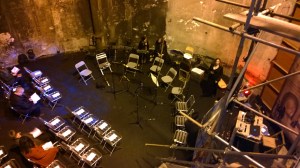
This must be one of the most bizarre musical venues I have ever been in, and an extraordinary place to hear one of Bach’s most sacred works. Between 1825/43, Marc Isambard Brunel and his son Isambard Kingdom constructed a tunnel under the Thames between Rotherhithe and Wapping, the first of its kind in the world. In order to construct the tunnel, they sank a 15m diameter shaft on the south side of the river in Rotherhithe. With the addition of stairs, this shaft later became the pedestrian entry to the tunnel, but was closed when the tunnel started taking trains rather than pedestrians. The Thames Tunnel is now an active part of London’sWP_20150411_19_23_30_Pro railway system, and the shaft has been re-opened with a concrete floor inserted to separate it from the trains below. It is currently only accessible by wriggling through a 1.3m high entrance and clambering about 12m down on some rickety scaffolding stairs. Continue reading

Handel: Giove in Argo

Handel: Giove in Argo
Britten Theatre, 26 March 2015
Laurence Cummings conductor
London Handel Orchestra

Like London busses, you can wait for ages to hear a pasticcio opera, and then three come along at once. After Fabio Biondi’s reconstruction of Vivaldi’s compilation L’Oracolo in Messenia at The Barbican and Opera Settecento’s excellent concert performance of Handel’s 1732 compilation opera Catone in Utica (both reviewed below), along came Handel’s 1739 Giove in Argo. It was considered lost until some arias were discovered a few years ago. John H Roberts has reconstructed and edited the score (for Bärenreiter), adding missing recitatives. After recent outings in Göttingen, Hanover and Halle, this was the first UK performance since 1739. It was given in the intimate space of the Britten Theatre with singers from the RCM International Opera School as part of the London Handel Festival.

The plot is loosely drawn from Ovid’s Metamorphoses. It focuses on the antics of a rather naughty Giove (Jove/Jupiter) and his attempts to seduce Continue reading

Bach: Clavier-Übung III – Stephen Farr

J.S.Bach: Clavier-Übung III
Stephen Farr organ
The 1975 Metzler organ,Trinity College, Cambridge
Resonus Classics RES10120.  105’08

Bach’s Clavier-Übung III is one of his most important contributions to the whole organ repertoire. Published for ‘connoisseurs’ in 1739, the 27 pieces include music of the utmost intensity and contrapuntal complexity, alongside more approachable pieces such as the well-known ‘Giant’ Fugue, Wir glauben all an einen Gott. Bettina Varwig’s detailed programme notes reveal that this collection could be Bach’s defiant response to his critic, and former pupil, Scheibe who criticised him for writing in “an antiquated, bombastic style that eschewed the current taste for pleasant, natural, singable music”.  It is about as far as he could get from that new style, one taken up with gusto by his son CPE Bach.

Stephen Farr’s choice of the 1975 Metzler organ in Trinity College, Cambridge, is a good one. An early UK example of continental organs designed with Continue reading

Organ Music before Bach

Organ Music before Bach
Kei Koito.
1736 Johann Jakob Hör organ, Pfarrkirche St. Katharina,Wolfegg, Germany
Deutsche Harmonia Mundi – Sony Music 8843040912. 78’37

Pachelbel Toccata in D Minor, Ciacona in D Minor, Fantasia in D Major (ex E-Flat Major), Vom Himmel hoch, da komm’ ich her, Toccata in G Minor, Ciacona in G Minor (ex F Minor), Fantasia in C Major, Toccata in C Major, Prelude in E Minor, Fugue in E Minor; Muffat Toccata prima, Ciacona in G Major, Toccata decimal; Fischer Ricercar pro Festis Pentecostalibus, Chaconne in F Major, Rigaudon & Rigaudon double, Passacaglia in D Minor; Kerll Passcaglia in D Minor;  Froberger Ricercar in D Minor, FbWV 411, Canzon in G Major, FbWV 305, Meditation faist sur ma Mort future laquelle se joue lentement avec discretion, FbWV 611a

Despite the all-encompassing title of this CD, the focus is on German organ music before Bach and, more specifically, South German and Austrian music. The opening piece is by Pachelbel, an organist composer raised in the strict Lutheran tradition.  But the Italian influence is immediately apparent. Like so many other Continue reading

Tenebrae by Candlelight

Tenebrae by Candlelight
Chapelle du Roi – Alistair Dixon director
St John’s, Smith Square, 1 April 2015

Palestrina: Lamentations, Gesualdo: Tenebrae Responds, Victoria: O Domine Jesu, Mass: Ave Regina, Ave Regina Coelorum, de Monte: Super Flumina Babylonis, Tallis: Lamintations I&II,  In Jejunio et Fletu, Derelinquit Impius, Byrd: Emendemus in Melius, Guerrero: O Domine Jesu.

The regular pre-Christmas and pre-Easter concerts in St John’s, Smith Square given by the vocal group Chapelle du Roi continued with one of their best yet as they celebrated ‘Tenebrae by Candlelight’.  ‘Celebrated’ is a loose term, as this was not a liturgical reconstruction, but a reflection on the music for Holy Week generally intended for use during the Tenebrae service.  The monastic service of Tenebrae was a combination of the office of Matins, normally sung just before sunrise, and the sunrise service Continue reading

More on the European Union Baroque Orchestra

EUBO is proud to announce that it has been selected to receive Creative Europe funding from the European Commission. The activities of EUBO during the period 2015 to 2018 will take place under the auspices of its new project, the EUBO Mobile Baroque Academy (EMBA), which will be organised by EUBO together with its nine partners. EMBA will nurture the performance of Europe’s distinctive shared heritage of baroque music, and the education of emerging Europe-wide talent, bringing baroque music to new audiences in innovative ways across Europe.

The activities of the new co-operation project, subtitled Pathways & Performance, will focus on music education and performance training. EMBA will provide a significant touring programme with its training orchestra EUBO under the direction of Music Director Lars Ulrik Mortensen and other renowned baroque music specialists. EMBA will also organise orchestral courses, interactive digital masterclasses, audience development events and a comprehensive digital programme ‘Baroque Bytes’ including live streamings and recordings of historically informed performances of baroque repertoire.

Student musicians are invited to take part in the first year’s activities by applying for a place at the Audition Courses which will take place in Luxembourg from 29 July to 1 August and from 1 to 4 August 2015. Further information on the courses is available at http://www.eubo.eu/EUBO/courses.

The EMBA partners are –
E
uropean Union Baroque Orchestra (UK) www.eubo.eu
European Association of Conservatoires (BE) www.aec-music.eu
Concerto Copenhagen (DK) www.coco.dk
Estonian Record Productions (EE) www.erpmusic.com
Villa Musica Rheinland-Pfalz (DE) www.villamusica.de
Trifolion/Ville d’Echternach (LU) www.trifolion.lu
The Malta Council for Culture and the Arts (MT) www.teatrumanoel.com.mt
Koninklijk Conservatorium Den Haag (NL) www.koncon.nl
Universitatea Nationala De Muzica Din Bucuresti (RO) www.unmb.ro
St John’s Smith Square (UK) www.sjss.org.uk

Die Tageszeiten – Les Passions de l’Ame & Solomon’s Knot

Bach & Telemann’s Die Tageszeiten
L
es Passions de l’Ame, Meret Lüthi, Artistic Director
Solomon’s Knot, Jonathan Sells, Artistic Director
St George’s, Hanover Square.  17 March 2015

JS Bach: Orchestral Suite No 3 in D, Singet dem Herrn; GP Telemann: Cantata Cycle: Die Tageszeiten TWV20:39

The latter years of a composer’s life frequently see reflections on earlier times and a reversion to earlier compositional styles. But Telemann, one of the most prolific composers of the Baroque era, took the opportunity to take a peek into the musical future with his rarely performed cycle of four cantatas, Die Tageszeiten (Times of the Day), It was written in 1755 at the time when Telemann’s composing output was in decline and shows several musical insights into the forthcoming classical era. This was a difficult period in Telemann’s life – his eldest son was dead, leaving him to care for his grandson alongside his own declining eyesight and health. Although generally described as a ‘cantata cycle’, it has something of the feel of a fledgling oratorio to it, not least in its combination of elements of traditional sacred cantata and opera, both genres that Telemann had excelled in during his time in Hamburg. This performance, part of the London Handel Festival, brought together the Bern-based orchestra Les Passions de l’Ame, led by violinist Meret Lüthi, and the eight singers of Solomon’s Knot, directed by Jonathan Sells, who also sang bass.

Each of the four sections is in the same format (Aria – Recitative – Aria – Chorus), reflecting morning, midday, evening and night, and sung respectively by soprano, alto, tenor and bass – in this performance each voice type shared by two singers. Having a different soloist for the second, more reflective and sacred part of the second aria in each section emphasised the text’s link with the passing of life’s stages and the life of the Christian Soul. As if to emphasis this point, the last example was sung from the pulpit.

It was clear from the start that this was rather different to Telemann’s usual style, the opening Sinfonie seeming to switch style from Wagner to Vivaldi in just a few bars, linked by a nimble little viola figure.  The instrumental colour and texture that Telemann drew from his accompaniment continued to fascinate, another example being the halos of strings depicting first the shimmering morning stars and, later, the dew rising from an evening alpine meadow. A noisy brook murmured, the west wind swayed branches, bees raided the flowers with constant buzzing, and the death bell tolled, all meticulously reflected in Telemann’s score.

One of the delights of the score is Telemann’s use of colloquial descriptions of tempo and mood, for example noting the slow movement of the opening Sinfonie as “Dallying and dainty” and the second evening Aria as “Drowsily”. Each section uses a specific instrumental colour, most notably a viola da gamba for midday, played exquisitely by Heidi Gröger. Zoe Matthews provided the bassoon’s depiction of night.

During the first half on the evening, the two groups had performed separately, Les Passions de l’Ame giving an inventive and inspirational performance of Bach’s Orchestral Suite No 3 in D, the Ouverture being not too fast, and the ever-popular Air being not too slow, with a particularly delicate reading of the melody by Meret Lüthi.  Solomon’s Knot then gave a stunning performance of Bach’s motet Singet dem Herrn, the eight singers producing a rich timbre that suited both the madrigalian intensity and joyful bounce of Bach’s varied textures. As with Die Tageszeiten, they all sang from memory, creating an ideal connection with the audience. They all took solo roles in the latter piece, most impressive being soprano Zoë Brown and counter-tenor Michal Czerniawski.

This was an excellent performance by Les Passions de l’Ame and Solomon’s Knot, both individually and together. I hope this partnership will continue.