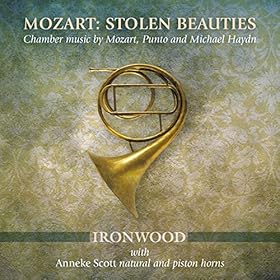
Mozart: Stolen Beauties

Mozart: Stolen Beauties
Ironwood with Anneke Scott, natural & piston horns
St George Hanover Square, 21 June 2015
and ABC Classics. ABC 481 1244

Mozart: Stolen BeautiesA CD launch concert in Handel’s own parish church of St George, Hanover Square featured the programme from the CD ‘Mozart: Stolen Beauties’. Ironwood is an Australian period instrument ensemble formed in 2006. They were joined by the distinguished horn player Anneke Scott, here playing both natural (or ‘hand’) and piston horn.

The ‘beauty’ that wasn’t stolen was the concluding Mozart Quintet for horn and strings in E-flat (K407). The autograph of this work was last known of in London 1847 when it appeared at a sale. It had earlier also proved elusive when Constanze explained to a potential publisher that the horn player Joseph Leitgeb had the score, but that he ‘lived in the suburbs’ of Vienna and would therefore be ‘difficult to track down’. The horn is accompanied by the unusual formation of violin, two violas and cello, rather than with two violins. This gives a richly sonorous timbre to the work, which Mozart (himself a viola player) used to highlight the key violin contributions. The horn writing is virtuosic, using the full range of the instrument of the day. Continue reading

Bach & Entourage: Sonatas for Violin and Basso continuo

Bach & Entourage
Johannes Pramsohler, violin, Philippe Grisvard, harpsichord
Audax ADX13703. 65’11

Sonatas for Violin and Basso continuo by Bach, Pisendel, Graun and Krebs

I have been watching violinist Johannes Pramsohler make his mark in the world of period violin playing over the past few years, and this CD shows that his growing reputation is well deserved. This well-chosen programme of relatively unknown Sonatas from the Bach circle, is a telling reminder that although his later fame came from his organ playing, Bach’s early childhood was spent learning the violin from his violinist father. As Pramsohler’s notes point out, it was only when the 10 year-old Bach, now orphaned, moved into his organ-playing elder brother’s house, that he started to focus on the organ. But he kept his father’s violin, his only inheritance, all his life. Although only one work is definitely by Bach, with two possibly Bach’s, Bach is suffused throughout the other works, by Pisendel, Graun and Krebs, representing the extraordinary flowering of musical talent in 18th century Weimar, Leipzig and Dresden.  The Graun and Krebs works are world premiere recordings, taking us into a slightly later musical period.  The CD ends with Bach’s extraordinary Fugue in g (BWV 1026).   Continue reading

Beethoven and the art of arrangement: Ensemble DeNOTE

Beethoven and the art of arrangement
Ensemble DeNOTE
Omnibus Classics CC5007. 69’07

Grand Trio, Op.38 (after the Septet, Op.20); Piano Quartet, Op.16 (after the Quintet for Piano and Winds)

Whether it was a commercial or a musical project, Beethoven’s own arrangements of his works for a smaller number of different instruments form a fascinating insight into the complex musical world of the late 18th and early 19th century. The two works represented on this CD reduce the Op.20 Septet for clarinet, horn, bassoon, violin, viola, cello and double bass to a Grand Trio for piano, clarinet and cello; and the Op.16 Quintet for piano, oboe, clarinet, bassoon and horn to a Quartet for piano, violin, viola and cello. Continue reading

Ingenium: Divina Mysteria

Ingenium
Divina Mysteria, Pavel Amilcar, violin
Vanitas VA03. 69’28

Pachelbel, Pandlfi-Mealli, Frescobaldi, Fontana, Bohn, Döbel, Froberger, Biber, Tunder,  Bruhns, Schmelzer, Kapsberger, Albertini.

Ingenium Stylus Phantasticus Divina Mysteria Froberger Tunder Schmelzer Kapsberger VanitasBased on the Stylus Phantasticus that influenced so much music during the 17th century, this CD explores its use over different musical forms, notably music for keyboard and the violin sonata, examples of the latter coming from Biber, Fontana. Pandlfi-Mealli, and Schmelzer. Each of the sonatas is paired with a piece from the keyboard repertoire, often reinterpreted by the addition of the other instruments. So we hear a Tunder organ Praeludium played on violin and archlute, and part of Bruhns’s substantial choral Continue reading

Tartini & Veracini: Italian Violin Sonatas

Tartini & Veracini: Italian Violin Sonatas
Rie Kimura & Fantasticus
Resonus RES10148. 57’58

Although Tartini is better known nowadays, no doubt because of the myths surrounding his ‘Devil’s Trill’ sonata, it was the virtuoso violinist Veracini that was hitting the headlines in early 17th century Italy, Dresden and London. There is a certain degree of comeuppance in the fact that Tartini was described (by Charles Burney) as a humble and timid man, whereas the now relatively unknown Veracini was considered ‘foolishly vainglorious’. When Veracini descended upon London, Roger North was scathing in his criticism of the influx of Italian violinists, based on hearing Veracini play – in a style he described as ‘not better than insane’.

Veracini’s two Sonata on this CD, from his 1744 Sonate Accademiche perhaps Continue reading

Amores Pasados

Amores Pasados
John Potter, Anna Maria Friman, Ariel Abramovich, Jacob Herringman
ECM New Series. 481 1555

AP coverWhat is a song? The music on this CD responds to that question by crossing the bridge between art song and pop song. It combines pieces from the English 16th century lute song repertoire with compositions influenced by those works by three present day musicians, more usually associated with rock music. We hear the Genesis keyboard-player, Tony Banks, reflect on Campion’s The cypress curtain of the night and Follow thy fair sun – as well as the Campion originals. Sting’s Bury me deep in the greenwood (written for the film, Robin Hood) is firmly in the lute-song tradition.

The CD opens with former Led Zeppelin bass-player, John Paul Jones’s 15 minute, three movement Amores Pasados, written in 1989 for Red Byrd. His No dormia, is a magically evocative, and almost medieval Continue reading

As our sweet Cords with Discords mixed be: English Renaissance Consort Music

As our sweet Cords with Discords mixed be: English Renaissance Consort Music
Consortium5
Resonus RES10155. 67’15

Music by Robert Parsons, William Byrd, John Dowland, Christopher Tye, Edward Blankes, Jerome Bassano, William Brade and Antony Holborne 

There are some people, even in the fairly rarefied early music world, who would rather pluck out their eyes than listen to a recorder consort. In normal circumstance I would just warn such people that this probably isn’t the CD for them. But this is an exception that might convert some doubters. Consortium5 (Oonagh Lee, Kathryn Corrigan, Gail Macleod, Roselyn Maynard, Emily Bloom) have established themselves as some of the most exciting and committed performers of early and contemporary music on recorders. And this CD demonstrates why they deserve that reputation.  Continue reading

Katharinenkirche Hamburg

Katharinenkirche Hamburg
Sietze de Vries, organ
Fugue State Records/JSB Records FSRCD007. 79’37

Jacob Praetorius, Reincken, Bach and improvisation

The recent reconstruction of the famous Hamburg Katherininkirche organ was major landmark in the organ world. Its nickname of the ‘Bach organ’ (or ‘ an organ for Bach’) is misleading, and relates to the visit of Bach in 1720. But it could equally, and with far more accuracy, be described as the ‘Scheidemann’ or ‘Reincken’ organ (Katherininkirche organists for nearly 100 years from 1629-1722), both of whom had far more influence on its development, and whose music it better represents. Its roots go back to about 1400, and it had reached an advanced state by 1605 when Continue reading

Bach at Martinikerk, Groningen

Bach at Martinikerk, Groningen
Wim van Beek, organ
Fugue State Records/Helior FSRCD003. 2 CDs. 51’12+57’41

Bach: Clavierubung III

This is a recording made in 2006 of the famous organ in the Martinikerk, Groningen, one of the famous North German Baroque organs. Its roots lay in the mid-15th century 1450 with a rebuilding around 1482 by Johan ten Damme. The Gothic organ was rebuilt in Renaissance style in 1542 and further enlarged in 1628, 1690, 1691/2 (by Arp Schnitger), by Frans Caspar Schnitger and Hinsz in 1729/30 and 1740. After many poor re-buildings in the early 20th century, it was finally restored back to a 1740 state in 1984 by Jürgen Ahrend, retaining most of its early pipework, some dating back to 1542. It is seen by many as an ideal ‘Bach organ’, although more recent thinking has recognised that the very different Saxon and Thuringian organs are closer to the sound world of the mature Bach. But he was certainly influenced by these more northern instruments, particularly in his youth. Continue reading

Koororgal Martinikerk Groningen

Koororgal Martinikerk Groningen
Wim van Beek, organ
Helior HGWB02. 77’08.

DuMage, Clérambault, JS Bach, Mozart, CPE Bach, Zipoli, Daquin, Paradisi.

Although the Martinikerk choir organ was only acquired in 1939, it has a much earlier history. There are no records, but is seems that it was originally built around 1742 for the St Elisabethsdal cloister in the south Netherlands, probably by Jean-Baptiste Le Picard, the best known of the French family of organ builders. In 1799, during the French occupation, the cloister was closed, the organ and other furnishings sold off, and the church demolished. The two-manual organ was divided between two churches, Continue reading

Songs of Love, War and Melancholy

Songs of Love, War and Melancholy
the operatic fantasies of Jacques-François Gallay
Anneke Scott, natural horn, Steven Devine, piano, Lucy Crowe, soprano
Resonus Classics. RES10153 66’41 

Fantaisie brillante sur l’opéra ‘Les Martyrs’ de Donizetti (Op. 49),
Fantaisie sur une cavatine de ‘Belisario’ de Donizetti (Op. 42),
‘Fuis, laisse-moi’ de ‘Roberto Devereux’ de Donizetti,
Fantasia sopra un motivo dell’opera ‘Bianca e Fernando’ di Bellini (Op. 47/2),
Troisième Mélodie sur une cavatine de ‘La Sonnambula’ de Bellini (Op. 28),
‘Une Larme Furtive’ de ‘L’Elisir d’amore’ de Donizetti,
Fantaisie sur l’opéra ‘L’Elisir d’amore’ de Donizetti (Op. 46),
Fantaisie brillante sur un motif de ‘Norma’ de Bellini (Op. 40),
‘L’Appel du Chasseur’ des ‘Soirées Italiennes’ de Mercadante.

This CD explores the fascinating (and little-known) world of the French ‘opera fantasy’, an early to mid 19th century musical genre where leading instrumentalists, already well-used to having to create their own repertoire, arranged extracts from Italian operas for their own instrument. One of the leading exponents of that art was the renowned principal horn-player of the Théâtre Italian, Jacques-François Gallay. Five of his Continue reading

The Saxon Alternative – Telemann: Music for Wind Band

The Saxon Alternative – Telemann: Music for Wind Band
Syrinx
Resonus Classics RES10154. 62’04

Overtures TWV 44:7, 55:c3; 44:2; 55:B3; 44:14

The sound of the Baroque wind band was (and still is) more often heard on the continent than in the UK, so this CD from Syrinx is a refreshing reminder of just how attractive baroque wind instruments can be.  It would be interesting to research the extent to which the weather was an explanation for this, as the wind band was often used in Germany for outside entertainment, always rather risky in the UK. Two of the five Telemann Overtures on this CD feature the traditional French-inspired German Continue reading

L’organo a Firenze dai Medici all’Unità d’Italia

L’organo a Firenze dai Medici all’Unità d’Italia
Gabriele Giacomelli
Tactus TC 860002. 79’03

This CD has been issued in celebration of the brief period, 150 years ago, when Florence was declared the capital of the Kingdom of Italy. Using the two historic organs in the San Lorenzo basilica, it covers the period from the time of the Medici family (who built San Lorenzo as their parish church and eventual mausoleum) to the Unification of Italy. The first half is played on a small Renaissance period organ, tuned in quarter-comma meantone, with pipework dating back to the 1450s, restored by Continue reading

Bach in Montecassino

Bach in Montecassino
Luca Guglielmi
Vivat 108. 69’12

This is a rather unexpected CD of Bach organ music played on a one-manual North Italian organ. But there is an interesting back-story. The pieces come from the Bach works collected by two 18th century scholars, Friedrich Wilhelm Rust and Padre Martini, who both played a part in what became the first collected edition of Bach’s works. After Rust visited the Abbey of Montecassino (south-east of Rome) and played the organ there (in 1766), he presented the Abbey organist with several Bach organ manuscripts. The Abbey Continue reading

Bird – The Oriental Miscellany

William Hamilton Bird (c1750-c1804) – The Oriental Miscellany
Jane Chapman (harpsichord) Yu-Wei Hu (baroque flute)
Signum SIGCD415.  74’14

This CD would be attractive enough to listen to without knowing any of the back-story. But it is a fascinating one. William Bird was part of the musical life of the British community in Calcutta in the late 18th century. His Oriental Miscellany (“being a collection of the most favourite Airs of Hindoostan, compiled and adapted for the Harpsichord”), was first published in 1789. It was the first Western attempt to notate traditional Indian music, and contains 30 songs written in a straightforward and approachable style, appropriate for gentle amusement. The list of subscribers Continue reading

Handel: L’Allegro, il Penseroso ed il Moderato, 1740

Handel: L’Allegro, il Penseroso ed il Moderato 1740
Gabrieli Consort & Players, Paul McCreesh
Signum SIGCD392. 2 CDs.  77’12+64’26=141’38.

 L’Allegro, il Penseroso ed il Moderato, Concerto Grosso in G (Op 6/1), Concerto Grosso in E Minor (Op 6/3), Organ Concerto in B-Flat (O  7/1)

Handel’s L’Allegro, il Penseroso ed il Moderato is one of his most attractive and approachable, but also his most complex and confusing, works. It is not clear what it is. It is not an opera, an oratorio, ode or cantata, but was loosely described at the time as ‘an entertainment’. There is no plot, no human characters or underlying narrative. The title is in Italian, the text in English. The three ‘characters’ of the title represent the contrasting temperaments of mirth (Allegro) and melancholy (Penseroso), joined, in the third part, by Moderato, the voice of reason, restraint and, it seems, “chaste love”. Two of the ‘roles’ are each sung by three different voices (Allegro by tenor, boy treble and bass; Moderato by baritone, soprano and tenor), with Allegro on one occasion sung as a duet. Continue reading

Jacquet of Mantua – Missa Surge Petre & motets

Jacquet of Mantua – Missa Surge Petre & motets
The Brabant Ensemble, Stephen Rice (conductor)
Hyperion CDA68088.  76’39

Surge Petre, Missa Surge Petre, Ave Maria a 3, O vos omnes, In illo tempore … Non turbetur, O pulcherrima inter mulieres, Domine, non secundum peccata nostra.

You would be forgiven for not having heard of the Renaissance composer, Jacquet of Mantua (1483-1559), and can blame the oddities of personal names at the time. He was known by a variety of names in his day, including Jachet de Mantoue, Iachet da Mantova, Iachetus Gallicus, Jacques Colebault or Collebaudi, but usually simply as Iachet (= Jack). He has also been confused with other composers, particularly Jacquet de Berchem. Born in Brittany in 1483, Jacquet of Mantua moved to Italy sometime before 1520, finally settling at the Gonzaga court in Mantua around 1527, following a year in Ferrara Continue reading

Monteverdi: Il ritorno d’Ulisse in patria

MonteverdiIl ritorno d’Ulisse in patria
Boston Baroque, Martin Pearlman (conductor)
Linn CKD451.  3 CDs. 176’

Monteverdi’s 1640 Il ritorno d’Ulisse in patria is not as well-known as his Orfeo (1607) or L’incoronazione di Poppea (1643), partly because of the difficulties in preparing a performing edition from the rather scant surviving evidence. For this recording, made in the studio shortly after a semi-staged production in Boston in April 2014, Boston Baroque’s director, Martin Pearlman, uses his own relatively conservative edition. As well as the orchestral ritornellos Pearlman has added a few orchestral colourings (using strings, cornetts and recorders) to the continuo line (of two theorbos, guitar, cello, two harpsichords, organ and an attractively buzzy regal). The use of instruments such as the cello (a later development from the bass instruments of Monteverdi’s time) suggests a certain relaxing of strict instrumental authenticity, but this does not detract from an otherwise impression edition. There is a nice balance between the over-orchestrations of yesteryear and severely austere continuo-only interpretations. Indeed, one of the highlights is Pearlman’s use of the various instrumental colours, with particularly effective contributions being made by the continuo theorbo players. Continue reading

Bach: Clavier-Übung III – Stephen Farr

J.S.Bach: Clavier-Übung III
Stephen Farr organ
The 1975 Metzler organ,Trinity College, Cambridge
Resonus Classics RES10120.  105’08

Bach’s Clavier-Übung III is one of his most important contributions to the whole organ repertoire. Published for ‘connoisseurs’ in 1739, the 27 pieces include music of the utmost intensity and contrapuntal complexity, alongside more approachable pieces such as the well-known ‘Giant’ Fugue, Wir glauben all an einen Gott. Bettina Varwig’s detailed programme notes reveal that this collection could be Bach’s defiant response to his critic, and former pupil, Scheibe who criticised him for writing in “an antiquated, bombastic style that eschewed the current taste for pleasant, natural, singable music”.  It is about as far as he could get from that new style, one taken up with gusto by his son CPE Bach.

Stephen Farr’s choice of the 1975 Metzler organ in Trinity College, Cambridge, is a good one. An early UK example of continental organs designed with Continue reading

Organ Music before Bach

Organ Music before Bach
Kei Koito.
1736 Johann Jakob Hör organ, Pfarrkirche St. Katharina,Wolfegg, Germany
Deutsche Harmonia Mundi – Sony Music 8843040912. 78’37

Pachelbel Toccata in D Minor, Ciacona in D Minor, Fantasia in D Major (ex E-Flat Major), Vom Himmel hoch, da komm’ ich her, Toccata in G Minor, Ciacona in G Minor (ex F Minor), Fantasia in C Major, Toccata in C Major, Prelude in E Minor, Fugue in E Minor; Muffat Toccata prima, Ciacona in G Major, Toccata decimal; Fischer Ricercar pro Festis Pentecostalibus, Chaconne in F Major, Rigaudon & Rigaudon double, Passacaglia in D Minor; Kerll Passcaglia in D Minor;  Froberger Ricercar in D Minor, FbWV 411, Canzon in G Major, FbWV 305, Meditation faist sur ma Mort future laquelle se joue lentement avec discretion, FbWV 611a

Despite the all-encompassing title of this CD, the focus is on German organ music before Bach and, more specifically, South German and Austrian music. The opening piece is by Pachelbel, an organist composer raised in the strict Lutheran tradition.  But the Italian influence is immediately apparent. Like so many other Continue reading

Handel Peace & Celebration – European Union Baroque Orchestra

Handel Peace & Celebration European Union Baroque Orchestra, Choir of Clare College Cambridge, Alex Potter, Lar Ulrick Mortensen.
Obsidian CD711 69’ 34”
    £13 from http://www.eubo.eu/shop/CD711.

Zadok the Priest, Let thy hand be strengthened, Concerto Grosso Op3/2, My heart is inditing, Ode for the Birthday of Queen Anne, The King shall rejoice.

This is live recording (with a little judicious patching) of a St John’s, Smith Square concert (under the title ‘Handel: A Royal Celebration’) that I reviewed in last December’s issue of Early Music Review.  It is a timely issue in the anniversary year of the accession of the first Hanoverian King, George I.  The talented young musicians of EUBO (a training orchestra re-formed each year) come to the fore in the Concerto Grosso Op 3/2, with its distinctive Largo featuring two cellos and oboe (played exquisitely by Guillermo Turina Serrano, Nicola Paoli and Clara Geuchen).  The rest of the piece involves outstanding playing by the two violinists Zefira Valova (the concertmaster for this tour, and formally a EUBO member) and Roldán Bernabé-Carrión.

For the rest of the disc they are in an accompaniment role.  The outstanding feature of the vocal works is the opening movement of the Birthday Ode, ‘Eternal source of light divine’, beautifully sung by Alex Potter, with the terrifying trumpet solo played with absolute conviction and surety by EUBO trumpeter Sebastian Philpott. You should buy this CD for this track alone – it is spine-tingling!  I noted in my concert review that the other soloists were drawn from the Clare College choir, “with varying degrees of success”.  The choir as a whole however do sound good, although there is occasionally a bit of a wobble from the alto line.  In these shaky financial times, EUBO needs the support of funders more than ever.  Buying this CD is a particularly good investment in the future of young musicians.

First published in Early Music Review, April 2014.

Upon a Ground – Tabea Debus, recorder.

Upon a Ground
Tabea Debus, recorder.
ClassicClips CLCL 124.   77’ 32”

Finger: A Division on a ground by Mr. Finger; Dornel: Première Suite; Taeggio: Vestiva i colli; Bellinzani: Sonata No. 12 Op 3/12; Barre: Chaconne der Sonata L’Inconnue; Blavet: Sonata Secunda; Anonymous: Durham Ground; Pandolfi Mealli: Sonata Quarta “La Castella”; Barsanti: Sonata V in F; Purcell: A New Ground in e. 

The Hülsta Woodwinds competition (in Münster, Westphalia) awards two first prizes, and Tabea Debus won one of them in 2011.  This CD is one of the elements of her prize.  And it certainly shows that the competition judges were on to a good thing.  Tabea Debus’s playing is an absolute delight.  She plays with a beautiful sense of musical line and phrasing, wearing her obvious virtuosity lightly, and producing results that are first and foremost musical.

Another excellent feature of this recording is the imaginative interpretations of the accompanying continuo instrumental players, Lea Rahel Bader (cello), Johannes Lang (harpsichord), Kohei Ota (theorboe & baroque guitar) and Jan Croonenbroeck (organ). Taeggio’s 1620 diminutions on Palestrina’s Vestiva i colli are preceded by the original piece played on a very attractive little chamber organ (by Johannes Rohlf, based on Näser, 1734).  Bellinzani’s Sonata opens with a delightfully Handelian Largo with wide leaps for the solo line.  After an Allegro (also with leaps and with a lovely dialogue between recorder and organ) and a harpsichord solo (to give the soloist a rest), it ends with a lively Folia.

Although the Pandolfi Mealli La Castella Sonata is performed in pure meantone, the other pieces are either in fifth-comma meantone or the so called ‘Bach’ tuning proposed by Robert Hill.  And, as if to prove that recorder players do have a life, when you take the CD out of its case, you are greeted on the inside of the rear cover by a photograph of Miss Debus apparently leaping over a fence.  See http://www.classic-clips.de/clcl124.html.

First published in Early Music Review, April 2014.

The Virtuoso Organist: Tudor and Jacobean Masterworks

The Virtuoso Organist: Tudor and Jacobean Masterworks
Stephen Farr, organ, Choir of Sidney Sussex College, Cambridge Resonus RES10143. 68’35
William Byrd, John Bull, Thomas Tallis, Thomas Tomkins, John Blitheman & Orlando Gibbons. 2013 Taylor & Boody Opus 66 organ, Sidney Sussex College, Cambridge.

The programme on this CD is designed to demonstrate the new 7-stop chamber organ in the Chapel of Sidney Sussex College, Cambridge.  It is designed in a 16th to early 17th century Dutch/North German style, one arguably similar to that of the English organ of the same period, about which we know very little as far as the sound is concerned.

The programme covers the English organ repertoire from about 1540 to 1637.  Tallis’s Ecce tempus idoneum and the anonymous Bina caelestis and Magnificat include chanted verses sung by the men of Sidney Sussex College Choir in the ‘alternatim’ tradition of the period.   The musical highlight is Farr’s magnificent performance of Thomas Tomkins’s monumental Offertory, at over 17 minutes long, one of the most complex examples of a uniquely English genre. It was very likely influenced by the two large-scale Tallis examples in the Fitzwilliam Virginal Book. Stephen Farr’s control of the pulse and build up of tension in this remarkable piece is exemplary – he demonstrates similar skill in Orlando Gibbons Fantasia (the Fancy in Gam ut flat) and the concluding Byrd A Fancie, from ‘My Ladye Nevells Booke’ (1591).

Tallis himself is represented by two verses on Ecce tempus idoneaum, featuring the prominent ‘false relations’ so typical of Tallis. The earliest pieces are from the enormous British Library Add. 26669 collection, dating from around 1540/50 and later owned and annotated by Tomkins – the hymn setting of Bina caelestis and a Magnificat by an anonymous composer that could well be Thomas Preston. The secular repertoire is represented by John Bull’s Galliard ‘to the Pavin in D sol re’ and Coranto Joyeuse, the latter using the delightfully pungent Vox Virginia reed stop.

Although he allows himself an occasional flourish (notably in the anonymous Bina caelestis) Farr’s playing is methodical in a way that is entirely appropriate for recordings.  His interpretations will repay repeated listening, with no risk of annoying mannerisms.  In live performance one might expect a little more flexibility in interpretation, but such individualisms can be tricky when set in recorded stone. His articulation and touch are attractively subtle.  We can hear the occasional slight pairing of notes (for example, in track 4, John Bull’s In nomine II) but he otherwise wears his period performance credentials lightly.

The organ sounds very effective in this repertoire, and speaks into a helpful acoustic.  It is tuned in a very appropriate (but not quite meantone) temperament devised for the restoration of the famous late 17th century Schnitger organ in Norden, Germany. A reasonable solution, not least as there are several parts of the English organ repertoire of this period that can sound weird in meantone temperament, even if that could well have been the tuning of the period.  The CD notes include comprehensive essays on the music (by Magnus Williamson) and the organ (by the organ builder, George Taylor).

http://www.resonusclassics.com/organ/the-virtuoso-organist-stephen-farr

The Virtuoso Organist: Tudor and Jacobean Masterworks

[https://andrewbensonwilson.org/2015/04/03/the-virtuoso-organist-tudor-and-jacobean-masterworks/]

up of

Et in Arcadia ego: Italian Cantatas and Sonatas. Concentus VII

Et in Arcadia ego: Italian Cantatas and Sonatas
Concentus VII
Resonus RES10142  67’16

Handel Mi Palpita il Cor, Pensieri notturni di Filli, Sonata pour l’Hautbois; Alessandro Scarlatti Filli tu sai s’io t’amo; Francesco Mancini Recorder Sonata 1 in d; Antonio Lotti Ti sento, O Dio bendato.

Emily Atkinson (soprano), Louise Strickland (recorder), Belinda Paul (oboe & recorder), Amélie Addison (cello) & Martin Knizia (harpsichord)

This CD, from a relatively new London-based group, explores music performed in the Roman Academy of Arcadia (Pontificia Accademia degli Arcadi).  It was founded in 1690, a year after the death of, and in homage to, Queen Christina of Sweden, a major patron of the arts who moved to Rome after her 1654 abdication.  The Academy took its inspiration from an idealised world of rural innocence, and advocated a simple and direct style in music and poetry. The two opening Handel’s cantatas, the pastoral Pensieri notturni di Filli and the more dramatic Mi Palpita il Cor, demonstrate the attractive and approachable style of his early years in Italy.  Music from Naples and Venice complete the programme.

Alessandro Scarlatti’s cantata Bella s’io t’amo includes a recently discovered opening recitative – the arias are notable for the use of obligato recorder, unusual in Scarlatti’s cantatas. The CD notes include English translations of the texts, which generally focus on the complicated love lives and amours of the likes of Clori and Phyllis.

One of the delights of the cantatas on this CD is that they are accompanied by recorders or oboe as well as the harpsichord and cello continuo group.  Louise Strickland and Belinda Paul demonstrated excellent articulation and use of baroque ornaments in their contributions to the bucolic sound world, and in the two instrumental sonatas, for oboe and recorder respectively that contrast with the vocal works.

The continuo playing by Amélie Addison and Martin Knizia is sensitive and entirely appropriate for the period and genre.  The simple harpsichord realisations are particularly welcome – far too many harpsichords over-do continuo realisations.

Emily Atkinson has an attractive and clear voice, her gentle inflexions adding to the Arcadian mood of the cantatas. Only in final aria of Pensieri notturni di Filli does the voice begin to show signs of struggle with Handel’s tricky flurry of notes.

http://concentus7.com/?page_id=435

COVERRES10142-500x500[

[https://andrewbensonwilson.org/2015/04/03/et-in-arcadia-ego-italian-cantatas-and-sonatas-concentus-vii/]

Vivaldi: Four Seasons & String Concerti – European Union Baroque Orchestra

Vivaldi The Four Seasons & String Concerti  European Union Baroque Orchestra, Huw Daniel, Bojan Čičič, Johannes Pramsohler, Zefire Valova violins. Lars Ulrich Mortensen. 52’50.
Obsidian CCL CD713

Not another Four Seasons, you might think.  But this is different, in several ways.  Firstly it is from the European Union Baroque Orchestra (EUBO) who regular readers will know I am a fan of.  Secondly the four violinists are all ex-members, and later concertmasters, of EUBO. And thirdly because this not only also includes the charmingly inoffensive little Concerto RV124, but also Vivaldi’s sonnets, read in Italian by another EUBO alumnus, Antonio de Sarlo (the CD booklet includes the texts).  And finally, although not obvious from the CD, this whole project was accompanied by a commissioned puppet show for children using Vivaldi’s music – hopefully this will be released on DVD in the future, but a video can be found on the EUBO website.

The Concerto RV124 introduces the first of the spoken Sonnets.  The four soloists then take their turns at portraying the various seasons with Huw Daniel as Spring, Bojan Čičič, Summer, Johannes Pramsohler, Autumn, and Zefire Valova as Winter.  All four excel throughout, but particularly in the slow movements when their collective ability to play on the edge of their tone with such musical conviction is outstanding.

For some reason, the recording balance of director Lars Ulrich Mortensen’s harpsichord is frequently far too prominent, becoming a distractingly percussive intrusion.  Currently shorn of their usually EU funding, EUBO is trying to survive on the occasional concert and on the sale of CDs like this until stable financial support can be found.  Anybody who has ever heard the talented young players of EUBO (who reform each year – or did, until their recent financial problems) will know how excellent they are, and how important a training experience it is for its members, many of whom go on to distinguished careers.  The CD can be ordered from http://www.eubo.eu/shop/CD713.

Andrew Benson-Wilson
First published in Early Music Review, December 2014

VivaldiCD713

Mozart. Mendelssohn – Chiaroscuro Quartet

Mozart. Mendelssohn Chiaroscuro Quartet 58’ 06”
Mozart Quartet K421, Mendelssohn Quartet 2, Op 13
Aparté AP092. 58’ 06”

 I first heard the Chiaroscuro Quartet (Alina Ibragimova, Pablo Hernan Benedi, Emilie Hornlund and Claire Thirion) when they were London students, and their talent was obvious from the start. Alongside Alina Ibragimova’s impressive (and well-deserved) solo career, the quartet are now making their mark in the world of period instrument quartets, with three CDs to date, all combining Mozart with a later composer.  After comparing Mozart with Schubert and Beethoven, they now turn to Mendelssohn, drawing connections between the 18 year olds’ Quartet No 2 and Mozart’s D minor Quartet (K421), written when he was a comparatively mature 27.  These talented young musicians, playing on gut strings with no vibrato to disturb the musical line, demonstrate inspiring musical minds and exceptional techniques, which they dedicate to the service of the music rather than self-aggrandisement.

In what is a rather intense programme, there are several magical moments, not least in the interpretation of the dark transition passage at the beginning of the second section of the first Mozart movement.  In contrast, their almost flighty playing of the Mozart trio is a delight, and a bit of relief in what is otherwise a pretty complex work. Their tonal unity in demonstrated in the several passages where the melodic line passes from one instrument to the other – imperceptibly in their case. The Mendelssohn is an emotionally powerful work, opening with what seems to be an innocuous song-without-words but quickly developing a much darker and more complex hue.  The slow movement opens with a similarly song-like theme before the viola leads into a plaintively chromatic fugue and a turbulent central section. Ever the tune-smith, Mendelssohn opens the Intermezzo with another song-without-words, before dissolves into a fairy dance.

One of the many strengths of the Chiaroscuro Quartet is their ability to play quietly, drawing the listener into their musical world. There are several examples in these two quartets, notably in transition passages. This is playing and musical interpretation of the highest degree.

My own quibble is with the complex programme notes, by Tom Service.  Rather than looking for links between the two pieces on the CD, his essay concentrates on rather convoluted links to Beethoven. The language become fanciful to a degree – do we really need to be told that our hearts will be in our mouths at the audacity of Mozart’s plunge into a discombobulating E flat major?

Extracts at http://chiaroscuroquartet.com/discs

[https://andrewbensonwilson.org/2015/04/01/mozart-mendelssohn-chiaroscuro-quartet/]

Fragments

Claude Ledoux: Notizen-Fragmente (2009/13)
Jean-Pierre Deleuze: Voici l’absence – Cinq déplorations en antiphonie (2011)
Cindy Castillo, organ, Aurélie Frank, voice
PARATY 114122.  69:39’

If ever an organ was designed for the performance of contemporary music, it is the 1981 Detlef Kleuker instrument in Notre-Dame des Grâces au Chant d’Oiseau in Brussels, designed by Jean Guillou as a successor to his 1978 ‘hand of God’ organ in Alpe d’Huez.  In this CD, two talented young Belgian musicians perform works composed for them by Belgian composers Claude Ledoux and Jean-Pierre Deleuze. The combination of organ and solo Cindy Castillofemale voice is a beguiling one. In this case it is enhanced by a generous acoustic, fascinating music, an extraordinary organ and excellent recording techniques (the engineer gets his own CV in the booklet) – and, of course, by the musically and technically virtuosic organ playing of Cindy Castillo (left) and singing of Aurélie Frank (below). Continue reading

Sammartini: Concertos for the Organ

Giuseppe Sammartini Concertos for the Organ, op 9.
Fabio Bonizzoni, La Rizonanza 63′ 17″
Glossa GCDC81505

This is a re-release of a 2000 recording. Giuseppe was the elder brother of the better known Giovanni Battista Sammartini.  Born in 1695, he left Milan for London in 1728, where he stayed until his death in 1750, making quite a name for himself.  These concertos, published after his death for “Harpsichord or Organ”, are domestic in scale, with just two violins, cello and bass alongside the organ. It is not clear when they were composed, but they have more of a Rococo than Baroque feel to them, rather enhanced by the playing style on this CD. The spiky solo registrations are not in keeping with the English organ of the period, and nor is the over-articulated performance style.  Bonizzoni keeps to the two-part structure of most of the organ solos (without infilling the harmonies, a debatable point for this repertoire), but it is a shame that he doesn’t make more of the organ when in its continuo role – it is more-or-less inaudible.  The notes give no information on the organ, but I have a feeling it is later than this repertoire.  It is certainly not in any English or Italian early to mid 18th century style. Two lively little Sonatas by Giovanni Battista Sammartini complete the disc. 

Sammartini Concertos For The Organ La Risonanza Fabio Bonizzoni Glossa

[https://andrewbensonwilson.org/2015/03/31/sammartini-concertos-for-the-organ/]

Les ombres heureuses: Les organistes français de la fin de l’Ancien Régime

Les ombres heureuses: Les organistes français de la fin de l’Ancien Régime Olivier Baumont (1748 Dom Bedos organ, Bordeaux & 1791 Érard-Fréres piano organize)
Radio France TEM316053.   63′ 31″ 

Music by Balbastre, Beauvarlet-Charpentier, Benaut, Corrette, A-L Couperin & Lasceux

The CD was so tightly jammed into the central jaws that it snapped in half as I tried to get it out of the box.  However I found snippets of all the pieces on the internet. The period leading up to the French Revolution formed the technical peak of the French Classical organ although the music written for it didn’t reach similar heights.  In France, the musical highlight came around 1700 with De Grigny, after which Continue reading

The Famous Weiss

The Famous Weiss David Miller, baroque lutes 68’21
Sonata No 5 in D minor, Prelude & Fantasie in C minor, Sonata No 30 in G minor, Prelude in D major, Campanella in D major, Passagaille in D major, Giga in D major.
Timespan TS1401

The thoughtful and reflective mood of the opening D minor Prelude sets the scene for this enthralling CD of lute music by Silvius Leopold Weiss.  I was introduced to the music of Weiss by David Miller in a Dartington concert in the mid 90s.  An almost exact contemporary of JS Bach and Handel, Weiss spent time in Rome (alongside Handel and Scarlatti) before settling as lutenist to the Dresden Court. His visit to Berlin produced the ‘Famous Weiss’ comment from the sister of the future Frederick the Great.

The two Sonatas (in practice, multi-movement Suites) from the Dresden manuscripts are nicely contrasted, the simpler D minor suite forming a foil to the more substantial, elaborate and musically advanced G minor set.  Of the six other pieces from a British Library manuscript, the Prelude in C minor, with its distinctive octave opening, shows Weiss’s imaginative use of harmonic modulation, a factor specifically mentioned in relation to a competition with Bach in Dresden. As the opening Prelude demonstrates, David Miller plays with a particular sensitivity to musical ebb and flow, as well as producing a beautifully rich and refined tone.

There is an informative video made during the recording process at http://www.timespanrecordings.co.uk/david-miller—baroque-lute.html.

Picture Picture

[https://andrewbensonwilson.org/2015/03/31/the-famous-weiss/]