Bach: Violin Concertos
Alina Ibragimova, Arcangelo, Jonathan Cohen
Hyperian CDA68068. 69’02
Bach: Violin Concertos BWV 1041, 1042, 1055R, 1056R, 1052R
![JS Bach:Violin Concertos [Alina Ibragimova; Arcangelo, Jonathan Cohen ] [HYPERION: CDA68068]](https://i0.wp.com/ecx.images-amazon.com/images/I/618CLr8euKL._SY355_.jpg) I first encountered Alina Ibragimova when she was part of a little student group playing in a lunchtime concert in 2007. Two years later (after she had already won several prestigious awards and released three CDs, of works by KA Hartmann, Roslavets, and Symanowski) I reviewed her extraordinary solo Bach recital at her alma mater, the Yehudi Menhuin School. In my review (in Early Music Review) I wrote that “I don’t think I have ever heard a more promising musician on any instrument – or, indeed, such an intensely musical (and moving) performance of Bach’s unaccompanied violin works . . . She has an extraordinarily compelling stage manner – quite, focused and seemingly at one with her instrument, she quietly walks on stage, stands and plays, looking at her violin with intense concentration and involvement with the music. Alina Ibragimova has an exquisite musical talent and an inspiring musical mind.” Her subsequent CD of the
I first encountered Alina Ibragimova when she was part of a little student group playing in a lunchtime concert in 2007. Two years later (after she had already won several prestigious awards and released three CDs, of works by KA Hartmann, Roslavets, and Symanowski) I reviewed her extraordinary solo Bach recital at her alma mater, the Yehudi Menhuin School. In my review (in Early Music Review) I wrote that “I don’t think I have ever heard a more promising musician on any instrument – or, indeed, such an intensely musical (and moving) performance of Bach’s unaccompanied violin works . . . She has an extraordinarily compelling stage manner – quite, focused and seemingly at one with her instrument, she quietly walks on stage, stands and plays, looking at her violin with intense concentration and involvement with the music. Alina Ibragimova has an exquisite musical talent and an inspiring musical mind.” Her subsequent CD of the  Bach solo violin works (CDA67691/2) remains one of my favourite interpretations. And, for many people, the highlight of the 2015 BBC Proms was Alina’s two late-night solo Bach performances. So another Alina Ibragimova Bach recording is something to look forward to.
The first surprise might be to find five Bach violin concertos listed, rather than the normally expected two, in A minor and E major. There is evidence that Bach rearranged many of his earlier instrumental pieces for other instruments, often for performance at the Leipzig Collegium Musicum. These included the two well-known violin concertos, which he transcribed for harpsichord. All too often, the scores of the original pieces have been lost, just leaving the revised versions. This recording includes three reverse reconstructions of these earlier versions. The first of these (BWV1055) seems to have been originally for oboe d’amore, but works well for violin, albeit with an emphasis on the lower registers. BWV 1056 is well-known as the Harpsichord Concerto in F, but could have derived from a violin or oboe original. BWV1052 is a backward reconstruction of the violin concerto, later reworked for harpsichord. Incidentally, for those who care about such things, the BWV numbers quoted on the CD refer to the later re-workings – the reconstructions included on this CD should have the suffix ‘R’ – BWV1055R etc. Richard Wigmore’s comprehensive notes set the works in context.
Alina Ibragimova plays with a lovely sense of freedom of the musical line, with attention to the little phrases and motifs that are the foundation of Bach’s extended musical lines. At times her playing can sound almost improvisatory, which suits the music perfectly. She has a light and delicate touch, both during the extraordinarily complex passages (during which she wears her virtuosity lightly) and also on those lovely occasions when she brings the volume down to a just audible level. Her slow movements are particularly beautiful, but it is a shame that the theorbo is frequently too prominent, often adding a distracting counter-melody. With that one exception, the accompanying forces of Arcangelo play with sensitivity, allowing Alina’s voice to be heard even at its most touchingly delicate.
An exceptional CD.
 José Maurício Nunes Garcia: Missa pastoril para a noite de natal;
 There cannot be a more appropriate merging of organ and music than is found on this CD. Although there is no specific evidence, the Klagenfurter Orgeltabulatur seems to have been written around 1560 and was possibly written for a Carinthian monastery in central Austria. It is now in the state archives of the state of Carinthia (as Klagl. 4/3). It is the earliest known collection of keyboard music in Austria, and one of the first to use the ‘New German Organ Tablature’ letter notation. At the same time as it was being prepared, Jörg Ebert was making a bit of a meal of building the organ commissioned by the Holy Roman Emperor Ferdinand I for the Court Church in Innsbruck in the Austrian Tyrol. He had been appointed in 1555, but progress was slow and, as a result, he nearly lost the contract. But by 1558 the organ was substantially complete, and was inspected and approved in 1561. A seminal restoration in the 1970s (by Ahrend) produced an excellent, and rare, example of a Renaissance organ, with only three stops having to be reconstructed from new. I gave a recital on it last year, and it is an absolute joy to play.
  This timely (but subtle) release for the season includes three choral preludes on the Advent choral Nun komm, der Heiden Heiland, the Italianate Pastorella and the Canonic Variations on the Christmas choral, Vom Himmel hoch, together with the Prelude and Fugue in C (BWV 547) which some commentators have associated with Christmas performance. These works are enclosed within the well-known Fantasia and Fugue in G minor (BWV 542) and the final exhilarating Prelude and Fugue in G (BWV 541).
 Sarah Tynan, soprano; Jeremy Ovenden, tenor; Matthew Brook, bass-baritone
 John Taverner: Missa Corona spinea, Dum transisset Sabbatum I and II
 Concert: Steven Devine, fortepiano, Jane Booth, basset horn, Anneke Scott, natural horn;
 It is pretty certain that the organ in the church of Notre-Dame de l’Assomption in Longueville (southwest of Brussels) was built around 1690, but it is not clear who the organ builder was, although Blasius Bremser is a possibility. It was originally built for the Saint-Martinsdale Priory in Leuven but was moved south to Longueville when the priory was dissolved in 1785, placing it in the Walloon rather than the Flemish province. It has one manual with 12 stops, two of which are divided (in the Spanish fashion) to allow for bass and treble solos. The construction and style are Flemish.
  This CD produces an interesting meeting of minds between the composer Johann Ludwig Krebs and the organ builder Johann Georg Stein, both born a few miles from each other (near Weimar) and at about the same time (1712/13). Both absorbed local influences in their craft, before stylistically moving into a new style. Krebs, of course, was the favourite pupil of JS Bach, leading to Bach’s comment about him being the “best crayfish (Krebs) in the brook (Bach)”. It is to Krebs that we owe the preservation of much of Bach’s organ music. His own organ compositions are often based on recognisable Bach pieces, often extended to quite extraordinary lengths and developed into the early Classical style. So it something of a relief to hear him composing in miniature form.
  Medieval music is a bit of a journey into the unknown, with many questions about the nature of the surviving music and many doubts about how, and on what instrument, the music was played. Iconography gives some clues as to the instrumental forces adopted, but much is left to interpretation – and dispute. On this CD (‘The Medieval Art of the Plectrum’), José Luis Pastor leads us through a comprehensive survey of music for plectrum (la Péñola) instruments from the 13th and 14th centuries, playing a 13th century Spanish lute, Vihuela de péñola, Cítola, Çinfonía de Trastes (organistrum), a 14th century Italian lute, and a Ghiterne (medieval guitar). You will need to read the CD notes carefully to follow what is being played on what, as the various instruments are not grouped together: track 1 to 3, for example, feature the Vihuela de péñola, Spanish lute, and a Cítola respectively.
 What a fascinating CD! With music ranging from the Renaissance, via the early Baroque to a composer born in 1984, the programme explores the musical colours of Venice and a none-too-subtle focus on its current environmental issues. Acqua Alta is a collaboration between the Renaissance ensemble Serikon, conductor Erik Westberg and the Artists for the Environment organization, and apparently also involves a meteorologist and climate specialist. With Venice flooding from rising sea levels with increasingly frequently and with higher water levels, it is an obvious city to focus on.
  The latest release in The Cardinall’s Musick Tallis Edition focuses on some lesser-known, but nonetheless fascinating pieces. The piece that gives the CD its title is one of Tallis’s earliest works, but probably not the first. It is nearly 16 minutes of rather convoluted praise to the Virgin Mary in which Tallis shows a considerable amount of early promise, not least in some of what was to become his trademark harmonic twists and turns. Detective work by David Allison has not only reconstructed the work from its surviving incomplete state, but has also explored the similarities between it and Robert Fayrfax’s setting of the same text. I would have preferred it to have started the disc (not least to match the order of the liner notes), but it appears after three opening Latin Responsories, the only other pieces in Latin.
 You really do need to like the sound of the harpsichord to appreciate this CD, with its two powerful French harpsichords doing battle with each other and, on occasion, the eardrums. Guillermo Brachetta’s arrangement of pieces from Rameau’s Platée lasts about 50 minutes, and runs the whole gamut of the French Baroque vocal, instrumental and dance style. And it is an extraordinary style, aided by a very clever arrangement and the forthright and imaginative playing by Guillermo Brachetta and his former teacher, Menno van Delft.
  This recording comes with several health warnings, not least the fact that none of the five featured Sonatas are quite what they seem. The three Bach sonatas were, as the CD title implies, intended for the viola da gamba. The Scarlatti Sonata was probably intended for solo harpsichord although there is an argument that it, and some of its fellow sonatas, could have been performed as a violin sonata. The Handel Sonata was originally for oboe but was transcribed for the violin with a scribbled note that it could be played on the viola da gamba. None were intended for the cello.
  plainchant choir and organ sing and play alternate verses, a tradition dating from the late Medieval period through to the late Baroque). Then late 16th century intabulations of choral settings and variations and, thirdly, examples of the organ pastorella, a popular Christmas musical theme in southern Europe, representing the shepherds away the birth of Jesus, and often including well-known Christmas melodies such as the Resonet in laudibus.
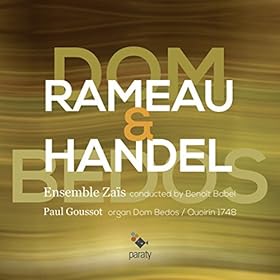 Handel and Rameau are both frustrating composers for organists. Both were very keen organists throughout their life, but Rameau left no organ music, and Handel very little. I have given many organ recitals solely devoted to Handel’s music, but only by drawing on music almost certainly intended for harpsichord. It works well, but I would love to have heard Handel (and Rameau) improvising on the organ. This CD is something of a nod towards that very happening. The unspoken premise of this recording seems to be that Handel and Rameau (born two years apart) meet near the west coast of France (which Handel certainly never ventured even close to) in a church housing one of the largest and most comprehensive French baroque organs ever built – the 1750 Dom Bedos organ of Saint-Croix in Bordeaux. There happens to be an orchestra present. They set about a run-through of some of their pieces, Handel expanding on his Organ Concertos and Rameau transcribing some of his orchestral and harpsichord ensemble works for organ and orchestra. Both improvise at will.

 As a supplement to Margaret Phillips’ 16 CDs of Bach organ works (published as eight double CDs plus this volume), this CD includes alternative versions, pieces usually allocated to but probably not by Bach, pieces not intended for organ, and one piece had not been rediscovered when the other Bach pieces were recorded, between 2005 and 2009. You could fill a further 16 CD with such peripheral and alternative pieces, so the selection of these 16 must have been quite a task. The choice is an excellent one, balancing well-known pieces such with little-known works like the Fantasia duobus subjectis.
  There is a current trend of building CD and concert programmes on collections of pieces made by others, one example being the Marian Consort & Rose Consort of Viols CD ‘An Emerald in a Work of Gold’. The music was drawn from the Robert Dow partbooks, copied in the mid-1580s and now housed in the library of Christ Church, Oxford. As well as being a major source of music of the period (with 134 pieces), Dow’s manuscripts are fine examples of musical calligraphy. The music is indicated as being suitable for voices and viols, so the pairing of the Marian Consort and the Rose Consort is appropriate, the latter providing accompaniment for five solo songs as well as instrumental solos.
  Anon: And I were a maiden, De tous biens plaine, Fortuna desperate; Henry VIII: Helas madame, van Ghizeghem De tous biens plaine; Josquin: De tous biens plaine, attrib. Busnoys: Fortune esperée; Josquin: Fortuna desperate; Penalosa: Vita dulcedo / Agnus Dei II; Agricola: Cecus non iudicat de coloribus; Encina: Triste España; Martini: Des biens amors, La martinella; Josquin: In te Domine speravi; Anon: In te Domine sperabo, La quercia, Biblis; Encina: Fata la parte; Anon: La Spagna; Ponce: La mi sola Laureola; Cornysh: Fa la so; Anchieta: Con amores, la mi madre; Isaac: Agnus Dei II, Josquin: Adieu mes amours.
 Antonio Scandello:
 Wettin, rulers of Saxony, dating from just before 1600. Amongst the many decorative figures and sculptures on the upper levels of the chapel are several depictions of musical instruments. Some years ago, it was discovered that these instruments were not sculptural models, but real, playable, Renaissance instruments, complete with the maker’s signatures. It took many more years before these were properly
  For this 3-CD series of the Biber Rosenkranzsonaten, Anne Schumann and Sebastian Knebel have divided the work into its three sections (the ‘joyful’, ‘sorrowful’ and ‘glorious’ mysteries) and have chosen a different recording venue for each section, based on the organ in each church – a commendable approach, not least because we hear a full size church organ used as a continuo instrument, rather than the silly little box organs so often heard.
  Buxtehude: Sonata in A Major (Op2/5), Praeludium in g (BuxWV 163);
 Bach: Partita No. 3 in E Major, BWV 1006; Cheryl Frances-Hoad: Suite No 1; Eugène Ysaÿe: Sonata for Solo Violin No 2; Gordon Crosse: Orkney Dreaming; Biber: Passacaglia; Piers Hellawell: Balcony Scenes; Cyril Scott: Bumblebees.
 Guerrero: Duo seraphim clamabant, Gloria (Missa Surge propera), Laudate Dominum, Maria Magdalene, Credo (Missa de la batalla escoutez), Vexilla Regis, Agnus Dei (Missa Congratulamini mihi);
 This CD is as much about the instruments as the music. The flute is an 1859 Louis Lot (serial number 435, out of 2150 produced during Lot’s lifetime), and appears to have its own page on social media. Lot’s flutes were based on the Böhm model that became the basis for the modern flute. In 1847, Böhm passed on the patent for his flute to Lot and his partner Godfroy. A device that allowed multiple holes to be opened by one lever allowed the flautist to play in all keys and in a wider range than before. The piano is the (1842) Pleyel in the Finchcocks Musical Museum collection, a modest grand of a type with a light action that was favoured by Chopin for its ability to “translate precisely and faithfully the feeling I want to produce”.
  What a delightful CD. Part of the ’eeemerging’ (Emerging European Ensembles) project led by the Ambronay cultural centre, it selects promising young musicians and helps them set up their careers, including the chance to make their first CD – like this one, from L’Aura Rilucente, a five-strong group formed in 2011 in Milan. Their fascinating programme includes three Trio Sonatas by Nicola Francesco Haym, usually only known (if at all) as the librettist for some of Handel’s operas (for example, Ottone, Flavio, Tamerlano, Rodelinda. Also known as a cellist, Haym’s composing activities have been almost entirely overlooked, so his inclusion on this CD is a real musical service.
  Although generally grouped under the title of the ‘virginalists’, most of the keyboard repertoire of Byrd’s era can be performed authentically on different keyboard instruments, although there are a few pointers towards either the organ (church or domestic) or one of the stringed keyboard instruments (harpsichord, virginal, clavichord). So the combination of harpsichord and organ on this CD is entirely appropriate, although there are one or two occasions when I might question Jean-Luc Ho’s particular choice of instrument. Both instruments were recorded in the Abbey of Saint-Amant-de-Boixe, Charente, France.
 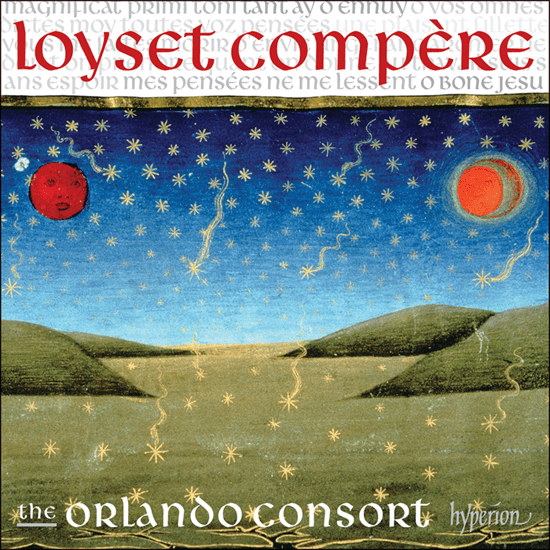 Loyset Compère is not as well-known as he deserves to be, and this recording could be the means by which his (recently re-assessed) place in musical history is acknowledged. The key to the re-assessment is the slightly embarrassing realisation that the Josquin that musicologists assumed to have been born in 1440 was not, in fact, Josquin des Prez, but another Josquin altogether. That makes Josquin des Prez around 10 years younger than thought. Similar birth date realignment concerning Obrecht and Agricola also make them younger than first thought. As David Fallows explains in his comprehensive programme notes, this leaves Loyset Compère as one of the earliest composers in the imitative style, now known to be later developed, rather than instigated, by Josquin and others.
  Andrew Benson-Wilson : Early Music Reviews +