
Dietrich Buxtehude (1637-1707)
Complete Organ Works
Vol 1: Compositions Pedaliter – 18 Praeludia BuxWV 136-153 (Ed. Klaus Beckmann)
120 pages • 23 x 30.5 cm • 455 g • ISMN: 979-0-004-16866-0 • Softbound
Edition Breitkopf EB 6661
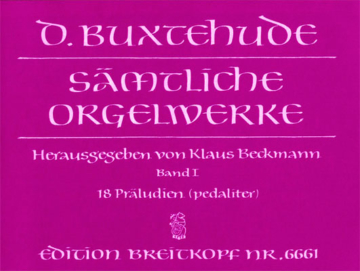 Dietrich Buxtehude holds a special place in the hearts of most organists, although this is occasionally because he is the only pre-Bach German composer that they are aware of. But, despite many years of musicological research and publications, he still remains a somewhat enigmatic composer. There is still no agreement as to his birth date or place, and what his name really was. He seems to have been born in Helsingborg (in present day Sweden, but then part of Denmark) as Diderich, but later changed the spelling from the Danish to a more Germanic Dietrich (or Dieterich). His surname also appears in several versions, including Box de Hude.
Producing modern editions of his organ music is fraught with potential difficulties, not least because no surviving copies of Buxtehude’s autograph copies have been found. Continue reading
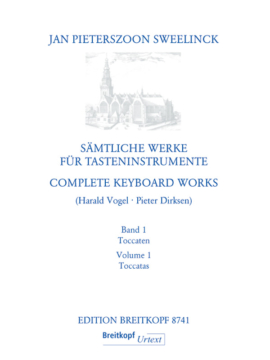 Renaissance period and the start of the Baroque. Born in 1562, he was employed by the city of Amsterdam as organist of the Oude Kerk for 44 years until his death in 1621. Organ music in the Calvanist church was limited to occasional playing of pieces to familiarise the congregation with the choral melodies, before or after the service, but not during. So Sweelinck’s duties as city organist were generally to give concerts for the public and visitors. This have him time to build up an extensive teaching practice, attracting a generation of North German organists who returned to develop the influential Hamburg organ school that dominated the 17th century, culminating in the music Buxtehude in nearby Lübeck. His music was known throughout northern Europe, with two of his pieces includrf within the Fitzwilliam Virginal Book.
 Frescobaldi’s Fiori Musicali was published in 1635. He was at the height of his musical powers, having just returned to Rome (after six years with the Medici’s in Florence) to work for the Barberini Pope and Cardinals, and continued his post as organist of St Peter’s in Rome, a post he had held throughout his many travels. Although many pieces in Frescobaldi’s earlier books of Toccatas (1615/16 and 1627) were clearly intended for organ and would have presumably have been playing in a liturgical setting, Fiori Musicali is his only organ book specifically geared towards use in the Mass. It was his last publication of new music, although he did re-issue some earlier volumes. It quickly became one of his most popular publications, and was used as an exemplar of polyphonic writing well into the 19th century. Bach also studied it and copied it out.
 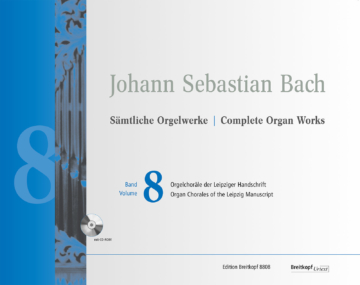 Editions of Bach’s organ works are something of a minefield, even when there are clear autograph scores available. In many cases that is not the case, so the role of the editor and the availability and accuracy of available sources becomes an important consideration. Of all the publishers to be involved in Bach, Breitkopf & Härtel are perhaps the most appropriate. Founded in Leipzig in 1719 four years before Bach took up his post there, they were the first to publish the complete works of Bach, between 1851 and 1900 for the Bach-Gesellschaft. Unfortunately, at the moment, I only have access to one volume of their latest complete Bach Organ Works, so cannot comment on the 10 volume set as a whole.
 The medieval cult of saintly relics has left us with some glorious examples of art, architecture, literature and music. But the studies of historians generally focus on one of first three of these aspects in isolation. This book aims to redress the balance by focussing on the musical aspects but within the context of the rich story of politics, power and influence, the complex history of monasticism and liturgy, and the artistic outpouring that the devotion to relics generated. It covers the period from around the mid-eighth century to the thirteenth in Tuscany. It is an extension of a Yale PhD thesis by musicologist Benjamin Brand.
 With 15 contributors, from Germany, Poland, the United States, Canada, and Australia, it covers the detailed history of the complex world of 15 Germanic Courts, of varying sizes. Many people’s knowledge of such institutions often only comes from the brief background knowledge of Bach’s various tenures in local Courts, before his eventual move to Leipzig. The essays in this book puts Bach’s career into a wider perspective, and one that is relatively little known. The Germanic system of often very small scale princely courts might have made for a complex hierarchy of aristocracy and governance, and some tricky questions of inheritance, but it made for an extraordinary flowering of art and music, as each little domain tried to outdo its neighbour.
 Andrew Parrott is one of the leading members of a particularly influential generation of musician/scholars who founded performing groups in the 1970s: in his case, the Taverner Consort, Choir and Players, founded in 1973 . They changed the way that we think about, perform, and listen to, ‘early’ music. Unlike many conductors who cut their teeth in the world of period performance, Andrew Parrott has retained his strong research interests, notably around the music of Bach and Monteverdi. Perhaps best known for his book, The Essential Bach Choir (published in 2000), an expansion of the theories of Joshua Rifkin that Bach’s choirs were essentially performing as one to a part, Parrott remains an essential component of the early music world. Hence the importance of his latest book: Composers’ Intentions? Lost Traditions of Musical Performance.
 Andrew Benson-Wilson : Early Music Reviews +