Gambarini: English Impresaria
Academy of Ancient Music, Bojan Čičić, Mhairi Lawson
Milton Court. 15 March 2026
Handel: Judas Maccabaeus: Overture; Pious orgies; Come, ever-smiling liberty; March. Occasional Oratorio: O liberty. Joseph and his Brethren: Prophetic raptures
Gambarini (arr. Rachel Stroud): Orchestrated music from Op. 1;
Behold and Listen; Se mai fosse la mia forte; Minuet in A major
Geminiani: Concerto Grosso Op.7 No. 6
Tessarini: Ouverture in D major, Op. 4 La Stravaganza; Violin Concerto, Op. 1 No. 7
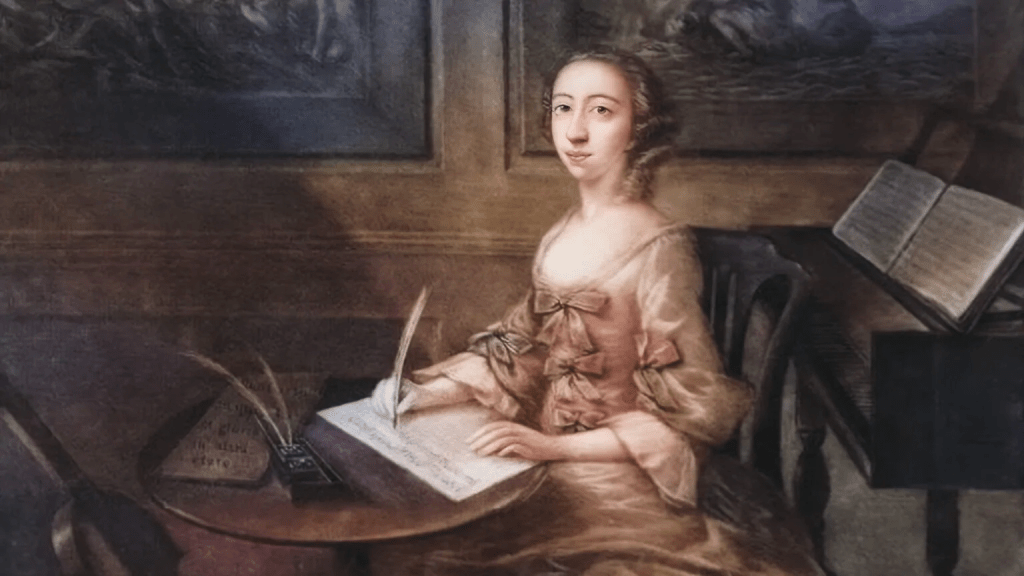
The search for little-known female composers has been the focus of many concerts in recent years, and Elisabetta de Gambarini (1731- 1765) deserves discovery, helped by this concert from the Academy of Ancient Music put together by the AAM’s resident Research Fellow. She was prominent in 18th-century England as a composer, singer, and harpsichordist. Her career started aged just 16 when she sang in Handel’s Occasional Oratorio. That clearly went well, because Handel then selected her for Judas Maccabaeus (as the Israelite Woman) and Joseph and his Brethren and, seemingly, also for Samson and Messiah.
Born in London to aristocratic Italian and Dalmatian parents, her father a diplomat and art collector, her mother a singer. Her musical education is obscure, although, alongside her mother, Geminiani is a possible early influence. Around the time of her Handelian singing debut, she published two sets of Lessons for the Harpsichord, the second also including songs in English and Italian, becoming, arguably, the first female British composer to publish a collection of keyboard music. Other unpublished works include an organ concerto, apparently performed shortly before her early death.
Her background gave her access to the higher echelons of British society, as evidenced by the dedications of her 1748 Opus 1 (published aged 18) to “The Right Honourable The Lady Viscountess Howe of the Kingdom of Ireland” and her Opus 2, later the same year, to “Frederick, Prince of Wales”. That access also seems to have encouraged her to start organising her own concerts, starting with her first benefit concert in March 1748 in London’s Haymarket Theatre, where she promised new vocal works and two new organ pieces. Her life ended tragically when, in 1764, just months after her marriage to Étienne Chazell, Master of the Horse to the French ambassador, there were reports of serious assaults by her husband. He eventually fled the country under diplomatic privilege during an arrest attempt at the ambassador’s residence. She died shortly afterwards while giving birth to Chazell’s baby daughter. There is far more information about her to be found on the internet, including the scores of her Opus 1 and 2 publications.
She was worth the attention that AAM gave her but, although the concert was well-performed, it fell short of the usual AAM standards in terms of research and concert planning. A confusing programme note opened with a paragraph in bold text all about Gambarini’s mother! The description of the pieces was in a seemingly random order that bore no relation to the order of the pieces played – I am sure that this does not only irritate reviewers. There was only one piece that was played in the manner in which Gambarini’s music was published and likely performed, a Minuet and Variations, played, as intended, as a harpsichord solo by Christopher Bucknall.
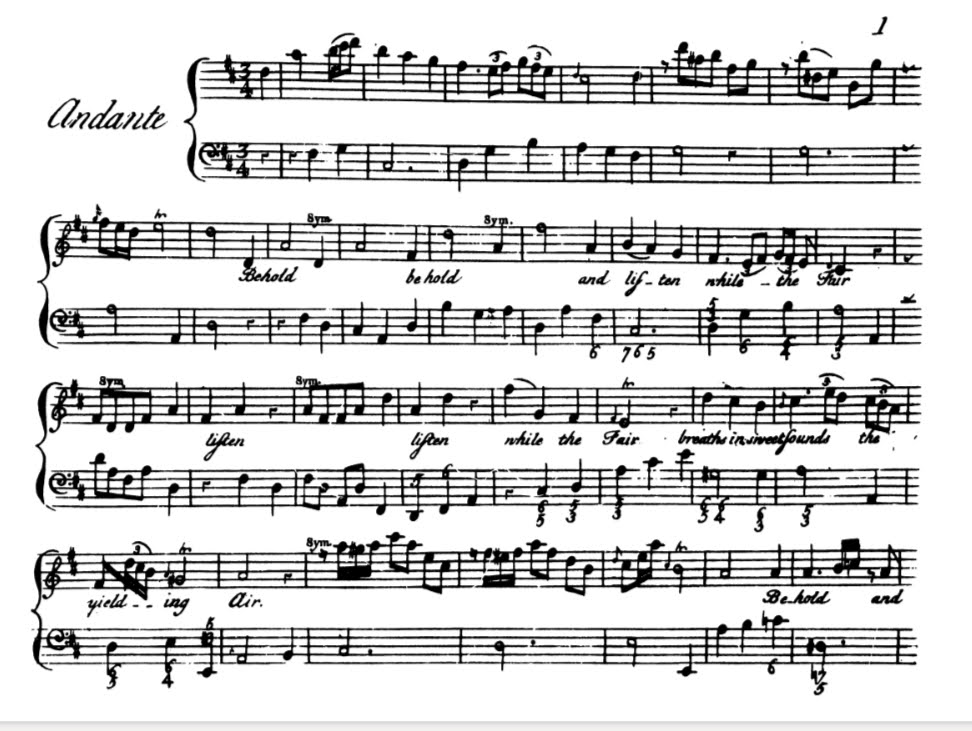
Rachel Stroud was invited to arrange the other Gambarini harpsichord pieces and songs for orchestra. She achieved that very effectively, turning the typical two-part 18th-century bass and treble harpsichord pieces into far more complex orchestral textures. However, I wasn’t convinced by the reason given for requesting the orchestration. The programme note suggests that the scores indicate “where orchestral interludes might have been present”. There is only one piece in Opus 2 that could possibly be interpreted as suggesting an orchestral interlude, and I am not convinced that is what it indicates (see score below). The piece was written for harpsichord and singer: presumably, Gambarini herself. The vocal line and the harpsichord treble line use the same stave, so I wonder if the ‘Sym’ marking merely shows where the harpsichord takes over the treble line on the upper stave. The use of continuo figures in this, and many other pieces, shows a similar scorewriting shorthand.
Unfortunately, although I accept this was a tricky composer to reflect in an orchestral concert, there were other concerns, one being the assumption that a full-sized 18th-century orchestra would have been at Gambarini’s aristocratic musical soirées. I have not found any real evidence for that, and the programme note did not offer any, other than a passing reference to unspecified “concert advertisements”. The programme note also suggests that Gambarini’s concerts were “the first mention of a woman playing the organ in public in Britain”. I am not convinced that this is true, as there are references to a female organist appointed in 1699 in Hertfordshire, and a reference to a Mrs Hussey, organist at St. Mildred, Bread Street, London in 1747. The claim that she was the first woman to publish music under her own name in Britain doesn’t take acount of Mary Harvey (Lady Dering, 1629–1704) who died around 30 years before Gambarini’s birth.
Of the non-Garbarine instrumental pieces, I found Geminiani’s Concerto Grosso in B-flat major No.6 Op.7 rather confusing, not least because the programme note gave a bizarre set of movements which bore little relationship to what we were hearing, notably having the Presto final section marked as “Adagio”! The exaggerated pauses between the 14 sections also lost any sense of momentum and programme. To top all that, I found the soprano (Gambarini was apparently a mezzo) soloist’s over-exaggerated diction (she opened with Handel’s “Pious orrrrgies, pious airrrrs!”, continuous strong vibrato, and very strong Scottish accent all rather distracting and, I suggest, a far cry from Gambarini’s likely vocal style.
That said, and to finish on a more positive note, there was some fine instrumental playing, notably from the AAM leader Bojan Čičić, along with fellow violinist Persephone Gibbs, together with Jane Rogers, viola, Gavin Kibble, cello, Philip Turbett, bassoon and Christopher Bucknall playing harpsichord and organ.
 Andrew Benson-Wilson : Early Music Reviews +