
Gleann Ciùin
Claire M Singer, LCO
Queen Elizabeth Hall, 7 December 2025
Solas; Ode to Saor;
56.9500° N, 3.2667° W; Maps; 57.0908° N, 3.6939° W;
Forrig; Gleann Ciùin.
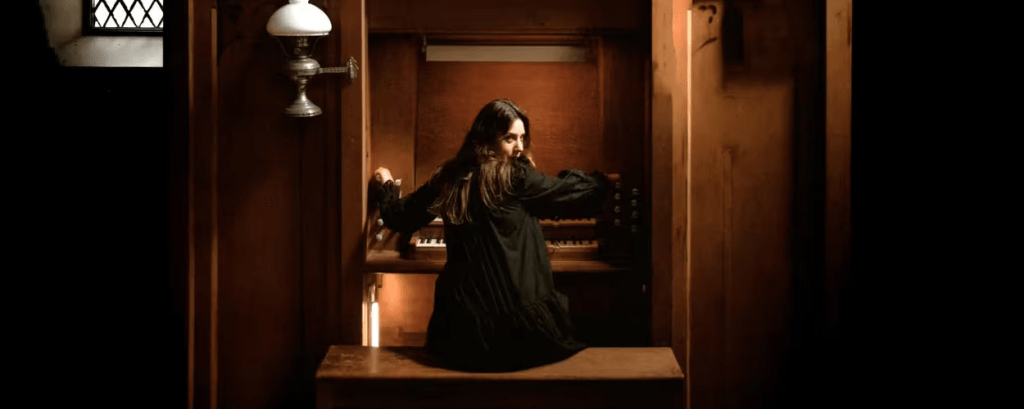
Claire M Singer is a Scottish composer, cellist and performer of acoustic and electronic music who “draws inspiration from the dramatic landscape of her native Scotland, exploring rich harmonic textures and complex overtones that create ever-shifting melodic and rhythmic patterns disappearing almost as soon as they emerge”. Although she had previously composed some pieces for organists, her own introduction to the organ world came in her imaginative appointment in 2012 as music director at the Union Chapel, an enormous Congregational church and events venue in Islington, and home to a famous 1877 ‘Father’ Willis organ. She has since managed a major restoration of the organ and an impressive series of organ-related events, not least curating the annual Organ Reframed festival, focused on encouraging experimental music based on the organ. This event at the Queen Elizabeth Hall featured music from three of her five CDs (Solas, Saor and Gleann Ciùin), played on the Queen Elizabeth Hall organ with added electronics and orchestrations played by members of the London Contemporary Orchestra.
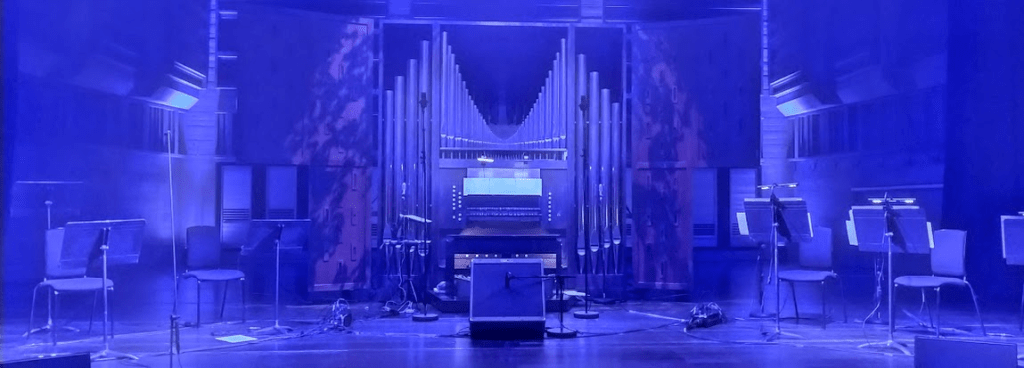
It was about as far from the usual organ recital as you can get. A very different type of audience sat in respectful darkness and silence, facing the gloomily lit stage. At the centre was the rarely seen Queen Elizabeth Hall organ, normally hidden away in a garage-like structure below the stage, and only elevated onto the stage when needed. It was built for the opening of the hall in 1967 by the influential Dutch firm of Flentrop to a specification by Ralph Downes in the radical emerging neoclassical style. It was intended for the performance of music by the likes of Bach and Handel, but although revolutionary at the time, the UK early music world soon adopted more historically informed performance practices, which the organ wasn’t able to keep up with. It was restored in 2019 by Manders as part of the refurbishment of the QEH. Critically, from Claire M Singer’s point of view, it has an entirely mechanical key and stop action (unlike the large concert organ in the Royal Festival Hall next door), allowing the subtle manipulation of the stops that is a hallmark of her musical interpretations on the organ.
Most of her pieces follow a similar pattern, with a few notes held down on the organ keyboards by what looks like chopsticks while single stops are very slowly pulled out, allowing precisely controlled amounts of air to enter the pipes. Until each stop is fully pulled out, the pipe will not sound at its correct pitch or timbre. Partially drawn stops produce ethereal sounds, full of internal movement and flux. On top of this extraordinary soundscape, various minimalist melodic lines and structural interventions slowly become apparent, as the tension and volume slowly increase before subsiding into the final delicate sounds of the slow shutting off of the air to the pipes. At times, it reminded me of my youth, listening to the more ethereal of Pink Floyd pieces in my pre-headphone days, lying on the floor between two large speakers.
In this performance, the sound of the organ was enhanced by the orchestral group of four cellos, two violins and two horns, appearing in various combinations. Additional electronic sounds, controlled by Claire from a laptop next to the organ, were added to most of the pieces, and were also the source of two pre-recorded short atmospheric soundscapes based on specific locations, whose grid references form their titles, in Claire’s beloved Scotland.

The concluding piece, Gleann Ciùin (The Quiet Glen), is the title track from Claire’s latest CD, which reflects her “journeys across the vast landscapes and weathered peaks of the Cairngorms in Aberdeenshire”. It was specially commissioned for the Queen Elizabeth Hall’s organ after its restoration in 2019. It was nominated for an Ivor Novello Award in 2020. A detailed review of this piece from that performance can be found here.
The sizeable audience was clearly moved by the music and the atmosphere, aided by variations in lighting. Since its use in Roman gladiatorial contests more than 2000 years ago, through its various secular and sacred incarnations, the organ has always been a superb sound synthesiser, capable of producing a kaleidoscope of sounds from imaginatively constructed pipes, most based on reproducing the sounds of other musical instruments. A new generation of young composers and performers like Claire are bringing the sounds of the organ to a very welcome wider audience.
For more information on Claire M Singer’s background and approach to composition, see this link to an informative Q&A session. For a very visual example of the way she manipulates the sound of the organ, see this video of her performing the nearly nine-minute-long piece, Forrig, at the Union Chapel in 2020. Links to her CDs can be found here.
 Andrew Benson-Wilson : Early Music Reviews +