Laus Polyphoniae 2024
“VOX\VOCES, monophonic\polyphonic”
Antwerp, Flanders
23 August – 1 September 2024

Antwerp’s annual Laus Polyphoniae festival, as the name suggests, is devoted to music from the late Middle Ages and Renaissance, a period when polyphony was paramount. This year’s festival had the banner of VOX\VOCES, monophonic\polyphonic reflecting an investigation of links between monophonic and polyphonic music during the period. As usual, it was organised by AMUZ (Flanders Festival Antwerp) from its base centred around the baroque St. Augustine Church in the centre of Antwerp. An introductory essay to the festival and clickable details of all the events can be found here. The festival lasted for 11 days, but I was only able to review the first four days. which included the International Young Artist’s Presentation (IYAP) on the first Saturday, reviewed here.
The festival opened on Friday 23 August in the magnificent St-Pauluskerk with the British vocal group Stile Antico, and regular Laus Polyphoniae favourites. Their programme focussed on the Missa Ave virgo sanctissima, the only surviving complete work by the Flemish composer Géry de Ghersem (1573-1630), together with motets by his contemporary, Philippe Rogier. This Mass was published in Madrid in 1598 as the conclusion of Philippe Rogier’s Book of Masses. Practically all of the rest of Ghersem’s music was lost in the 1755 Lisbon earthquake and fire. The Missa Ave virgo sanctissima is a seven-part mass, based on Francisco Guerrero’s five-part motet Ave virgo sanctissima, which opened their concert, the dense five-part polyphonic texture being a mere hors d’oeuvre for the polyphony to come from Ghersem. Whilst Guerrero’s motet uses a two-in-one unison canon between the two upper voices, Ghersem adds two more voices and uses a three-in-one canon, with many changes of canon intervals, distances and voices, the resulting seven-voice texture reflecting devotion to Mary.

St-Pauluskerk
Both Philippe Rogier’s and Géry de Ghersem’s polyphonic textures were densely integrated, with only occasional moments when the texture reduced. Rogier’s motets gave more scope for more expressive textures than the Mass setting, his short double-choir Regina caeli, the slowly unfolding textures of Caligaverunt oculi mei and the lively concluding Cantantibus organis with its bell-like passages being particularly impressive. Stile Antico sang with their characteristically extraordinary cohesion of voices, essential for the clarity of the seven-voice texture of the Ghersom Mass. Arranged, as usual, with no director in a circle in the centre of the church, the different voices in a mixed order around the circle, their clear and unforced voices (expanded from 12 to 13 for this repertoire) clearly impressed the capacity audience in the enormous St-Pauluskerk, with its organ case designed in Ruben’s workshop.

St-Pauluskerk: organ case from Ruben’s workshop
The following day (Saturday 24 August) saw six young ensembles take part in the annual International Young Artist’s Presentation (IYAP), the annual coaching and presentation scheme promoted by AMUZ and the Musica Impulscentrum to help promising young musicians “grow into tomorrow’s stars”. The six IYAP concerts are reviewed here.

Copy of a late 15th-century positive organ and Apfelregal based on a 1506 woodcut
The two Saturday evening concerts included references to three pioneering organists, the first two being Paul Hofhaimer (1459–1537) and Hans Buchner (1483–1538), followed (in theory at least) by the blind medieval organist and composer Francesco Landini (c1330-1397), in his time the most famous composer in Italy. Paul Hofhaimer and Hans Buchner featured, in improvisatory form, in the St.-Pauluskerk performance of Heinrich Isaac’s Missa Paschalis ‘ad organum’ by Cappella Pratensis with organist Wim Diepenhorst playing a copy of a late 15th-century positive organ and an Apfelregal based on a 1506 woodcut (pictured above – part of the instrument collection of the Alamire Foundation in Leuven). The much-travelled Franco-Flemish composer Heinrich Isaac was born in Flanders around 1450, but soon caught the attention of the Habsburg Maximillian I who, after his marriage to Mary of Burgundy, became enamoured with the music of the Burgundian Netherlands.
Settling in Innsbruck, Maximillian added Issac to his chapel alongside Hofhaimer. Isaac and Hofhaimer attended the 1507 Imperial Diet in Constance, where Maximilian announced himself Emperor of Austria, Burgundy and Spain – an imposing occasion. Hofhaimer’s former pupil Hans Buchner was the Constance cathedral organist where, incidentally, the 1521 case of the organ he designed still remains (pictured).

Constance Cathedral: Buchner’s 1521 organ case
Isaac was commissioned by Constance Cathedral to compose a set of Mass Propers compiled in the Choralis Constantinus, along with more than 375 polyphonic motets. Cappella Pratensis combined Isaac’s Easter Missa Paschalis ‘ad organum’ with motets from the Constance Cathedral collection, with Wim Diepenhorst improvising alternatim organ versets based on the chant melodies, as might have been performed by Hofhaimer but, on this occasion, based on improvisation advice in Buchner’s Fundamentbuch treatise. I wasn’t close enough to the organs to see if Wim Diepenhorst used any of Buchner’s rather awkward fingering suggestions, but didn’t hear any of the equally awkward-sounding ornaments that he recommends in his treatise. The use of the two organs made for an interesting contrast in colour, notably in the concluding Ite missa est when the organs and singers combined for the first time. As usual, the singers gathered around a large revolving monk-style music desk. It was directed by Stratton Bull in what I learnt afterwards was his last concert as artistic director of Cappella Pratensis, which explained the standing ovation he received at the end.
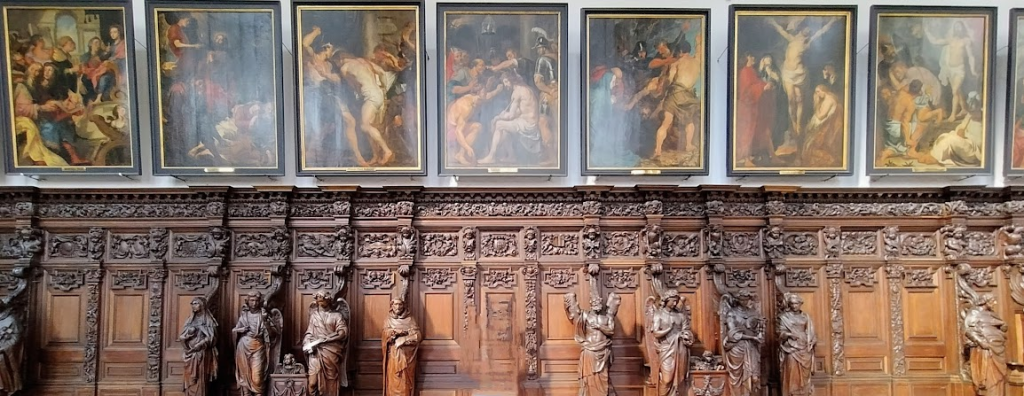
St-Pauluskerk
The late-night concert started at 22:15, more than 12 hours after my first concert of the day, so perhaps my musical antennae were beginning to wilt but the concert by the Sollazzo Ensemble of Francesco Landini: The sweet view left me cold and frustrated. Childhood smallpox left Landini blind, but he became a famed organist and composer – his memorial in Florence shows him playing the portative. Although this concert did include a portative organ, it was a particularly undistinguished example and was never used in a solo role, merely as a supporting and rather indistinct voice alongside a harp and vielle. The most lively bit of portative playing came in the one piece not by Landini, and then only as an accompaniment to the vielle. The speech of the portative was indistinct, not helped by not being given enough wind for the pipes to sound properly. This resulted in the notes oozing into speech and pitch instability. There was also no real structure to the programme, with songs merging into each other and the text so indistinct that it was difficult to work out which piece was which.
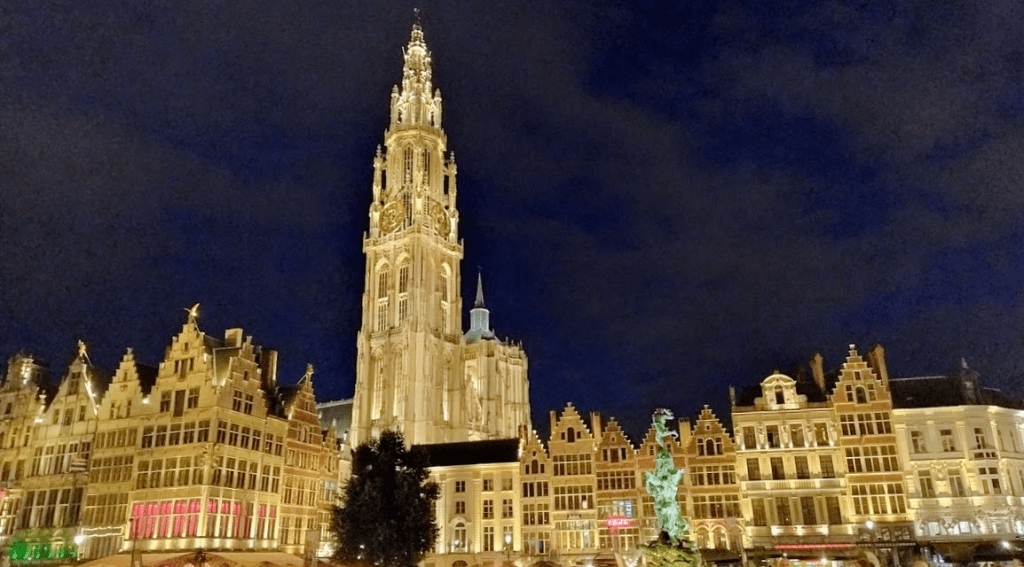
Antwerp Catherdal and Grote Markt
I felt much more positive at the first of the Sunday evening concert with PER-SONAT‘s concert of polyphonic hymns from the 12th-century Codex Calixtinus and improvisations in the style of the late 9th-century Codex Musica Enchiriadis (a handbook for singers and one of the earliest sources of polyphony) under the title of St James: Songs for Santiago de Compostela. The sound of the nine little bells reverberating around the vast acoustic of the St-Pauluskerk was an evocative start to the concert although, sadly the bells were then left more-or-less in silence. The eight singers were supported by two vielles, the larger one played ‘cello-style’ by Elizabeth Rumsey with smaller treble ones played from the shoulder by Elizabeth Sommers, the latter making a significant contribution to the success of the concert by her exquisite and imaginatively improvisatory playing, including two solo moments. The vocal pieces were well structured, showing the development of early polyphony ranging from the simple addition of an upper voice to a chant melody to more rhythmically and musically advanced examples.

St-Pauluskerk
The Sunday late-night concert at AMUZ was given by the Boreas Quartett Bremen with Dorothee Mields and their programme Basevi codex: Motets and Songs from Alamire’s Smallest Manuscript. There is a tradition in Laus Polyphoniae for performers to be given a small gift at the end of their concert. This year it was a bar of Antwerp chocolate, but in 2015 it was a facsimile of the 16th-century Basevi Codex, originally published by the famous Antwerp printing workshop of Petrus Alamire. It contained music from the court of Margaret of Austria, regent of the Habsburg Netherlands, in Mechelen (her Palace is pictured below).

Palace of Margaret of Austria, Mechelen
Inspired by their gift of a copy of the Basevi codex, the Boreas Quartett Bremen gave an excellent concert based on music from this 16th-century manuscript. The four recorders (of sensible size for late-night listening) played in exquisite consort, adjusting their volume to suit the lowest, and quietest, recorder. Similarly, soprano Dorothee Mields moulded her voice into the texture of the recorder quartet. Their programme included instrumental and vocal music by Johannes Ghiselin, Pierre de la Rue, Jacob Obrecht, Loyset Compère, Antoine Brumel, Johannes Ockeghem, Ninot le Petit, Alexander Agricola, Johann Prioris and Heinrich Isaac – his La mi la sol, the repetitive nature of the text made up for by some energetic recorder playing.

Antwerp Catherdal: west porch
My last event of the festival was the Monday lunchtime concert in AMUZ by the five voices of the Antwerp-based Utopia Ensemble and their performance of Jacobus Vaet’s Missa Quodlibetica alongside motets and chansons by Barbion, Maessins, non-Papa and Gombert. The best-known quodlibet is, of course, the final variation of Bach’s Goldberg Variations. But there are also seven masses with the title ‘Quodlibetica’., the first being by Jacobus Vaet, Maximilian II’s maestro di cappella. His Missa Quodlibetica is a potpourri of melodies that has so far escaped identification but are assumed to date back to his youth. Judging by the pieces by Gombert and Lassus they were among Vaet’s musical influences, with a smooth closely integrated polyphonic texture with only occasional homophonic passages and reductions in the number of voices and a generally syllabic text underlay which made for relatively compact sections of the Mass. Interesting pieces alongside the Vaet Missa Quodlibetica included the Quicquid appositum / Gloria tibi Domine by Pieter Maessens and the concluding Tibi Laus by Lassus with its beautifully expansive o beata Trinitas final phrase.
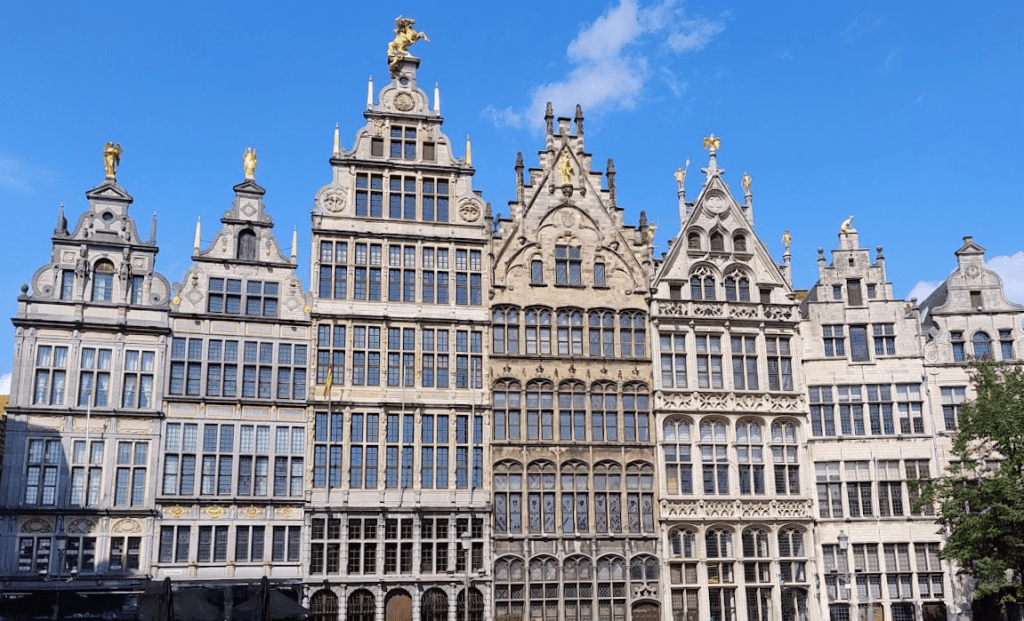
Antwerp Grote Markt
For some of the festival concerts there were online concert introductions which can be viewed here. Three of the concerts from later in the week were live-streamed and can be viewed here until September 30.
… Huelgas Ensemble – Blasius Amon: Missa Pro defunctis
… Profeti della Quinta – Emilio de’ Cavalieri: Lamentationes Hieremiae prophetae
… Sollazzo Ensemble – Cantano gli angeli
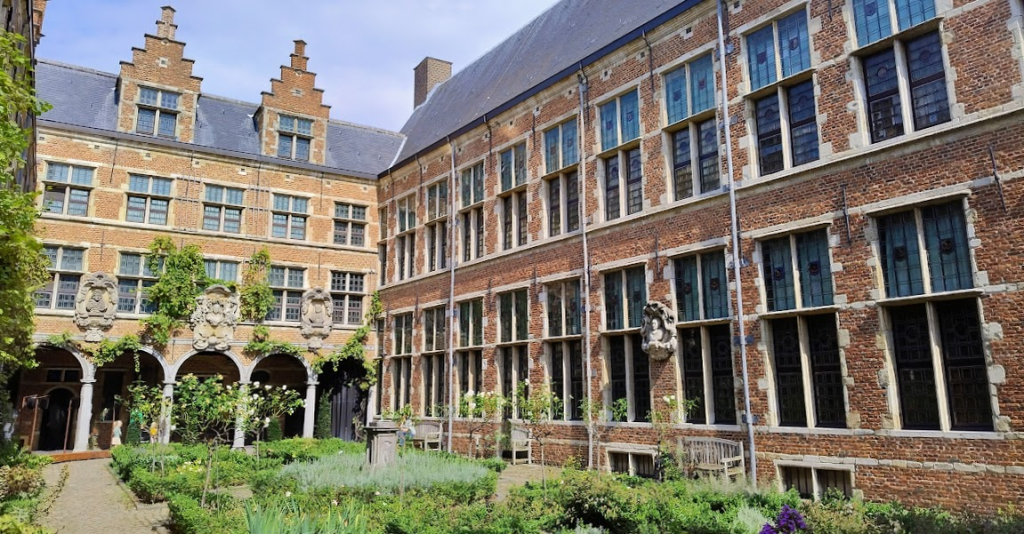
Plantin-Moretus Museum
The Alamire Foundation, the International Study Centre for Music in the Low Countries, created two sound installations during the festival. The first was Silentii in the garden courtyard of the Plantin-Moretus Museum, with Gregorian music from five loudspeakers each with one voice providing “soothing monophonic music that invites one to pause for a moment, to reflect or to relax”. The second installation was Gaudi in the cloister of St-Pauluskerk. This was based on the processional song Gaude redempta by Guillaume Du Fay.
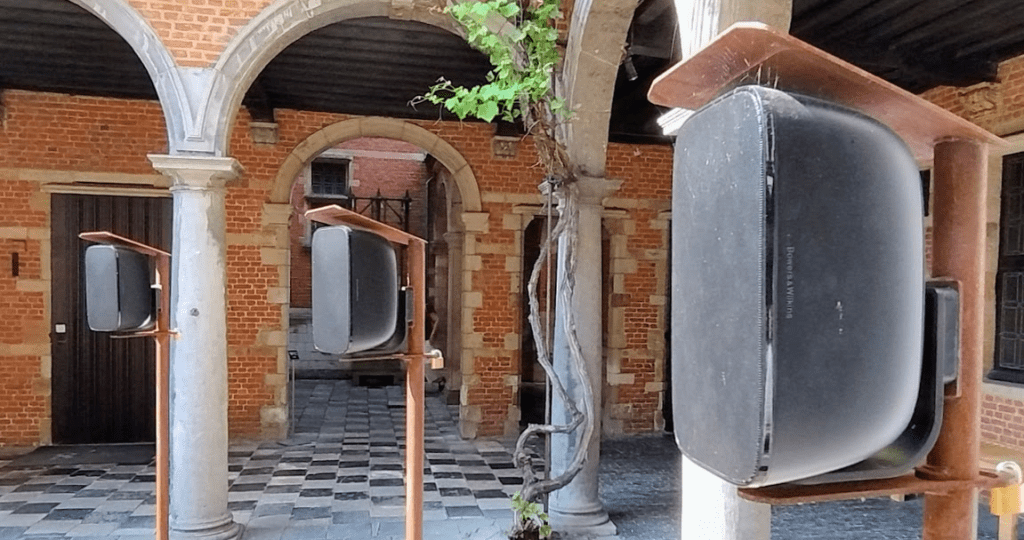
Silentii speakers in the Plantin-Moretus Museum courtyard garden
Each festival is accompanied by a lavish book with the complete programme and supporting essays. Past editions can be accessed here.
Next year’s festival, Laus Polyphoniae 2025 is from Friday 22-31 August 2025, with the title of “Polyphony from the time of the Cathedral builders 1140-1440”. In the meantime, AMUZ continues with its year-round programme of concerts and event, details here.

 Andrew Benson-Wilson : Early Music Reviews +