
BBC Proms: Bach’s St John Passion
Bach Collegium Japan, Masaaki Suzuki
Royal Albert Hall, 19 August 2024

Bach’s Passio secundum Joannem, the St John Passion, was first performed on 7 April 1724 during the Good Friday Vespers at the Nicholaskirche in Leipzig, a last-minute change from the originally planned Thomaskirche. It was less than a year since he took up the post of Thomaskantor, a post that, infamously, had been first offered to both Telemann and Graupner who both turned the offers down. The 300th anniversary of the first performance was one of several anniversaries celebrated during this year’s BBC Proms at the Royal Albert Hall. It was first performed complete at the Proms in 1967, although extracts had been incorporated into the popular ‘Bach Wednesdays’ since 1924.
Proms audiences, both live and via Radio 3, should now be used to hearing moderately-sized period performances of Bach and his ilk in the vast acoustics of the Royal Festival Hall, but it still raises issues, despite the improved acoustics of the space. If you heard it live in the hall, it is worth hearing it again on BBC Sounds for a more focused aural experience. I am not always complimentary about the technical aspects of live BBC Proms recordings, but this one is impressive. The performers were the well-known Bach Collegium Japan and their director Masaaki Suzuki who founded BCJ in 1990 as a way of introducing Japanese audiences to European Baroque music performed on period instruments and largely featuring Japanese musicians. He celebrates his own 70th anniversary this year. They are regular visitors to the Proms and are well-known worldwide for their regular tours and extensive Bach recordings.

Masaaki Suzuki’s musical approach was well represented in this performance, his meticulous and sensitive approach to detail taking precedence over any overtly dramatic gestures. That said, there were moments of real drama in the unfolding text, more apparent in the recording than live, although several moments of possible dramatic interpretation were passed by. The 36-bar orchestral introduction to the opening chorus Herr, unser Herrscher always, for me at least, sets the tone of the whole performance. Keeping the separate instrumental strands distinct, Suzuki’s powerful interpretation emphasized the rhythmic structure of the music, helped by an enormous contrabassoon (at c3m tall, it was made more impressive by being positioned on top of a chair) punching out the two-to-a-bar beat while the murmuring strings underlie a pair of harmonically-intense slow moving oboes.
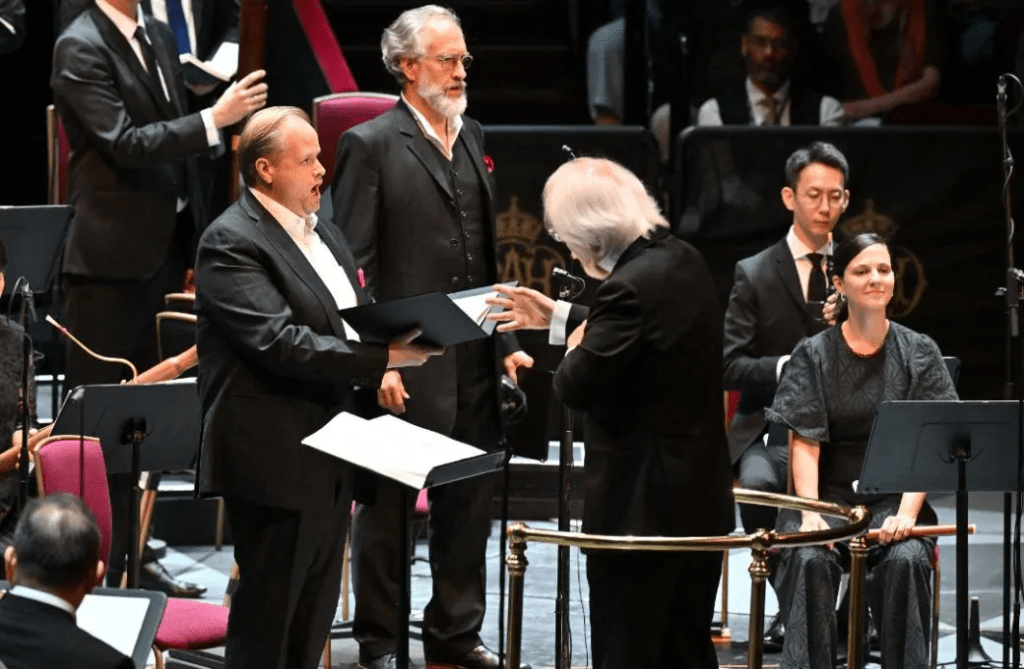
The recitatives were led by Benjamin Bruns as the Evangelist and Christian Immler as Jesus and bass soloist, pictures above. The opening sequence has such delights as the words Facheln, Lampen und mit Waffen (torches, lamps, and weapons) which Bruns delivered with due emphasis, his flexible range of tempos giving meaning to the often impenetrable (at least to me) text. His harmonically tortured conclusion of Da verleugenete Petrus exquisitly reflected Peter bitter tears after his triple denial of Jesus. Christian Immler’s bass gave suitable gravitas to Jesus’s utterances, although his lowest notes were a bit subdued. Yusuke Watanabe’s prominent role in Part 2 as Pilate was impressive, although standing at the back at the end of the shallow circle of chorus singers behind the orchestra, there was no chance of any real visual dialogue with Jesus, standing with the Evangelist at the front. Only once did I spot Jesus turning to look at Pilot during their debate, an element of visual drama that was lacking throughout this rather cerebral performance.
The other soloists Carolyn Sampson (soprano), Alexander Chance (counter-tenor) and Shimon Yoshida (tenor) all excelled, although Carolyn Sampson (a regular at the Proms, pictured below), who started her impressive career as an outstanding early music singer, now has a very much wider range of repertoire and has developed a noticeable vibrato. Alexander Chance impressed with his beautifully stable and clear counter-tenor voice with some fine ornaments. His Es ist vollbracht! was heart-wrenching. The other two subsidiary characters of the Maid, and Petrus, singing from the choir, also impressed. The 20-strong choir (which included the principal soprano, counter-tenor and tenor soloists) stood in a wide shallow arc, giving a stereo spread that was more apparent in the hall than on the recording. Their singing, in a slightly detached style, helped project the notes to the vast audience with impressive clarity. They caught the contrasting moods well, notably in the turbo chorus in the more dramatic moments of Part 2 symmetrically positioned around the chorale Durch dein Gefängnis, Gottes Sohn.

Key instrumental moments came from Ryo Terakado and Yukie Yamaguchi, violins (but muted violins rather than violas d’amore in Betrachte, meine Seel), Emmanuel Balssa and Toru Yamamoto, viola da gamba and cellos, Yoko Tsunta and Raquel Martorell Dorta, flutes, and Masamitsu San’nomiya and Go Arai, oboes and oboes da caccia. The layout of the orchestral players was slightly unusual with the strings in descending order to the left of the group and the pairs of flutes and oboes at the front right, where the 2nd violins are generally placed. From my seat, this gave the oboes rather more prominence than is apparent in the recording.

I recommend listening to the excellent BBC Radio 3 interval talk, in which the organist, harpsichordist, conductor, and researcher Joseph McHardy discusses with Hannah French the musical, historical, and cultural background of St John Passion. It starts 38 minutes into the broadcast.

Performance photos ©BBC | Mark Allan
The top and tail photos (©ABW) are from the facade of the former
Royal College of Organists building next to the Royal Albert Hall.
 Andrew Benson-Wilson : Early Music Reviews +