
York Early Music International Young Artists Competition 2024
National Centre for Early Music
York, 13 July 2024

Founded in 1985, the biennial York Early Music International Young Artists Competition takes place in the National Centre for Early Music (NCEM) in the former church of St Margaret’s, Walmgate in York. As usual, it formed the conclusion of the annual York Early Music Festival. The competition is open to ensembles with at least three members aged 36 years or under with an average age of 32 or less. The repertory must be from the Middle Ages to the nineteenth century, and performers must use historically informed playing techniques, instruments and stylistic conventions.
This year, nine ensembles were selected by the Festival’s Artistic Advisors based on audio recordings but one, the Swiss-based ensemble BREZZA had to withdraw before the final. As usual, the two days before the final featured informal recitals under the guidance of conductor and keyboard player Steven Devine. These informal recitals allow finalists to adapt to the performance space and get to know the audience before the competition final. The Competition final takes place before an international jury (on this occasion Bart Demuyt, Philip Hobbs, Elizabeth Kenny, Lionel Meunier and Emily Worthington) with an audience that includes representatives of the broadcasting, recording, festival and music promotion worlds. It is a key opportunity to identify new and promising young talent.
The final was broadcast live on the NCEM YouTube channel, and can be viewed here – there is also a link to the detailed programme for the final. The final was also recorded by BBC Radio 3, and highlights will be broadcast on the Early Music Show on 3 November and will be available afterwards on BBC Sounds.

The first group to appear were TRIO ALTIZANS (Eriko Nagayama violin, Antonio Pellegrino violoncello, Agata Sorotokin fortepiano) from The Netherlands. They formed in 2023 after meeting at the La Risonanza Early Music Festival in Bertinoro, Italy, and concentrate on the classical and early romantic repertoire. Their programme ‘GEISTER MEDLEY’ contrasted single movements from Beethoven and Schubert Piano Trios using the NCEM’s 1820 Viennese fortepiano. The wonderfully eerie sotto voce opening of the Largo assai ed espressivo from Beethoven’s 5th Piano Trio in D, Op70/1 (The Ghost) made for an ideal start to the day-long competition, attuning the ears to the acoustics of the space with its barely perceptible sounds. They contrasted this with the jovial concluding Allegro moderato from Schubert’s 2nd Piano Trio, in E flat, D929, based on a range of themes including a Swedish folk song. They kept the momentum going well during Schubert’s rather rhapsodic structure in a thoughtful interpretation. I am not a string player nor an expert on this period of music, but I was interested in their prominent use of portamento (sliding between notes) in both pieces.

They were followed by ENSEMBLE BASTION from Switzerland (Maruša Brezavšček recorder, Martin Jantzen viola da gamba, Elias Conrad theorbo and guitar and Mélanie Flores harpsichord) who met, as so many early music groups do, at the Schola Cantorum Basiliensis. Their programme was called LES GOÛTS RÉUNIS: THE UNITED MUSICAL TASTES, taking its name from the collection of suites by François Couperin that reflected the rivalry between the music of Italy and France. They opened with Couperin’s little Échos from his Concerts Royaux followed by a fascinating version of Corelli’s Sonata IV in F, Op5 with added Italian-style ornaments by the Swedish composer John Helmich Roman. They played part of the first movement without ornaments, before restarting with the ornamented version. They closed with the French, Italian and Polish-inspired style of the German Telemann’s Sonata a Flute Dolce, Dessus de Viole e Basse, TWV 42:C2, the last two pieces featuring impressive virtuoso moments from Maruša Brezavšček on recorder and Martin Jantzen playing bass and treble violas da gamba. They built a good rapport with the audience, and I liked the way that Maruša Brezavšček performed sitting down, creating an attractive collegiate feel for the group.

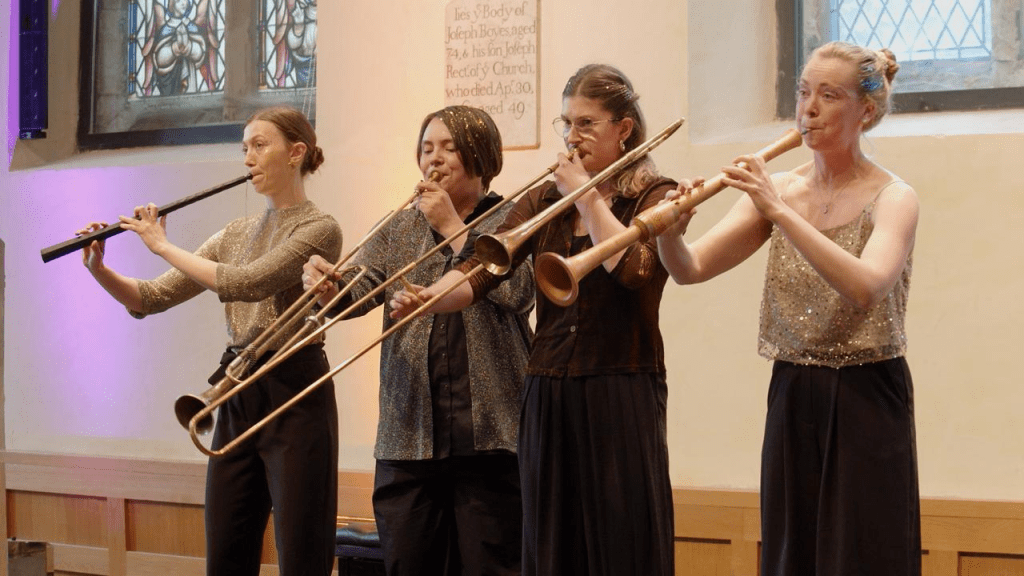
[HANSE]PFEYFFEREY from Germany (Laura Dümpelmann shawms, Lilli Pätzold cornetto, Alexandra Mikheeva slide trumpet and trombone and Emily Saville trombone) are a Renaissance wind band specializing in music (improvised and rediscovered) from the period around 1500. They have been active in and around Bremen and Magdeburg since 2020, initiating concerts as well as educational programmes for children. Their programme had the catchy title of PARTY LIKE IT’S 1524 and featured music by Senfle, Issac and Busnoys alongside improvisations and pieces that they have reconstructed. They made good use of the space on the wide stage, forming different groupings between pieces. Their spoken introductions were good humoured (including a reference to a piece based on an elderly man who was “loosing faith in his equipement”) and they coped well with the plumbing complications of their instruments.
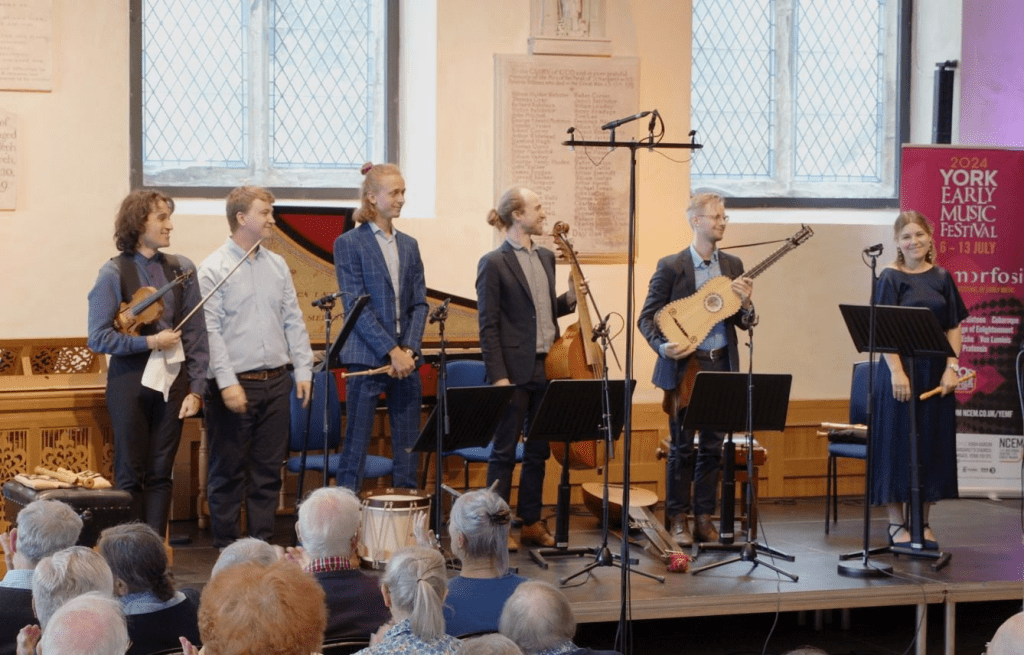
The UK based APOLLO’S CABINET (Teresa Wrann recorder, Thomas Pickering harpsichord, organ, traverso and recorder, David Lopez Ibanez violin, Harry Buckoke viola da gamba, Jonatan Bougt theorbo and baroque guitar and Daniel Watt percussion) offered their programme MUSICAL WANDERLUST: CHARLES BURNEY’S EUROPEAN TRAVELS IN PURSUIT OF HARMONY based on the 1770 and 1772 travels of the organist, composer and music historian Charles Burney. Their well-constructed and neatly segued sequence of pieces featured imaginstive interpretations of music from France, Italy and Germany. The percussion was used sensitively, with a special mention to the thunder drum, looking like a large mug, with a long spring attached to a drumskin at one end giving a very impressive sound. The links between the pieces were well done, notably with the concluding pairing of Bach’s Quodlibet (the final variation of the Goldberg Variations) and a magnificent arrangement of Buxtehude’s La Capricciosa, based on the same Kraut und Rüben song that Bach incorporates into his Quodlibet. Bach combined several songs remembered from family gatherings in his youth into the Quodlibet, wheras Buxtehude was clearly in more jovially laddish mood in his sparklng set of variations, probably more suited to a gathering of friends in a pub.
The lunch break was followed by medieval music ensemble RUBENS ROSA (Aliénor Wolteche medieval fiddles, Matthieu Romanens tenor, Mélina Perlein-Féliers medieval harps, Elizabeth Sommers medieval fiddle and viola d’arco and Asako Ueda medieval lute and Renaissance guitar) graduates of the Schola Cantorum Basiliensis. Their programme WARBLINGS OF PARADISE opened with a piece by Guiraut Riquier (c1230-c1300), considered to be one of the last of the troubadours. They included an Estampie composed by their fiddle player Aliénor Wolteche in the style of the medieaval dance form. They followed this with pieces by Tromboncino and Morton taken from a c1500 Italian manuscript now in Cape Town. They made effective use of their instruments, for example contrasting the twang of a Gothic harp with the more mellow sound of an earlier harp, comparing the medieval fiddle and the larger viola d’arco and using an ostrich feather quill as the lute plectrum. The vocal pieces from tenor Matthieu Romanens were attractively simple. They finished with a contrafact of the Spanish song Dindirindin, set to a new religious text rather than the original song about a nightingale.

PSEUDONYM from Switzerland (Liane Sadler Baroque traverso, Maya Webne-Behrman violin, Stephen Moran viola da gamba and Gabriel Smallwood harpsichord and organ) are graduates of the Schola Cantorum Basiliensis. Their programme BROKEN COLOURS reflected the colours of the ‘broken consorts’ of the first decades of the early seventeenth century in Italy with pieces by Castello, Merula, Marini, Falconierie and a piece by Palestrina with added upper-voice diminutions by Rognoni with the performers themselves adding similar ornamentation to the other voices. They featured the distinctive sound of a narrow bore early Baroque tranverse flute, an instrument with evidence of use in such musical groups. Their sensitive playing and spoken introductions helped towelcome the audience into their attractive sound world. Martini’s Tremolo (from his 1617 Affetti musicali) featured a style of playing used by the German organ composed Samuel Scheidt, with the name of imitatio violinistica.

They were followed by AYRES EXTEMPORAE from Belgium (Xenia Gogu Mensenin violin, Víctor García García violoncello piccolo, Teresa Madeira violoncello), their line-up of two cellos and violin being particularly unusual. Their programme ERBARME DICH! was explained as a “musical journey that describes the human condition: the torment and despair for mistakes made and the acceptance of imperfection and self-forgiveness. Through the music of Biber and Bach, we will explore the path towards personal absolution”. Biber’s anguished and frenetic E minor Sonata for violin and continuo C142 represented torment. They used the two cellos to recreate the texture of the largely improvised continuo accompaniments, with the five-string piccolo cello taking the tenor voice role in Bach’s Erbarme dich (BWV 55). Their own version of two movements from Bach’s transcription for a trio of his Sonata for Viola da Gambe and harpsichord, with the piccolo cello taking the gamba line and the violin and cello playing the right and left hands of the harpsichord part. Their very professional performance included impressive coordination between the three players and their instruments.

The competition final ended with the FRIEDRICHS NEBELMEER ENSEMBLE (Pablo Gigosos flute, Mei Kamikawa oboe, Claudia Reyes clarinet, Andrés Sanchez horn and Angel Alvarez bassoon) was formed in 2022 and is based in Switzerland. Their programme, DEAR WANDERER, explores the revolution in wind band music in the decades around 1800, with advances in instrument technology, the rise of the clarinet, and a search for new sonorities. Anton Reicha was key to these changes, not least in pioneering the woodwind quintet. The four-movement quintet performed here combined movements from three quintets by Danzi, Cambini and Reicha. They started with two skittish Allegrettos from Danzi’s Quintet in G minor Op56/2, the elegant Larghetto sostenuto ma con moto by Cambini’s Quintet no. 2 in D minor providing a slow movement before the jolly concluding Finale: Allegretto from Reicha’s Wind Quintet in E flat, Op88/2, played with a delightful sense of humour. UK audiences don’t often get the chance to hear the distinctive sound of a wind band, so it was good to hear the different sonorities of the instruments, notably the horn, with its changing tone as the volume increased. The little improvised introductions from the clarinet and flute to the Larghetto sostenuto ma con moto and concluding Finale were a nice touch.

In the many years since I first reviewed the York Early Music International Young Artists Competition, I have usually closed my review with a paragraph offering general comments on various performance issues, usually resulting from the relative inexperience of some of the performers. But this year, such was the professionalism and musical skill of all the ensembles, I struggle to think of any such comments. Although some of the groups were recently formed, they all demonstrated impressive stage experience, not least in controlling when, and if, the audience should applaud – although, on this occasion, the audience didn’t always follow their clues. They all communicated well with the audience, involving them in their music-making, and all demonstrated a real personal involvement in their music. Such was the overall quality of the performances that I thought that any one of the eight ensembles would deserve the first prize.

The five members of the jury were asked to use the following criteria in reaching their decision –
choice of repertory
a sustainable interesting repertory for future performances
application of historical style of performance
musicianship
interpretation
creativity of programme planning
technical ability
presentation – stage presence, rapport with audience, professionalism
quality of programme notes
overall contribution to the early music scene
eventual professional viability
professionalism of dealings with the Festival office.
There were four prizes on offer, headed by the first prize of £1000, a professional CD recording in York with Linn Records and a paid concert during the 2025 York Early Music Festival. Additional prizes were offered by the European Union Baroque Orchestra (EUBO) Development Trust of £1000 for the most promising young artists, £500 voted for by the Friends of the York Early Music Festival, and Cambridge Early Music who offered a paid concert.
The first prize was awarded to Ayres Extemporae. Ensemble Bastion won the EUBO Development Trust prize the Friends of the NCEM prize went to Apollo’s Cabinet and the Cambridge Early Music prize was offered to Hanse Pfeyfferey.
Given the overall standard of performance, it was particularly satisfying that four of the eight groups won prizes. Each prize is adjudicated separately, and one group can often win more than one.
The next competition will be in July 2026. Details will be published on the NCEM website in 2025.

Performance photos by NCEM, other photos ABW
 Andrew Benson-Wilson : Early Music Reviews +