
Frederick Lampe: The Dragon of Wantley
New Sussex Opera, Bellot Ensemble, Toby Purser
Theatre Royal, Winchester. 28 April 2024
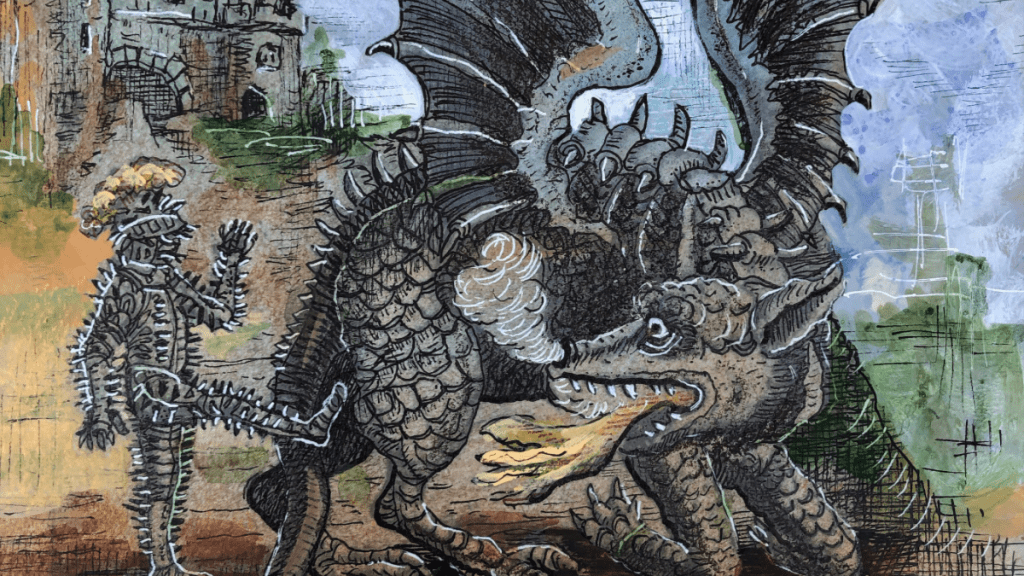
As part of a short tour of south-east England, the New Sussex Opera brought their production of Frederick Lampe’s 1737 opera The Dragon of Wantley (1737) to the splendid surroundings of the Theatre Royal, Winchester. It is a fascinating piece, full of political and musical allusions that would probably have been obvious to the London audience of the time but may evade the average 21st-century audience. It is based on a dragon-slaying legend at Wharncliffe Crags (aka Wantley), north-west of Sheffield. It was the subject of a 1685 broadside ballad and Lampe’s 1737 popular opera to a text by Henry Carey. The dragon causes havoc to the local community until the local squire, Moore of Moore Hall is persuaded to deal with it,. He demands a night (and more) from the 16-year-old Margery. The jealousy of his mistress Mauxalinda provides much of the plot. Eventually, a fatal kick to the dragon’s most vulnerable spot (pictured above) solves the dragon problem, if not the girlfriend issue.
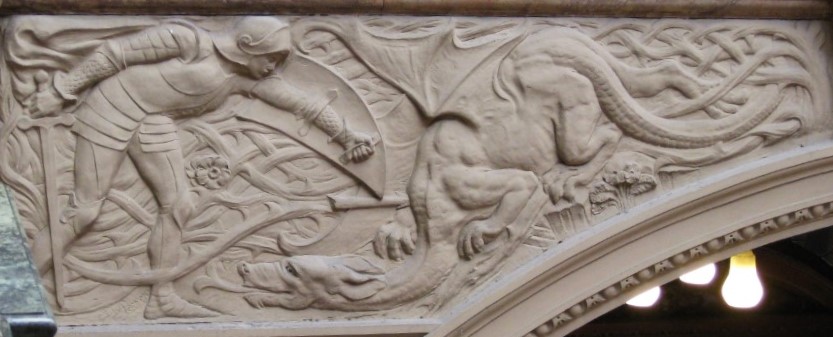
The most apparent mockery implicit in the text and music is a good-natured lampoon of the elaborate Italian-inspired operas composed by Handel (who apparently thought Lampe’s tunes were “well-composed”). Henry Carey intended “to display the Nonsense so prevailing in Italian Operas”, and described Lampe’s music as being “as grand and pompous as possible. The musical comedy goes much further, with every word set to music in the recitative, aria and chorus style of Italian opera and endless musical parodies, not least in the array of not-quite-right da capo arias. Elements of standard Baroque opera are elaborated, for example, with extended melismas which sound even sillier with English words. Other musical and Handelian allusions relate to the well-known rivalry between Handel’s star Italian sopranos Cuzzoni and Faustina who sang together in Handel’s 1726 Alessandro. Another reference to a Handelian singer was a comment clearly referring to the famous castrati Fariinelli, with a reference (“He’s a man, every inch”) to the sexual prowess of castrati, despite missing some of the usual equipment.
The musical allusions conceal what to the audiences of the day were probably the more apparent digs at the politics of the day, notably the taxes that Prime Minister Robert Walpole was trying to extract from the lower social orders. For example, all the drinks mentioned in the text (and there are lots) were those that were to be taxed.

This New Sussex Opera production was set (by director Paul Higgins) in South Yorkshire during the 1982 miners’ strikes, the most serious battle of which was at Orgrave, about 20 miles away from Wantley. The chorus and orchestra were billed as the Wantley Colliery Choir and Band and the clothing and badges reflected the mood of the time. And the dragon was, surprise, surprise, a drag version (by Robert Gildon who, as Gubbins, was the miners’ leader) of Thatcher, complete with an enormous handbag. The theatrical device, although great fun, clouds the fact that it is generally accepted that Thatcher won the battle with the Yorkshire minors, although on this occasion, as the dragon, she was defeated, curiously not by Moore but by his sidekick who delivered the fatal kick up the bum.
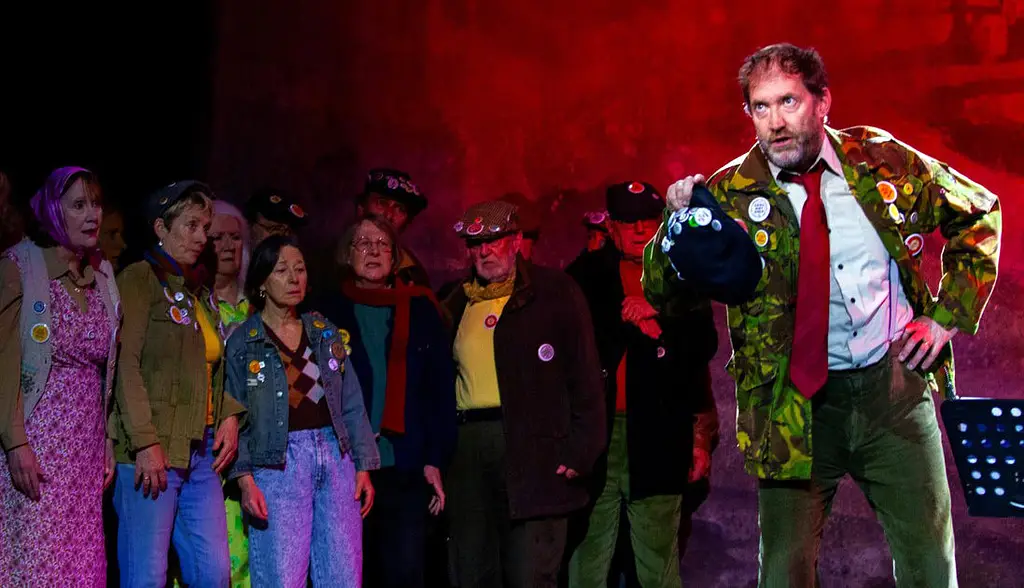
Moore (Magnus Walker) was presented as a rather diffident Alan Bennet-style portrayal of a college lecturer rather than a womanising bold knight, although for the final battle, he dons the bright red academic garb of a Vice-Chancellor. He is pictured below delivering the lines “Zeno, Plato, Aristotle, all were lovers of the bottle”). The two feuding women (Charlotte Badham as Mauxalinda and Ana Beard Fernández as Margery, pictured above) channelled the contrasted personalities well, with some fine singing in some tricky parts.

Another musical dig at Handel came at the end with the rousing chorus “Sing and roario an oratorio to gallant Moorio”, with the now red-jacketed colliery choir clutching scores of Messiah.
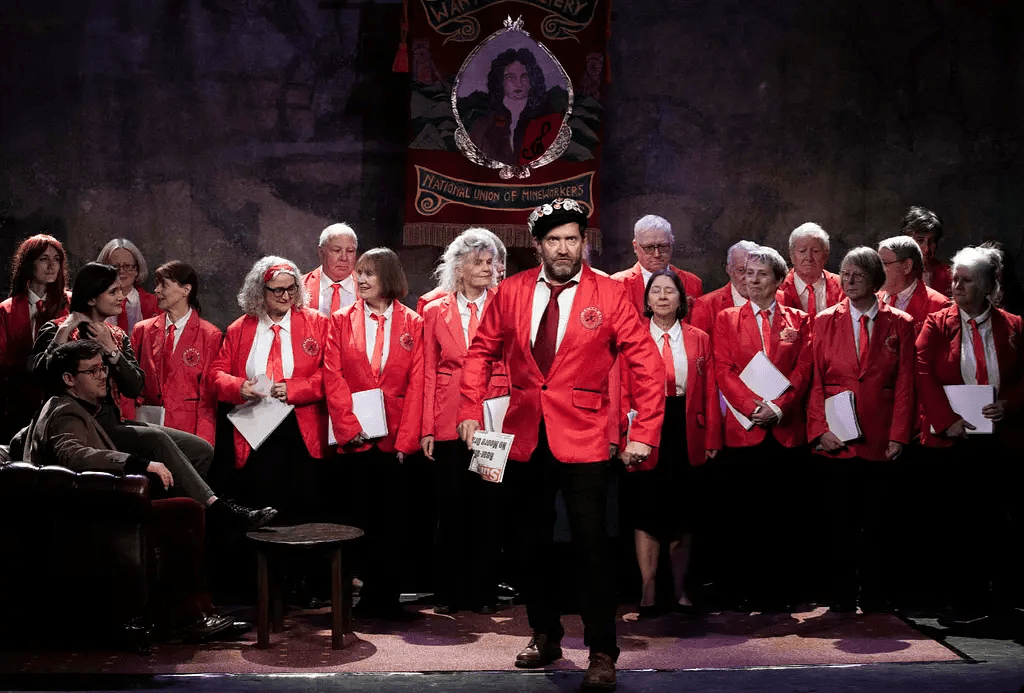
Musical director Toby Purser led the period instrumentalists of the Bellot Ensemble from a digital harpsichord. Lampe’s score takes no prisoners and there were times when the consort playing was perhaps not at its best, but the continuo bass team of Pablo Tejedor-Gutiérrez, cello, and Josie Jobbins, bass, deserve a mention for some very rapid playing, as does violinist Edmund Taylor for some inventive twiddles.

Production photos: Robert Knights
 Andrew Benson-Wilson : Early Music Reviews +