Songs from a Beautiful Mouth
Barbara Strozzi: Il primo libro de madrigali (1644)
Solomon’s Knot
Wigmore Hall, 4 Fenruary 2024
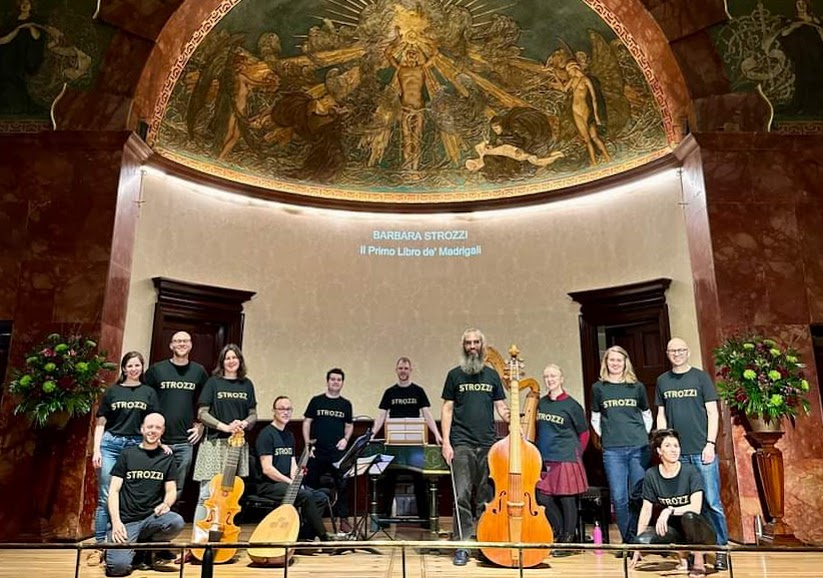
Solomon’s Knot has built an impressive reputation for its innovative approach to performing early music. Singing from memory, they incorporate subtle and very personal theatrical elements into their performances, whether bringing to life the individual characters in a Bach Passion or, as in this performance, stringing together a sequence of 17th-century madrigals into a believable storyline. The focus of this concert was the 1664 Il primo libro de madrigali the first publication by the extraordinary Barbara Strozzi (1619-1677), a Venetian composer who had been a teenage pupil of Cavalli. The madrigals, in a variety of styles, set texts by her father, the poet Giulio Strozzi. He had nurtured her musical career from an early age, helped by the elevated social and cultural circles in which her family moved.
In her gushing dedication to the Duchess of Tuscany, Strozzi writes that the “lyric verses … are all trifles of he who from my girlhood has given me his surname and material comfort. These will relieve the boredom of anyone who does not remain entirely pleased with the poor harmonies of my songs.”

There certainly would not be anybody who would have not been entirely pleased with the language of Strozzi’s harmonies. Her music is a mini encyclopedia of mid-17th-century Venetian musical styles. The vocal textures ranged from two to five voices, with continuo accompaniment improvised from a line of single bass notes. The continuo group for this performance was theorbo (Eligio Quinteiro), lirone (Emilia Benjamin), violone (Jan Zahourek), harp (Siobhan Armstrong) and harpsichord (Walewein Witten), making very effective use of combinations of all five instruments in various combinations.
The distinguished opera director Thomas Guthrie provided an impressive narrative to bind the twenty-five madrigals into a coherent storyline, based on two (and a half) pairs of couples, with the two sopranos (Zoë Brookshaw and Clare Lloyd-Griffiths) teaming up, perhaps inevitably, with the two tenors (Thomas Herford and David de Winter). Bass Jonathan Sells and alto Kate Symonds-Joy seemed to have a rather more itinerate coupling, reduced to dad and mum dancing at the back of the stage during the final madrigal where I couldn’t help but notice that the two couples had swapped partners.
The various vocal groupings and underlying storylines helped to make sense of the somewhat Arcadan nature of the texts, with appearances from Phyllis, the Three Graces, Venus, Cupid, Philomena, Cloris, Acis, Thyrsis, a Nightingale and a Quail. The madrigals offered a coy lover, a modest lover, a plea for ladies to take advantage of their youth while it existed, freedom following an unfaithful, loveless woman, a quarrel between the five senses, rejected lovers, a homily to a cruel lady’s brass door knocker, amorous advice, and fading love.
A well-presented and beautifully performed concert of music by one of the most interesting 17th-century composers.
 Andrew Benson-Wilson : Early Music Reviews +