Spitalfields Music
‘Sound House’
The Society of Strange and Ancient Instruments, Jon Nicholls
The Octagon, Queen Mary University of London. 8 December 2016
Music by Jon Nicholls, Tobias Hume, William Lawes, William Byrd, Thomas Tomkins, Orlando Gibbons.
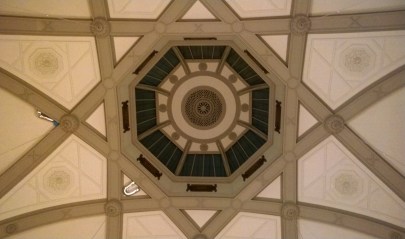 For many years now, Spitalfields Music has been spreading its wings way beyond its original home in Spitalfields, both for its major programme of community work and for venues for its musical and other performances. It is now a major arts and community organisation covering the whole of the East End of London. Among the venues for this year’s winter festival (which included a hidden Masonic Temple) was The Octagon, built in 1887 as part of the grand premises of the People’s Palace, described in The Times on its opening as a “happy experiment in practical Socialism”. It is now the home of Queen Mary University of London. The architect, ER Robson (best known for his influential school designs), used the British Museum Reading Room for inspiration in designing the octagonal library.
 More ‘happy experiments’ were in evidence in the programme ‘Sound House’ given by The Society of Strange and Ancient Instruments (SSAI). It was based on the 17th century scientific writings and acoustic experiments of Francis Bacon, as described in his posthumously published Sylva Sylcarum and New Atlantis. In the latter vision of a new society, Bacon promoted the idea of Sound Houses where his acoustic experiments could be continued and better appreciated by the populace. Bacon’s musical ideas might seem commonplace today, not least through the medium of electronics and manipulated sound, and his experimental approach to sound is a key feature of many musicians today.
 The London Bach Society was founded 70 years ago by Dr Paul Steinitz under the rather unambitious title of the ‘South London Bach Society’, but soon lost the ‘South’ part of the name. 1946 might not seem to be the ideal time to concentrate on things musical (and, indeed, devoted to a German composer), but they were not alone: The Arts Council and BBC Third Programme were launched around then, as were a number of orchestras. From the start, the focus of the LBS was to ‘get back to Bach in its original form’ at a time when Bach performance was very far from what we could no consider as being in any way ‘authentic’ with enormous choirs and orchestras, and a funereal approach to tempo and romantic notions of instrumentation, phrasing and articulation. To this end, the Steinitz Bach Players was founded, in 1968, bringing together a small group of professional musicians interested in period performance techniques on period instruments.
 Andrew Benson-Wilson : Early Music Reviews +