The Saxon Alternative – Telemann: Music for Wind Band

The Saxon Alternative – Telemann: Music for Wind Band
Syrinx
Resonus Classics RES10154. 62’04

Overtures TWV 44:7, 55:c3; 44:2; 55:B3; 44:14

The sound of the Baroque wind band was (and still is) more often heard on the continent than in the UK, so this CD from Syrinx is a refreshing reminder of just how attractive baroque wind instruments can be.  It would be interesting to research the extent to which the weather was an explanation for this, as the wind band was often used in Germany for outside entertainment, always rather risky in the UK. Two of the five Telemann Overtures on this CD feature the traditional French-inspired German Continue reading

Betrayal: A Polyphonic Crime Drama

I Fagiolini
Village Underground. 13 May 2015

It’s not often that I find myself standing in a long queue outside a venue controlled by bouncers. But this was, after all, an I Fagiolini event (commissioned by the Barbican), and the little beans had come up with yet another of their spectaculars. The venue was Village Underground, a performance and arts venue created out of a derelict railway viaduct and adjoining warehouse. The bouncers eventually let us in, after we had shown the ‘Crime Scene Inspection Permit’ we had been told to bring with us. We were immediately shrouded in thick smoke, the little blue-light torches were had been given not being a great deal of help. In the murk, we managed to find a series of display boards showing an enigmatic sequence of photos and poetic texts, all linked by lines. Several chalked body outlines could be seen on the floor, close to various seemingly random objects that had been grouped near the display boards. The investigation permit began to make sense. As the gloomy room filled up with people it became harder to move about, an issue that became more serious when the singers and dancers joined the scene. Continue reading

London Festival of Baroque Music – Day 4/5

‘Women in Baroque Music’
St John’s, Smith Square & Westminster Abbey, 18/19  May 2015

SJSS 2I couldn’t get to the lunchtime concert on day 3 of the festival, but it was given by soprano Rowan Pierce and the young group Medici, under the title of ‘Future Baroque’, with music by Handel, Bach, Royer, Telemann, Corelli and Vivaldi. Unless I have missed something, this was another event that seemed to bypass the festival’s theme, although it did include as its final work Agitata da due venti, a surviving fragment from Vivaldi’s opera L’Adelaide and later also included in his Griselda, composed for the virtuoso soprano Margherite Giacomazzi.

‘Leçons des ténèbres’
Julia Doyle & Grace Davidson, sopranos,
Jonathan Manson, bass viol, Steven Devine, harpsichord, organ & director

The Monday evening concert (St John’s, Smith Square, 18 May) Continue reading

London Festival of Baroque Music – Day 3

‘Women in Baroque Music’
St John’s, Smith Square, 17  May 2015

The third day of the festival started with ‘Sing Baroque’, with Robert Howarth, one of the Robert HowarthOrchestra of the Age of Enlightenment’s regular conductors, leading a Sunday morning workshop on the choral sections of Vivaldi’s Gloria – “for all aspiring Baroque singers – no experience necessary!”. This is certainly not the sort of event that should be reviewed, but I will comment on the experience of watching a conductor at work from the other side of the podium. Conducting styles vary by personality (and over historic time), but there is a generation of younger conductors who focus on using collaboration, cooperation and genuine good humour (rather than dictatorship or bullying) as the key to communicating their ideas. It was clear that Robert Howarth is one of those. As well as giving the gathered singers an excellent insight into the music and aspects of performing it, Robert Howarth also made it an extremely entertaining occasion. Music’s gain is stand-up comedy’s loss.

The Sunday afternoon included a guided tour of The Wallace Collection exploring ‘Music, Dance and Gallentry in 18th-century French Art’, followed by a concert focusing on the harpsichord music of Elizabeth Jacquet de La Guerre (1665-1729) given by Béatrice Martin. Continue reading

London Festival of Baroque Music – Day 2

‘Women in Baroque Music’
St John’s, Smith Square, 16  May 2015

‘Canto dell dame’
Concerto Soave
María Cristina Kiehr soprano, Jean- Marc Aymes, harpsichord, organ & director.

On the cover of the festival programme book are the words “Joy / Passion / Religion / Love / Death / Adoration / Intensity. The Saturday afternoon concert of 17th century Italian music given by Concerto Soave included all of those aspects, sometimes in the same piece. Featuring Concerto Soavefive female composers, the music ranged from the very beginning of the Baroque up to the end of the 17th century. The earliest composer was Francesca Caccini (1587-1641), daughter of Giulio Caccini (represented here by Peter Philips’ harpsichord transcription of his Amarillo, mia Bella). Francesca Caccini made her debut aged 13 at the Medici Court, singing at the wedding of Henri IV of France to a Medici bride. After time in France she returned to become the leading female singer in Florence. Apart from one opera (the earliest known one by a woman) her only surviving music was published in 1618. The three pieces demonstrated the early recitativo style of Continue reading

Fragments

Claude Ledoux: Notizen-Fragmente (2009/13)
Jean-Pierre Deleuze: Voici l’absence – Cinq déplorations en antiphonie (2011)
Cindy Castillo, organ, Aurélie Frank, voice
PARATY 114122.  69:39’

If ever an organ was designed for the performance of contemporary music, it is the 1981 Detlef Kleuker instrument in Notre-Dame des Grâces au Chant d’Oiseau in Brussels, designed by Jean Guillou as a successor to his 1978 ‘hand of God’ organ in Alpe d’Huez.  In this CD, two talented young Belgian musicians perform works composed for them by Belgian composers Claude Ledoux and Jean-Pierre Deleuze. The combination of organ and solo Cindy Castillofemale voice is a beguiling one. In this case it is enhanced by a generous acoustic, fascinating music, an extraordinary organ and excellent recording techniques (the engineer gets his own CV in the booklet) – and, of course, by the musically and technically virtuosic organ playing of Cindy Castillo (left) and singing of Aurélie Frank (below). Continue reading

Sammartini: Concertos for the Organ

Giuseppe Sammartini Concertos for the Organ, op 9.
Fabio Bonizzoni, La Rizonanza 63′ 17″
Glossa GCDC81505

This is a re-release of a 2000 recording. Giuseppe was the elder brother of the better known Giovanni Battista Sammartini.  Born in 1695, he left Milan for London in 1728, where he stayed until his death in 1750, making quite a name for himself.  These concertos, published after his death for “Harpsichord or Organ”, are domestic in scale, with just two violins, cello and bass alongside the organ. It is not clear when they were composed, but they have more of a Rococo than Baroque feel to them, rather enhanced by the playing style on this CD. The spiky solo registrations are not in keeping with the English organ of the period, and nor is the over-articulated performance style.  Bonizzoni keeps to the two-part structure of most of the organ solos (without infilling the harmonies, a debatable point for this repertoire), but it is a shame that he doesn’t make more of the organ when in its continuo role – it is more-or-less inaudible.  The notes give no information on the organ, but I have a feeling it is later than this repertoire.  It is certainly not in any English or Italian early to mid 18th century style. Two lively little Sonatas by Giovanni Battista Sammartini complete the disc. 

Sammartini Concertos For The Organ La Risonanza Fabio Bonizzoni Glossa

[https://andrewbensonwilson.org/2015/03/31/sammartini-concertos-for-the-organ/]

Mark Rylance v Iestyn Davies

As television screens seemed to be filled with lingering shots of Mark Rylance in his role as Thomas Cromwell in BBC’s Wolf Hall, he returned to his old hunting ground at the Shakespeare Globe to take the role of the dotty Philippe V of Spain, patron of Farinelli, in Claire van Kampen’s play with music ‘Farinelli and the King’ (Sam Wanamaker Playhouse, 24 Feb).  In a role that he could have been born to play, the mercurial Rylance mischievously teased and inveigled the audience into the world of the complexly depressive King, starting with the very opening scene where he chats to his goldfish as he tries to catch it with a fishing rod.

Better known as the composer of the music for many of the Globe’s Shakespeare productions (and, perhaps, also as Mrs Rylance) this was Claire van Kampen’s debut as a playwright.  She has produced a play that is full of humour and sensitive insight into the world of madness and depression, as well as a fascinating insight into the world of Farinelli in the court of the crazy king.  In a similarly excellent performance, the appropriately named Melody Grove played the King’s wife, Isabella, who had procured Farinelli from London to aid the King.   Sam Crane acted the role of Farinelli, but in an clever twist to the play, we also had the outstanding countertenor Iestyn Davies taking on the singing side of Farinelli’s life, the combination of both sides of Farinelli’s personality on stage at the same time adding a fascinating psychological aspect to the evening.  This worked a great deal better than I thought it would, and proved to be an illuminating insight into the often divided personalities of performers, with Farinelli’s insecure and reticent side becoming all too evident as the evening progressed, and as his relationship with Philippe and Isabella grew stronger.

The miniature band of musicians was directed from the harpsichord by Robert Howarth, although unfortunately his pre-play playing was drowned out by the chatter of the excitably audience.  I was rather glad that, despite Rylance’s extraordinary (and unashamedly crowd-pleasing) acting, it was for Iestyn Davies that the audience reserved its strongest applause.  And so they should.

[https://andrewbensonwilson.org/2015/03/30/mark-rylance-v-iestyn-davies/]

Wind in Basingstoke

The Orchestra of the Age of Enlightenment brought their programme of music for winds to Basingstoke’s Anvil, the day after their performance at the Queen Elizabeth Hall (6 Feb).  Under the banner of the OAE’s ‘Flying the Flag’ series, they focussed on central Europe and Bohemia, with Mozart and his little-known friend Josef Mysliveček, as well as the later Bohemian composer Josef Triebensee, who arranged movements of Don Giovanni for the Prince of Lichenstein’s harmonie wind band around 1790.  The evening opened with Mozart’s monumental so-called ‘Gran Partita’ (Serenade No 10 for 13 wind instruments); nearly an hour of music of the most extraordinary intensity, and given an exceptional performance by the OAE players.  I particularly liked the way that they slightly extended some key rests, adding to the air of suspense.  Josef Mysliveček met the young Mozart in Bologna, and was an early influence despite their later falling out.  The composer of some 29 operas and 55 Symphonies, the jolly little Wind Octet No.2 in E flat (discovered not so long ago in a pile of manuscripts in the Black Forest) was probably not the finest work to display his talents, but the OAE (in the more traditional wind band grouping of 8 players) bought out his humour of his writing, not least in one little passage where a oboe scale was finished off, after a slight pause, by the second oboe.  The choice of Triebensee’s arrangement of Don Giovanni was apt, as the opera itself includes an on-stage wind band playing an arrangement of Mozart’s own Figaro – Mozart’s dig at the bourgeoisie habit of background music.  A fine oboist himself, Triebensee played the tricky second oboe part in the first performance of The Magic Flute, and makes much of the oboe in his arrangements, generally of soprano arias.  Although lacking a vocal line, his arrangements are clever reinterpretations of Mozart’s originals, and formed a light-hearted end to what had possible been a rather heavy evening for Basingstoke’s concert goers.

[https://andrewbensonwilson.org/2015/03/30/wind-in-basingstoke-6-feb-2015/]

King’s College Minimalism at Kings Place

Included within the year-long Kings Place ‘Minimalism Unwrapped’ festival, Stephen Cleobury and the Choir of King’s College Cambridge devised a programme based around plainchant (4 Feb).  They combined this with their own celebrations of the 500th anniversary of the completion of their Chapel and reflections on the College’s (and their sister foundation of Eton College) founder Henry VI and their patron, the Virgin Mary.  The result was a complete Sarum Rite plainsong Vespers In Nativitate Beatae Maria Virginis (including Dunstable’s Ave Maria Stella and Magnificat secundi toni) and a recreated Mass sequence De Beatae Maria Virginis, incorporating music from the Old Hall Manuscript by Damett, Bittering, Power and ‘Roy Henry’.  Each half ended with a piece from the Eton Choir Book.  The Vespers was enclosed within Robert Parsons’ Ave Maria and the Old Hall Salve Regina by Robert Hacomplaynt, the interestingly surnamed Provost of Kings from 1509-28.  The more elaborate flowing melismas of the Vesper antiphons provided contrast to the simpler melodic lines of the  Psalms.  Despite any possible arguments of authenticity, I do find the habit of over-lengthening the silence in the middle of a chant verse, and then almost overlapping the end of one verse with the start of the next, rather curious.  The 16 choral scholars (nearly all undergraduates, judging by their academic gowns) were joined by 17 boy choristers for the large-scale pieces that opened and closed each half.   Although it was a slightly curious notion to include music of this period in a festival of minimalism – and, of course, it would have sounded very different if the King’s College Choir had been singing on home turf – this was a fascinating and musically compelling insight into musical and liturgical history.  It was also a fine example of the outstanding music making that goes on day by day in our cathedrals and college foundations.

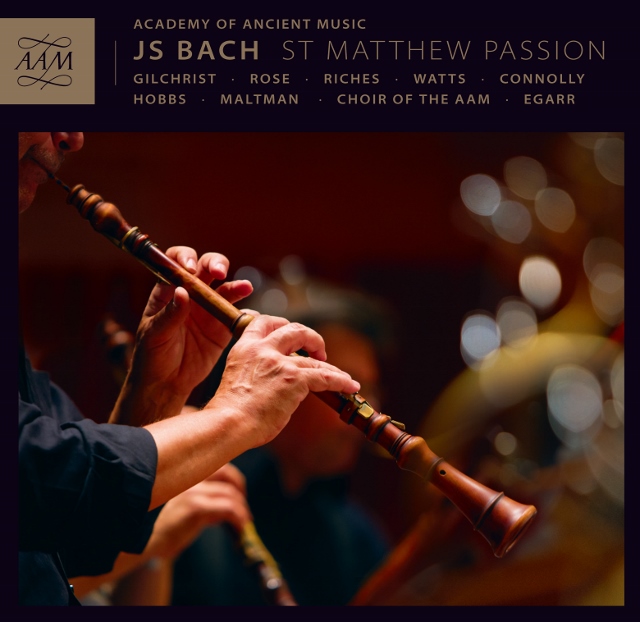
Bach: St Matthew Passion (1727 version)

Bach St Matthew Passion (1727 version)
Academy of Ancient Music, Richard Egarr.
AAM Records. AAM004.  

Richard Egarr director & harpsichord, James Gilchrist Evangelist, Matthew Rose Jesus, Elizabeth Watts soprano, Sarah Connolly alto, Thomas Hobbs tenor, Christopher Maltman bass. Choir of the AAM.   3 CDs. 58’40+49’39+36’19=144’38

Richard Egarr’s introductory article to this new recording of Bach’s most famous work is headed ‘Oh No, not again’.  It concludes with ‘Don’t be a bowl of petunias’, an enigmatic reference to the frequently reincarnated bowl of petunias in ‘The Hitchhikers Guide to the Galaxy’.  His article questions the perceived wisdom of assuming that later incarnations of a piece of music are inevitably the best and most complete.  Like Handel, Bach often changed and re-ordered his music, often for the most pragmatic of reasons.  Normally heard in the version developed from performances in 1736, 1742 and 1746, the Academy of Ancient Music has returned to its first known incarnation of the Matthew Passion, dating from an (assumed) Good Friday Vespers performance in Leipzig’s Thomaskirche in 1727.  This early version was copied down a few years after Bach’s death by a pupil of one of Bach’s singers, but we do not know why.  It is a remarkable survival.

There are several differences from the later version, many very subtle.  The major ones include the fact that the double choir and orchestra structure is weakened by having just one continuo group, rather than two.  This implies that the two choirs and their orchestras would have been positioned closer together, as they are on this recording.  In contrast, the separation of the two orchestras is then emphasised by having both orchestra leaders (rather than just one) take on the two big violin solos, the solo in Erbame dich played from orchestra 2, accompanied by orchestra 1, with Gebt mir meinen Jesum wieder the other way round.  Part One ends, not with the usual O Mensch, bewein dein Sünde groß, but with the simply-stated chorale Jesum lass ich nicht von mir.  The Second Part opens with Ach, nun ist mein Jesus hun!, but sung by a bass rather than an alto. This might have spiritual significance, but could equally have been the purely practical result of which singer happened to be in best voice at the time. Perhaps the most distinctive change from the later version comes closer to the end, with the famous bass aria Komm, süßes Kreuz.  This is normally the moment when the viola da gamba player takes centre stage for the complex obligato accompaniment.  But here Bach chooses the elegiac sound of the solo lute (with organ), a strikingly compelling tonal alteration to the more usual sound.  Other changes in instrumentation include the use of the organ and winds (rather than a ripieno choir or soloist) to bring out chorale melody in the opening chorus. More subtle changes are found in the relative reduction in ornamentation, notably in the lack of appoggiaturas (for example, in the orchestral accompaniment of So ist mein Jesus nun gefangen) – often tricky in performance.

Stephen Rose’s intelligent programme note introduces the liturgical and musical background to the Leipzig Passion.  It is difficult to imagine the response of the Leipzig congregation to first hearing a work of such power, but Rose helpfully analyses the Passion’s arias within the context of Luther’s 1519 three stages of meditation and contemplation on the Passion story, something listeners of the day would have understood better than we do today.

The Academy of Ancient Music field a strong cast of soloists and instrumentalists, with an exceptional performance from James Gilchrist as the ever-communicative Evangelist.  The two 10-strong choirs give gutsy readings of the turbo choruses although, when at full throttle, the sopranos display rather too much vibrato for my taste.

Richard Egarr’s interpretation is characteristically distinctive, not least for his occasionally relaxed approach to pulse and rubato.  For example, in the alto aria, Buß und Rei, (CD1:10) he lingers on the penultimate note of phrases, perhaps signifying the repentance and regret of the opening line. Moments like this certainly attracted attention on my first listen, but I found my initial surprise lessened with repeated listening.  Indeed, the performance as a whole combines musically strength with sensitivity, and can be thoroughly recommended, not just for the undoubted importance of hearing this rarely performed 1727 version.  I have only heard it live once before, during the 2012 Leipzig Bachfest performed by Bach Collegium Japan and the Tölzer Knabenchors under Masaaki Suzuki.

The CD was recorded over a 7-day period in St Jude-on-the-Hill, with Philip Hobbs as the distinguished producer and engineer.  It comes in a hardback booklet format, with the full text and an English translation. A sound sample and an introductory video can be found at http://www.aam.co.uk/#/recordings/discography/js-bach/bach-matthew-passion.aspx.

[https://andrewbensonwilson.org/2015/03/29/bach-st-matthe…n-1727-version/]
AAM Mat Pass

Mozart 250 – ‘Capricious Lovers’ & ‘An Exotic and Irrational Entertainment’

Mozart in London Festival
Classical Opera, Ian Page

Classical Opera launched their ambitious ‘Mozart 250’ project with a ‘Mozart in London’ Festival weekend of events at Milton Court.  The 250 of the project’s title refers to the years since Mozart’s childhood visit to London (23 April 1764), during which he composed his first significant works. The plan is to “follow the chronological trajectory of Mozart’s life, works and influences”, culminating in 2041, the 250th anniversary of Mozart’s death. The weekend included talks, discussions and concerts over a three-day period.  I attended the events on Saturday 21 February, starting with the discussion on Mozart in London between Cliff Eisen, Ian Page, David Vickers and Andrew McGregor.

The first of the two Saturday concerts was ‘Capricious Lovers’, a look at English opera at the time of Mozart’s visit. Extracts from six operas (performed between 2 November 1764 and 15 February 1765) gave a fascinating insight into London musical life over this very brief period.  The first half concentrated on works given in Drury Lane, with George Rush’s The Capricious Lovers, Michael Arne & Jonathan Battishill’s Almena and William Bates’. PharnacesThe second half focussed on Covent Garden, with Thomas Arne’s The Guardian Outwitted, Thomas Arne’s Artaxerxes and the pasticcio Maid of the Mill.  Under the baton of Ian Page, sopranos Rebecca Bottone & Sarah-Jane Brandon, mezzo Samantha Price and tenor Robert Murray were joined by The Orchestra of Classical Opera in a well-chosen range of arias, duets, trios, together with overtures from Capricious Lovers and The Guardian Outwitted.  The highlight was the delightful duet ‘O dolly, I part / with a hole in my heart’ from The Guardian Outwitted sung by a coquettish Rebecca Bottone & Robert Murray.

Drury Lane and Covent Garden were the two London theatres licensed to stage plays and operas in English – the reserve for Italian opera was the King’s Theatre, Haymarket.  Under the title of ‘An Exotic and Irrational Entertainment’, the evening concert looked at the music performed there between 24 November 1764 and May 1765.  Alongside J.C.Bach’s Adriano in Siria and Mattia Vento’s Demofoonte, we heard extracts from the pasticcio operas Ezio, Berenice and Solimano, including pieces by Pescetti and Perez as well as Bach and Vento. As in the earlier Handel days, the King’s Theatre attracted some of the finest singers of the time.  Sopranos Martene Grimson & Anna Devin and mezzo Samantha Price were the very impressive representatives of the original singers, soprano Teresa Scotti and the castrati Ferdinando Tenducci and Giovanni Manzuoli.  It was immediately apparent that the Italian style came with harmonically and instrumentally richer accompaniments than their English cousins in the other place.  This concert was preceded by a talk from Daniel Snowman on ‘A Night at the London Opera in Mozart’s London’, reflecting a rather different interpretation of the period and the life of the Mozart family than that expressed in the earlier discussion.

This is an extraordinary project, not least for the length of programme through to 2041. On the basis of this one day, Ian Page and Classical Opera have set themselves an enterprising and important sequence of events, running through to 2041.

[https://andrewbensonwilson.org/2015/03/30/mozart-250-capricious-lovers-an-exotic-and-irrational-entertainment/]

‘Bewitched’

Bewitched
Les Passions de l’Ame, Robin Johannsen, Meret Lüthi.
Deutsche harmonia mundi / Sony Music 88843040882.  60’06.
Corelli La Follia; Geminiani ‘The Enchanted Forest’; Handel Armida abbandonata.

Bewitched
I praised the début CD (‘Spicy’, Deutsche harmonia mundi  88883748742) from the Swiss violinist Meret Lüthi and her Bern-based period-instrument orchestra, Les Passions de l’Ame in my review in Early Music Review (February 2014).  I am equally impressed with their second CD.  As with ‘Spicy’ they have produced an imaginative programme, in this case combining two pieces linked to the story of the crusader Rinaldo and his doomed love affair with the sorceress Armida, as told by Torquato Tasso in his La Gerusalemme Liberata.  After the opening salvo of Corelli’s La Follia variations, intended to represent the wildly contrasted emotions of Armida, we hear the first part of Francesco Geminiani’s orchestral suite ‘The Enchanted Forest’ (La Foresta Incantata), incidental music written for a 1754 pantomime ballet in the Grand Théâtre du Palais de Tuileries in Paris based on Tasso’s story. We do not know how the music would have been performed in the original production, as all that survives is this two-part suite, a collection of dance-like pieces of varying length and mood.

After the first part of the Enchanted Forest (in d minor), we hear Handel’s c1708 take on the story, the dramatic secular cantata Armida abbandonata (Dietro l’orme fugaci, HWV 105) for solo soprano, sung by the American soprano Robin Johannsen. I was impressed by Robin Johannsen when I first heard her in Hasse’s Romolo ed Ersilia at the 2011 Innsbrucker Festwochen der Alten Musik. Her singing is beautifully clear and focused, with a sensitively honed vocal timbre and an effective use of ornaments and da capo elaborations and the occasional use of a very gentle vibrato to colour the notes. She captures the contrasting moods of Handel’s exquisite cantata to perfection.  The opening accompagnato is interesting for having the continuo accompaniment provided by the solo violin alone, played by the director of Les Passions de l’Ame, Meret Lüthi.

We then return to the D major second part of The Enchanted Forest, the sensuous and subdued opening very effectively continuing the desolate mood of the Siciliana at the end of Armida abbandonat, before the full orchestra, with trumpet and horns blazing, takes overThe central part of the second half is a dramatic multi-section piece that could be a mini-opera in its own right. The playing of the 19 musicians of Les Passions de l’Ame is excellent, and is combined with sensitive continuo accompaniment to the Handel.  Merit Lüthi directs from the violin with an impressively light touch, bringing out both the Italian and French influences in Geminiani’s music.  At the time, Charles Burney thought he was too French, and the French thought he was too Italian! Today we appreciate the benefits of both musical styles.

You can hear extracts on the Les Passions de l’Ame website at http://lespassions.ch/cms/en/discography

[https://andrewbensonwilson.org/2015/03/24/bewitched-robin-johannsen-les-passions-de-lame-meret-luthi/]

Orfeo at the Roundhouse

The Roundhouse is the latest of the Royal Opera House’s ventures away from Covent Garden, another being the Sam Wanamaker playhouse at The Globe. The circular building (a former engine shed in North London, and one of my haunts in earlier rock concert days) made an impressive, if acoustical tricky, venue for Monteverdi’s Orfeo. The audience sit in a 270° arc around the off-centre circular stage with the instrumentalists of the Early Opera Company at the back of the stage.

The Prologue opened with a young and rather sour looking Pluto and his entourage processing down a long sloping gangway onto the stage and up to a raised dais above the orchestra and what turned out to be the entrance to Hades. The gods were accompanied by be-robed priests who turned out to be the three Pastore (billed as ‘Pastors’ – very droll). It had the air of a court house, with the gods sitting in judgement as the scene unfolded below. Musica (who turns into Euridice via an on-stage costume change) sat with Orfeo draped pieta-like across her lap, a touching scene reversed at the end of the evening.The only prop was a simple chair, with the other scenes created by a lively group of 14 child dancers and acrobats (from East London Dance) who created arches through which the protagonists moved, as well as the ripples of the Styx.

This was the first attempt at opera direction by the Royal Shakespeare Company’s former Artistic Director, Michael Boyd, and he sensibly resisted the temptation to overly embellish the plot. The sparse setting allowed the focus to be on the music itself, something that the young singers rose to with considerable aplomb. The Transylvanian baritone, Gyula Orendt was a most impressive Orfeo, the clarity of his voice overcoming some slight pronunciation difficulties and the curious spectacle of him being hoisted precariously into the air at the end. Mary Bevan was outstanding as Euridice and Musica, both with her acting and the beauty of her voice. The other members of the cast were of a similar high standard, including the chorus drawn from Guildhall students. However, I was not convinced about casting Susan Bickley as the Messenger. The playing of the Early Opera Company and Christopher Moulds’ musical direction was spot on. There is more I could write about some of the production issues, but will certainly remember this as a fine musical event.

[https://andrewbensonwilson.org/2015/03/23/orfeo-at-the-roundhouse-16-jan-2015/]