BBC Proms: Purcell’s The Fairy Queen
Les Arts Florissants, Le Jardin des Voix, Compagnie KÄFIG
Paul Agnew, conductor, Mourad Merzouki, choreographer/stage director
Royal Albert Hall, 6 August 2024

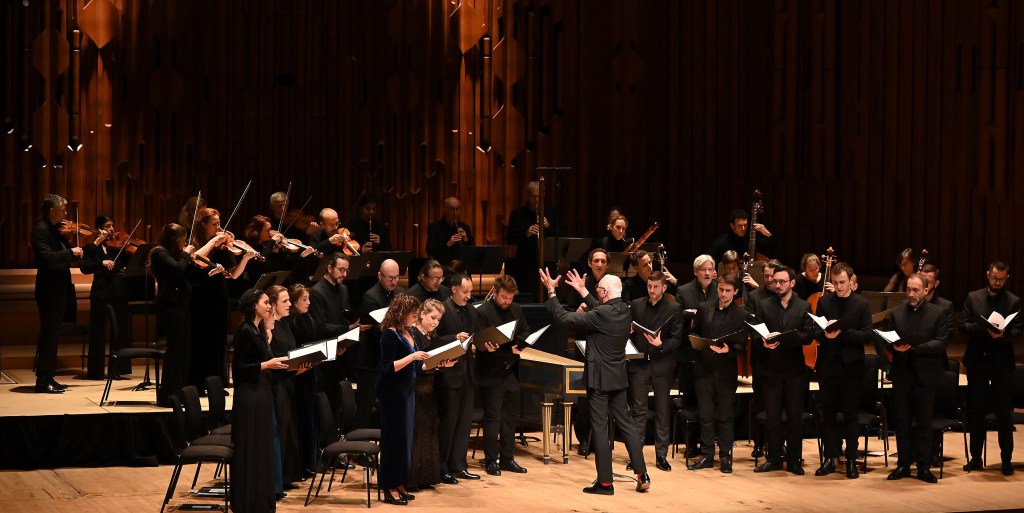
There are many ways to perform Purcell’s The Fairy Queen, but this must rank as one of the most inventive and entertaining. I have seen many versions of this musical extravaganza, including a bottom-numbingly-long version that attempted to recreate the original 1692 production when Purcell’s five masques were interspersed between sections of the spoken play, which was an appallingly turgid adaptation of Shakespeare’s Midsummer Night’s Dream. Composed to celebrate the anniversary of William and Mary’s wedding, Purcell’s five masques bear a marginal and rather metaphysical and academic relationship (explained here) to Shakespeare’s play, the revised version concentrating on the dream-like world of the fairies. The five masques are all introduced by Titania or Oberon, who may well have been played by eight or nine-year-old children, seemingly joined by a wider cast of young children.
 l tower were added. Internally, the Romanesque triple-aisled basilica was altered, rather inelegantly, by inserting two enormous domed cupolas into the original external walls, resulting in a bit of an architectural mess. After two major fires in the 17th century (which destroyed the cupolas), the church was restored, and impressive new convent buildings were added, with cells for 45 nuns. During the Revolution, the Abbey first became a prison (1792), and then a barracks (1808). In the 1920s, the Abbey complex was purchased by the town of Saintes. In the 1970s, restoration of the monastic
  buildings (abandoned since the war) was started and, in 1972, an annual Festival of Ancient Music was created, later becoming the Festival de Saintes. In 1988 the Abbey was launched as a cultural centre by President François Mitterrand, and in 2013 it became la cité musicale, housing a Conservatoire of Music and a range of year-round musical activities, including many for young people. The former nun’s cells now sleep visitors and guests of the Festival.
 Over the years, William Christie has done much to introduce French baroque music to British ears, and has opened our ears to Purcell. But I had not heard his take on Messiah live before. It was bound to be rather different from the usual variety of British interpretations, and it was. We are increasingly used to lightly scored performances with moderately sized choirs, in contrast to the cast of thousands of yesteryear, but this very Gallic interpretation added a layer of delicacy and dance-like joie de vivre to Handel’s music, all done in the best possible Bon Goût. Les Arts Florissants fielded a choir of 24 (quite large, by some standards today, and in Handel’s time) and an orchestra with 6, 6, 4, 4, 2 strings, together with five soloists. Both instrumentalists and the chorus were encouraged to keep the volume down, usually by a finger on the Christie lips. This seems to be in line with Handel’s intentions, as indicated by his scoring and, for example, his very limited use of the trumpets. When things did let rip, there was still a sense of restraint amongst the power.
  Andrew Benson-Wilson : Early Music Reviews +