
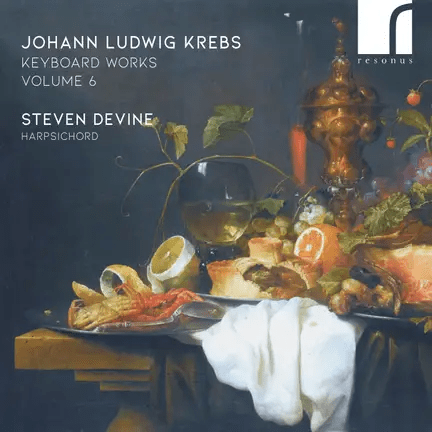
Johann Ludwig Krebs (1713-1780)
Keyboard Works, Volume 6
Steven Devine, harpsichord
Resonus Classics RES10376 (70’50)
Sechs Preambulis (Vier Pieces, Part 1, 1740)
Suite No. 5 in F Major, (Clavier-Übung, Part IV, 1746) Krebs-WV 811
Suite in A Minor ‘nach dem heutigen Gusto’ (Vier Pieces, Part 2, 1741) Krebs-WV 819
The twice-extended series of recordings of the complete harpsichord works of Johann Ludwig Krebs (Bach’s ‘favourite pupil’) has reached what now seems to be its conclusion with the release of the sixth and (we are, perhaps rashly, promised) the final volume. This disc focuses on the first two parts of the Krebs collection ‘Vier Pieces’, dating from 1740/41. Krebs had left the Leipzig Bach circle in 1737 to become organist at the Marienkirche in Zwickau. The organ was in poor condition, and Krebs’ efforts to commission a new Silbermann failed. He stayed until 1744 by which time he had married and had his first child. He also wrote a lot of music during that time, including the Vier Pieces.


 Andrew Benson-Wilson : Early Music Reviews +