
Bach: Goldberg Variations
Nathaniel Mander, harpsichord
ICSM / Chronos ICSM018. 42’28
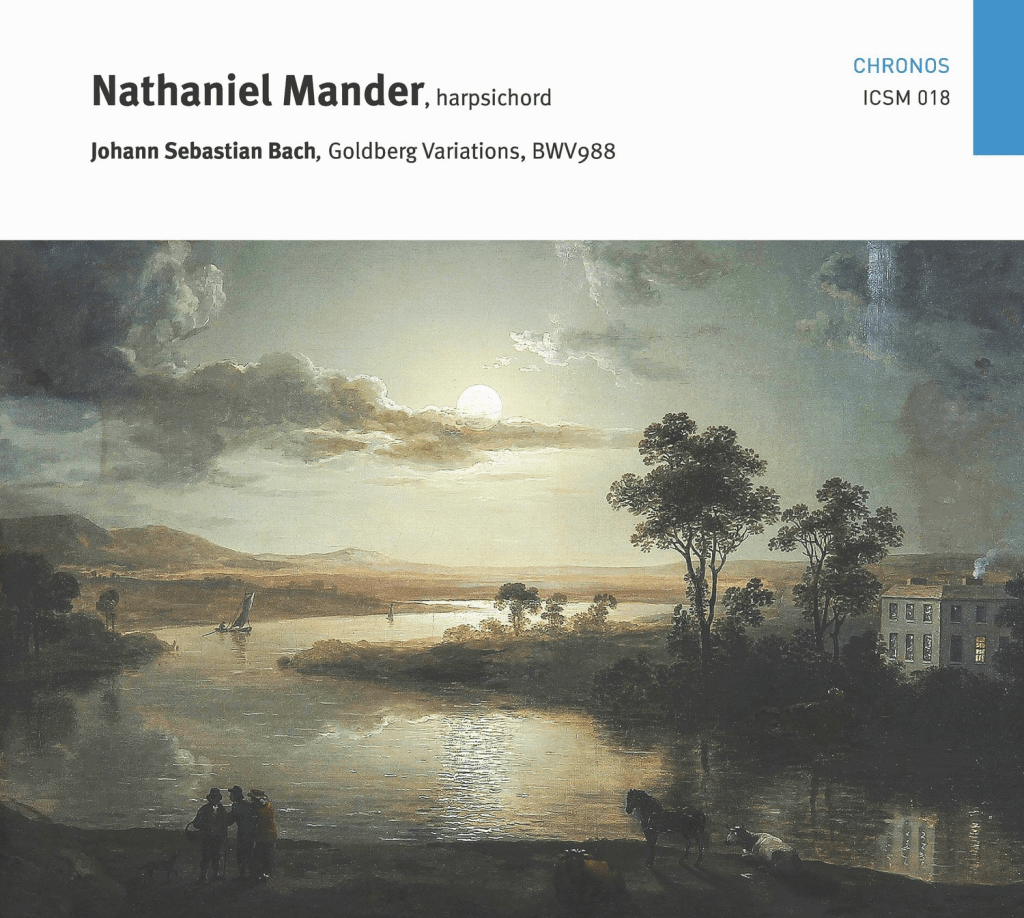
The Goldberg Variations is one of the most complex of all Bach’s keyboard works to understand and perform, so it is a brave move for anybody to make it their debut recording. However, Nathaniel Mander does have at least one distinguished predecessor in Glen Gould’s 1955 debut recording. It was published in 1741 under the (publisher’s) title of Clavierubung IV, following the earlier Clavierubung I, II, and III. The title implies that it is ‘Keyboard practice’, but it certainly is far more than that. Bach (who called it Aria with diverse variations for a harpsichord with two manuals) notes that it was “composed for connoisseurs, for the refreshment of their spirits”, which gives a far more appropriate impression of its status. The legend that Bach wrote the variations for Johann Gottlieb Goldberg is almost certainly not true, not least because Goldberg was just 13 at the time. But he was clearly a gifted player, and was a student of Bach’s son, Wilhelm Friedemann in Dresden, and also took lessons with J.S. Bach in Leipzig.

 l tower were added. Internally, the Romanesque triple-aisled basilica was altered, rather inelegantly, by inserting two enormous domed cupolas into the original external walls, resulting in a bit of an architectural mess. After two major fires in the 17th century (which destroyed the cupolas), the church was restored, and impressive new convent buildings were added, with cells for 45 nuns. During the Revolution, the Abbey first became a prison (1792), and then a barracks (1808). In the 1920s, the Abbey complex was purchased by the town of Saintes. In the 1970s, restoration of the monastic
  buildings (abandoned since the war) was started and, in 1972, an annual Festival of Ancient Music was created, later becoming the Festival de Saintes. In 1988 the Abbey was launched as a cultural centre by President François Mitterrand, and in 2013 it became la cité musicale, housing a Conservatoire of Music and a range of year-round musical activities, including many for young people. The former nun’s cells now sleep visitors and guests of the Festival.
 Andrew Benson-Wilson : Early Music Reviews +