York Early Music International Young Artists Competition 2019
National Centre for Early Music
York, 11-13 July 2019
Founded in 1985, the York Early Music International Young Artists Competition (until 2009 under the auspices of the Early Music Network) is firmly ensconced in the National Centre for Early Music in the splendidly restored former medieval church of St Margaret’s Church, Walmgate, York. This year was the 18th incarnation of the biennial event, which for some years has formed part of the annual York Early Music Festival and is supported by the National Centre for Early Music, BBC Radio 3, Arts Council England and Linn Records. The full list of competition rules can be seen here but, briefly, there must be a minimum of two members aged 36 years or under with an average age of 32 or under. The repertory must be from the middle ages to the nineteenth century, using historically informed playing techniques, instruments and stylistic conventions. The ten finalists were chosen from 58 applications to provide a balance sequence of concerts in the final, covering the whole ‘early music’ period. The BBC Radio broadcast of selections of pieces from the final can be heard here.


 After reforming, renaming, and regrowing itself from the long-running Lufthansa Festival, the London Festival of Baroque Music has become, phoenix-like, one of the most important early music festivals in London. Under the banner of ‘Baroque at the Edge: pushing the boundaries‘, this year’s LFBM used the music of Monteverdi and Telemann, from either end of the Baroque (and both with anniversaries this year) to explore ‘some of the chronological, geographical and stylistic peripheries of Baroque Music’. With one exception, all the concerts were held in the Baroque splendour of St John’s, Smith Square.
  One of the key events of the London Festival of Baroque Music was final concert of the current incarnation of the European Union Baroque Orchestra, and orchestra I have been reviewing enthusiastically for many years. After extensive annual training auditions attracting around 100 applicants, aided by leading period performers, around 30 instrumentalists are selected each year to tour a series of concerts around Europe. But this concert was also, very sadly, the very last EUBO concert in its present state as a UK-managed organisation. Founded 32 years ago as a UK initiative (during the 1985 European Music Year), and managed ever since from its base near Oxford, the vote by a small percentage of the UK population to drag the UK out of the European Union means that it is no longer viable to run an EU venture from the UK. In its 32 years, EUBO has encouraged and nurtured around 1000 young musicians, giving some of the finest period instrumentalists around an early grounding in performance practice at the start of their careers. For the future, after a hiatus of a year to allow for the transfer, when there will be no auditions or orchestra , EUBO will restart from a new base, and with new management, based in the music centre AMUZ in Antwerp.
  Part of the 2015 expansion of the European Union Baroque Orchestra’s activities has been the EUBO Mobile Baroque Academy (EMBA), a cooperative project aimed at finding new and creative ways of addressing the unequal provision of baroque music education and performance across the European Union. The touring orchestra (EUBO) still forms the core activity of the EMBA, reforming each year with a new intake of talented young period instrumentalists chosen from educational auditions held each spring. For more than 30 years EUBO has provided specialist training and experience, and has encouraged and supported many of the top period instrument specialists around today. One such is the distinguished oboist and director Alfredo Bernardini, a member of the very first EUBO in 1985 and the director of this EUBO tour.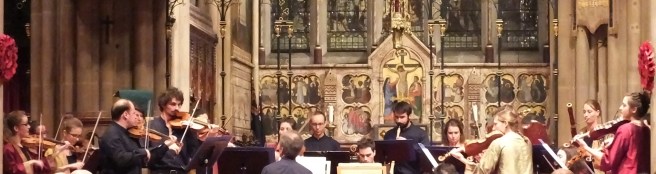
 Handel’s early works, particularly those written during his period in Italy have a very special vitality, musical elegance and sense of melodic delight. The secular cantata Apollo e Daphne is one such, started in Venice in 1709. but not completed until he briefly moved to Hanover, in 1710, as Court Kapellmeister to the Elector of Hanover. It is the music performed during his time in Hanover that is the focus for this recording from the Irish/Scottish Ensemble Marsyas. Apollo e Daphne lacks an overture, so the curiously lengthy example from Il pastor fido has been included here, although at more than half the length of the cantata it makes for an unnecessary imbalance to the following cantata. That imbalance is further exaggerated by adding two curious Arias in F for wind band between the overture and cantata (here with added percussion), with a segue between the second Aria and the opening recitative of Apollo e Daphne. It’s a rather odd musical construction, but that should not detract from the many delights of this recording.
 The weekend traditionally opens on Friday evening with the famous Regensburg cathedral boys’ choir, the Regensburger Domspatzen,
  The European Union Baroque Orchestra was formed in 1985, and has recently successfully negotiated its way through a difficult period of financial uncertainty. It celebrated its renewed, if short term security with the first short series of concerts for the newly formed orchestra of young musicians. They are selected anew each year through combined educational and selection courses and then usually meet five or six times a year to rehearse and then tour a new programme. One of the key features of EUBO is giving the musicians the chance to experience life as a touring orchestral musician, evidenced on this occasion by

 Andrew Benson-Wilson : Early Music Reviews +