Byrd 1589: Songs of sundrie natures
Alamire, Fretwork, David Skinner
Inventa INV1011. 2 CDs. 53’18+69’19=122’37

Following their 2021 recording of Byrd’s first song collection, the 1588 Psalmes, Sonets & Songs of sadnes and pietie (reviewed here), Alamire and Fretwork turn to what Byrd described as the result of his being “encouraged thereby, to take further paines therein, and to make the pertaker thereof, because I would shew my selfe gratefull to thee for thy loue, and desirous to delight thee with varietie, whereof (in my opinion) no Science is more plentifully adorned then Musicke“. The ensuing 1589 collection “Songs of sundrie natures” was intended “to serue for all companies and voyces: whereof some are easie and plaine to sing, [while] other more hard and dificult“. It is divided into songs of 3, 4, 5 and 6 parts and offers a wide choice of music for a wide range of musical abilities – a sensible financial arrangement, no doubt.



 After the Holy Week Festival showcase Good Friday afternoon St John Passion came a concert focussed on one of England’s finest composers, Thomas Tallis. Living though the reigns of five monarchs (from Henry VII to Elizabeth), and composing in the latter four of them, Tallis managed to negotiate the complex religious twists and turns of Tudor life. The highlights of the evening came at the end, with the first modern performance of David Skinner’s reconstruction of a piece composed by Tallis (an early version of the famous Gaude gloriosa Dei mater), but with new words (See, Lord, and behold) added by Katherine Parr, Henry VIII’s eighth and final Queen.
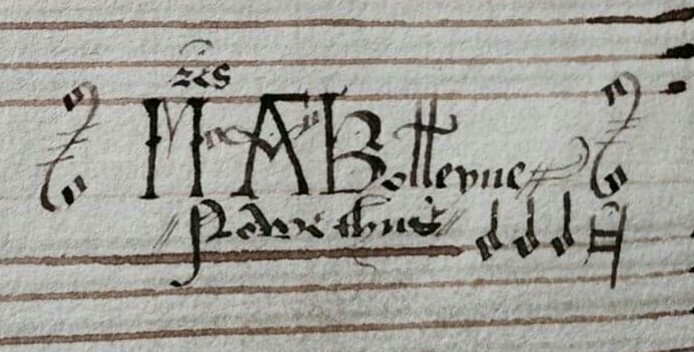
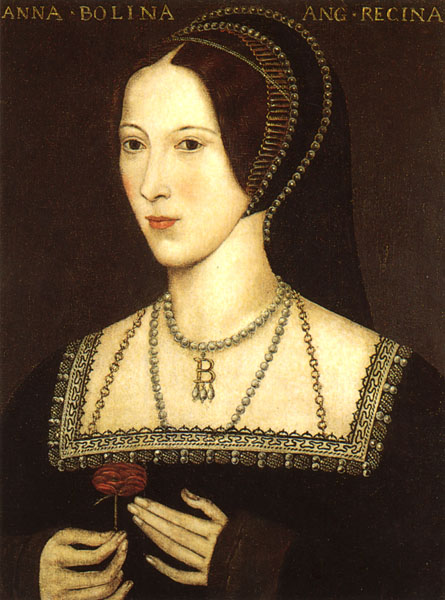 Having recently dusted off ‘The Spy’s Choirbook’, a manuscript by Alamire in the British Library, David Skinner and Alamire have now turned their attention to a manuscript that (arguably) belonged to Anne Boleyn, currently in the Royal College of Music (MS1070). The inscription ‘Mistres ABolleyne nowe this’ indicates the link to Anne, the ‘Mistres’ suggesting that the songbook was started before she became Queen in 1533 – and, I suggest, also before she became Marquess of Pembroke in 1532, and possibly before 1525 when her father was elevated to the peerage as a Viscount, or 1529 when he was created an Earl, both ranks giving Anne a courtesy title. ‘Nowe thus’ is her father’s motto.
 Andrew Benson-Wilson : Early Music Reviews +