Bach: Art of Fugue
Academy of Ancient Music, Concert Theatre Works
Laurence Cummings, Bill Barclay
Peter Bray, Steffan Cennydd, Imogen Frances, Simon Slater
Milton Court, 15 May 2025
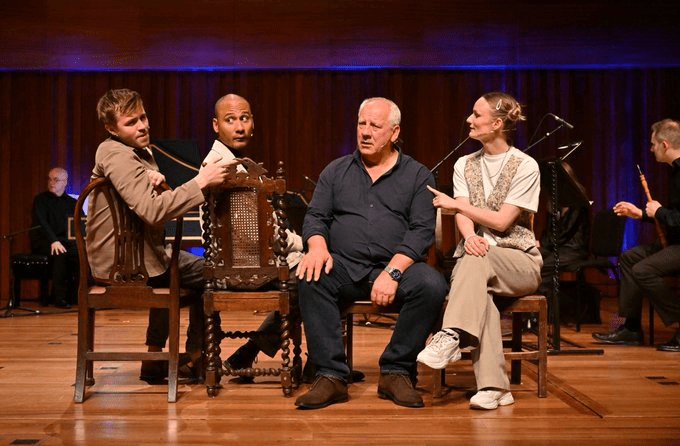
Photo: Mark Allan
Johann Sebastian Bach’s Art of Fugue (Die Kunst der Fuge) is one of the greatest monuments of Western music. You mess with it at your peril. And mess with it at their peril is just what writer and director Bill Barclay with Concert Theatre Works did with the connivance of Lawrence Cummings and the Academy of Ancient Music (AAM), who commissioned this particular messing.
The Art of Fugue was composed during the last decade of Bach’s life, although the spurious accounts of Bach dying while composing the final fugue, on which much of the plot of this concert-theatre production relies, have long since been discredited. It was not published until shortly after Bach’s death, although autograph manuscripts of most of it survive. It consists of fourteen fugues (each called Contrapunctus) and four canons, all in D minor, and all using the same main theme, albeit in many varied forms. With the exception of the final fugue, which is written in conventional two-stave keyboard format, each piece has a separate line for each of the four voices (open-score) in a similar fashion to several learned musical works of the previous century or more. There is no indication of which instrument Bach intended or, indeed, if he intended it for performance at all, using it as an example of his skill in contrapuntal composition. There are no orchestral instruments of the time that could play all the lines on the same instrument, leading to the assumption that it was intended for the harpsichord. Performance on the organ is common, although there are many questions to be considered, not least the choice of registrations.

 Andrew Benson-Wilson : Early Music Reviews +