Bach: Violin Concertos
Alina Ibragimova, Arcangelo, Jonathan Cohen
Hyperian CDA68068. 69’02
Bach: Violin Concertos BWV 1041, 1042, 1055R, 1056R, 1052R
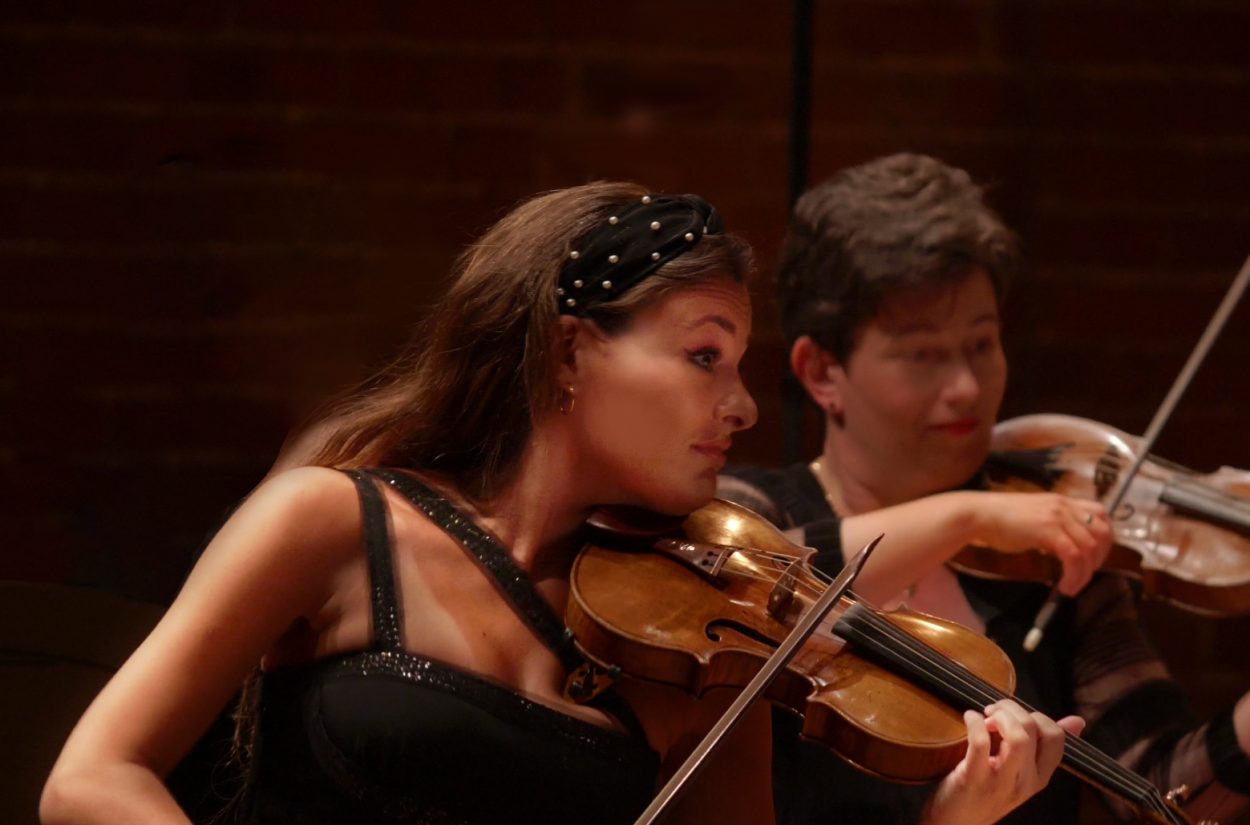
![JS Bach:Violin Concertos [Alina Ibragimova; Arcangelo, Jonathan Cohen ] [HYPERION: CDA68068]](https://i0.wp.com/ecx.images-amazon.com/images/I/618CLr8euKL._SY355_.jpg) I first encountered Alina Ibragimova when she was part of a little student group playing in a lunchtime concert in 2007. Two years later (after she had already won several prestigious awards and released three CDs, of works by KA Hartmann, Roslavets, and Symanowski) I reviewed her extraordinary solo Bach recital at her alma mater, the Yehudi Menhuin School. In my review (in Early Music Review) I wrote that “I don’t think I have ever heard a more promising musician on any instrument – or, indeed, such an intensely musical (and moving) performance of Bach’s unaccompanied violin works . . . She has an extraordinarily compelling stage manner – quite, focused and seemingly at one with her instrument, she quietly walks on stage, stands and plays, looking at her violin with intense concentration and involvement with the music. Alina Ibragimova has an exquisite musical talent and an inspiring musical mind.” Her subsequent CD of the
I first encountered Alina Ibragimova when she was part of a little student group playing in a lunchtime concert in 2007. Two years later (after she had already won several prestigious awards and released three CDs, of works by KA Hartmann, Roslavets, and Symanowski) I reviewed her extraordinary solo Bach recital at her alma mater, the Yehudi Menhuin School. In my review (in Early Music Review) I wrote that “I don’t think I have ever heard a more promising musician on any instrument – or, indeed, such an intensely musical (and moving) performance of Bach’s unaccompanied violin works . . . She has an extraordinarily compelling stage manner – quite, focused and seemingly at one with her instrument, she quietly walks on stage, stands and plays, looking at her violin with intense concentration and involvement with the music. Alina Ibragimova has an exquisite musical talent and an inspiring musical mind.” Her subsequent CD of the  Bach solo violin works (CDA67691/2) remains one of my favourite interpretations. And, for many people, the highlight of the 2015 BBC Proms was Alina’s two late-night solo Bach performances. So another Alina Ibragimova Bach recording is something to look forward to.
The first surprise might be to find five Bach violin concertos listed, rather than the normally expected two, in A minor and E major. There is evidence that Bach rearranged many of his earlier instrumental pieces for other instruments, often for performance at the Leipzig Collegium Musicum. These included the two well-known violin concertos, which he transcribed for harpsichord. All too often, the scores of the original pieces have been lost, just leaving the revised versions. This recording includes three reverse reconstructions of these earlier versions. The first of these (BWV1055) seems to have been originally for oboe d’amore, but works well for violin, albeit with an emphasis on the lower registers. BWV 1056 is well-known as the Harpsichord Concerto in F, but could have derived from a violin or oboe original. BWV1052 is a backward reconstruction of the violin concerto, later reworked for harpsichord. Incidentally, for those who care about such things, the BWV numbers quoted on the CD refer to the later re-workings – the reconstructions included on this CD should have the suffix ‘R’ – BWV1055R etc. Richard Wigmore’s comprehensive notes set the works in context.
Alina Ibragimova plays with a lovely sense of freedom of the musical line, with attention to the little phrases and motifs that are the foundation of Bach’s extended musical lines. At times her playing can sound almost improvisatory, which suits the music perfectly. She has a light and delicate touch, both during the extraordinarily complex passages (during which she wears her virtuosity lightly) and also on those lovely occasions when she brings the volume down to a just audible level. Her slow movements are particularly beautiful, but it is a shame that the theorbo is frequently too prominent, often adding a distracting counter-melody. With that one exception, the accompanying forces of Arcangelo play with sensitivity, allowing Alina’s voice to be heard even at its most touchingly delicate.
An exceptional CD.


 Andrew Benson-Wilson : Early Music Reviews +