Bach St Matthew Passion (1727 version)
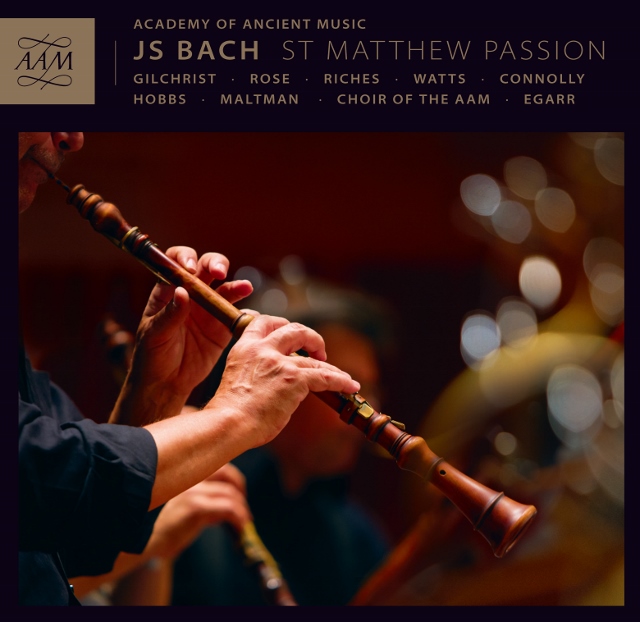
Academy of Ancient Music, Richard Egarr.
AAM Records. AAM004.
Richard Egarr director & harpsichord, James Gilchrist Evangelist, Matthew Rose Jesus, Elizabeth Watts soprano, Sarah Connolly alto, Thomas Hobbs tenor, Christopher Maltman bass. Choir of the AAM. 3 CDs. 58’40+49’39+36’19=144’38
Richard Egarr’s introductory article to this new recording of Bach’s most famous work is headed ‘Oh No, not again’. It concludes with ‘Don’t be a bowl of petunias’, an enigmatic reference to the frequently reincarnated bowl of petunias in ‘The Hitchhikers Guide to the Galaxy’. His article questions the perceived wisdom of assuming that later incarnations of a piece of music are inevitably the best and most complete. Like Handel, Bach often changed and re-ordered his music, often for the most pragmatic of reasons. Normally heard in the version developed from performances in 1736, 1742 and 1746, the Academy of Ancient Music has returned to its first known incarnation of the Matthew Passion, dating from an (assumed) Good Friday Vespers performance in Leipzig’s Thomaskirche in 1727. This early version was copied down a few years after Bach’s death by a pupil of one of Bach’s singers, but we do not know why. It is a remarkable survival.
There are several differences from the later version, many very subtle. The major ones include the fact that the double choir and orchestra structure is weakened by having just one continuo group, rather than two. This implies that the two choirs and their orchestras would have been positioned closer together, as they are on this recording. In contrast, the separation of the two orchestras is then emphasised by having both orchestra leaders (rather than just one) take on the two big violin solos, the solo in Erbame dich played from orchestra 2, accompanied by orchestra 1, with Gebt mir meinen Jesum wieder the other way round. Part One ends, not with the usual O Mensch, bewein dein Sünde groß, but with the simply-stated chorale Jesum lass ich nicht von mir. The Second Part opens with Ach, nun ist mein Jesus hun!, but sung by a bass rather than an alto. This might have spiritual significance, but could equally have been the purely practical result of which singer happened to be in best voice at the time. Perhaps the most distinctive change from the later version comes closer to the end, with the famous bass aria Komm, süßes Kreuz. This is normally the moment when the viola da gamba player takes centre stage for the complex obligato accompaniment. But here Bach chooses the elegiac sound of the solo lute (with organ), a strikingly compelling tonal alteration to the more usual sound. Other changes in instrumentation include the use of the organ and winds (rather than a ripieno choir or soloist) to bring out chorale melody in the opening chorus. More subtle changes are found in the relative reduction in ornamentation, notably in the lack of appoggiaturas (for example, in the orchestral accompaniment of So ist mein Jesus nun gefangen) – often tricky in performance.
Stephen Rose’s intelligent programme note introduces the liturgical and musical background to the Leipzig Passion. It is difficult to imagine the response of the Leipzig congregation to first hearing a work of such power, but Rose helpfully analyses the Passion’s arias within the context of Luther’s 1519 three stages of meditation and contemplation on the Passion story, something listeners of the day would have understood better than we do today.
The Academy of Ancient Music field a strong cast of soloists and instrumentalists, with an exceptional performance from James Gilchrist as the ever-communicative Evangelist. The two 10-strong choirs give gutsy readings of the turbo choruses although, when at full throttle, the sopranos display rather too much vibrato for my taste.
Richard Egarr’s interpretation is characteristically distinctive, not least for his occasionally relaxed approach to pulse and rubato. For example, in the alto aria, Buß und Rei, (CD1:10) he lingers on the penultimate note of phrases, perhaps signifying the repentance and regret of the opening line. Moments like this certainly attracted attention on my first listen, but I found my initial surprise lessened with repeated listening. Indeed, the performance as a whole combines musically strength with sensitivity, and can be thoroughly recommended, not just for the undoubted importance of hearing this rarely performed 1727 version. I have only heard it live once before, during the 2012 Leipzig Bachfest performed by Bach Collegium Japan and the Tölzer Knabenchors under Masaaki Suzuki.
The CD was recorded over a 7-day period in St Jude-on-the-Hill, with Philip Hobbs as the distinguished producer and engineer. It comes in a hardback booklet format, with the full text and an English translation. A sound sample and an introductory video can be found at http://www.aam.co.uk/#/recordings/discography/js-bach/bach-matthew-passion.aspx.
[https://andrewbensonwilson.org/2015/03/29/bach-st-matthe…n-1727-version/]



 Andrew Benson-Wilson : Early Music Reviews +