
Mayfair Organ Concerts – The Grosvenor Chapel
17 March 2026
Andrew Benson-Wilson
Early Music Day recital
Francisco Correa de Arauxo (1584–1654)
Libro de tientos y discursos de musica practica y theoríca de organo (1626)
Tiento de Quinta Tono 6′
Tiento de Quarto Tono 4’30
Segundo Tiento de Quarto Tono – a modo de canción 5’30
Quinto Tiento de Medio Registro de Baxones de Primero Tono 4’30
Tiento de dos tiples, de Septimo Tono 7′
Tiento de medio registro de tiple de Sexto Tono – a modo de Batalla 10′
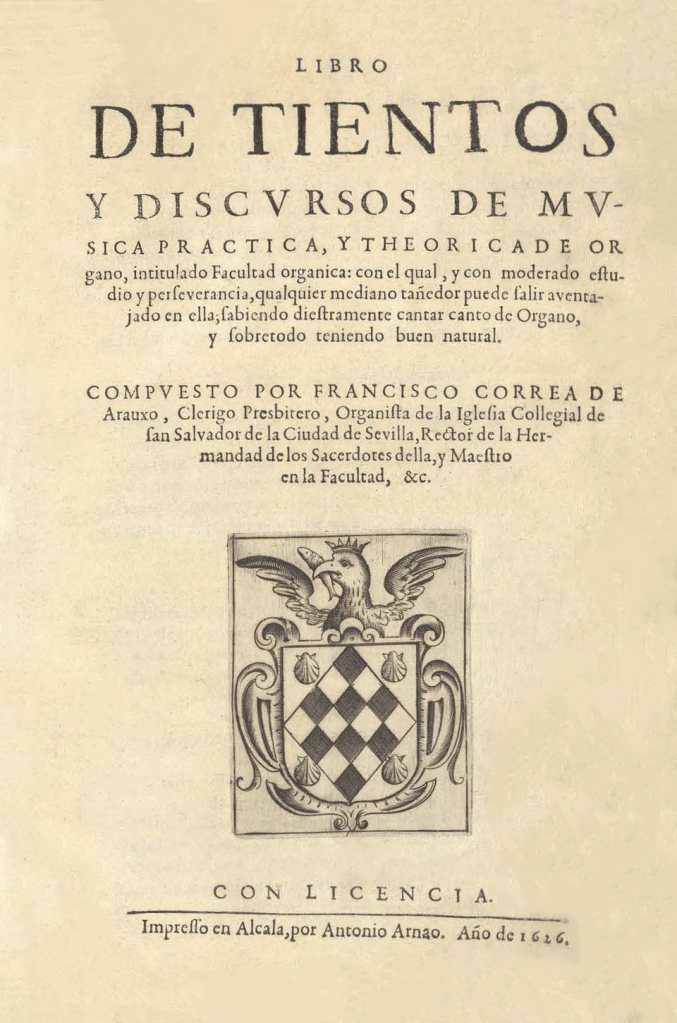
This year’s Early Music Day recital focuses on the publication, exactly 400 years ago, of the monumental Libro de tientos y discursos de música practica, y theorica de organo intitulado
Facultad organica (Book of Tientos and Discourses on Practical and Theoretical Organ Music
entitled Organic Faculty) by the Spanish organist, composer, and theorist
Francisco Correa de Arauxo.
Correa de Arauxo (1584–1654) was born in Seville. In 1599, aged just 15, he became organist of San Salvador, the second most important church in Seville. He became a priest around 1608, but became embroiled in various tussles with the authorities. He maintained the Seville post until 1636 when, after many unsuccessful attempts to become cathedral organist, he was appointed organist at Jaén Cathedral and, four years later, Segovia Cathedral, where he stayed for the rest of his life, despite repeated offers from Seville to return as cathedral organist.
His monumental Libro de tientos contains 69 pieces, of which 62 are tientos (fantasias). Despite being a virtuoso performer, his treatise is geared towards players of different levels of ability, allocating the pieces to five grades of difficulty. He gives detailed information about each piece, and instructions on many aspects of performance, including the complex and uniquely Spanish style of ornamentation. One writer compared him to the contemporary Spanish artist, El Greco, commenting that “Correa de Arauxo’s great musical tapestries are flush with all the riotous colour of that painter’s liquid silks and satins and courtly splendour.”
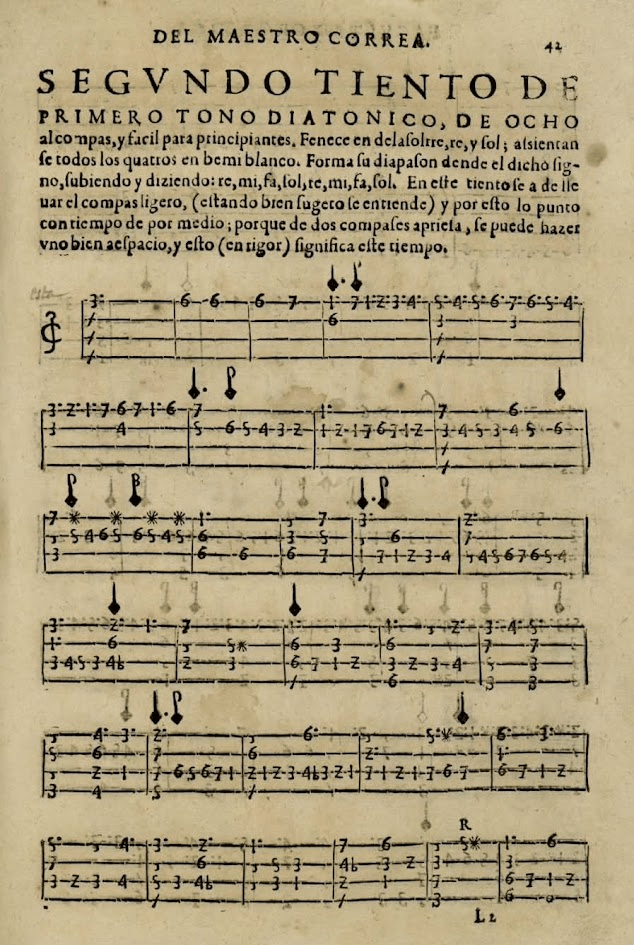
The Tiento de Quinta Tono (5) is an example of the way Arauxo transforms strict polyphonic pieces into virtuosic keyboard displays, with elaborate figurations and elaborations (glosas), enlivened by his complex system of ornamentation.
The Tiento de Quarto Tono (15) is in a contrasting mood, but similar style to the previous piece, again ornamenting a polyphonic structure, but in a more melodic, even dreamy, manner.
The Segundo Tiento de Quarto Tono – a modo de canción (16) is unusual in that, after a simple polyphonic opening, it turns into a canzona, a multi-section musical form that was developed from the Franco-Flemish polyphonic songs (chansons) by Italian composers such as Gabrieli and Frescobaldi.
The Quinto Tiento de Medio Registro de Baxones de Primero Tono (34) is an example of a piece written for the divided keyboard of the Spanish organ, in this case ‘de Baxones’, in the bass. Unusually, the last section has seven notes to the bar.
The Tiento de dos tiples, de Septimo Tono (54) is one of the most expressive pieces in the entire
Libro de tientos, its two evocatively intertwining treble voices (over three accompanying voices) giving an exotic melodic formulation that seems to hark back to the musical tradition of Moorish Spain.
The extended Tiento de medio registro de tiple de Sexto Tono – a modo de Batalla (63) is an early example of a Spanish Battle scene for organ, although unlike some of the later examples, the actual battle part is relatively short and simple. For more dramatic examples, come to my recitals on 17 May and 8 September, listed below. It starts as a divided register with a treble solo, the figuration soon quickening, leading to what seems like a patriotic song and a triple time dance section, followed by the final section marked a moda de batalla. Unlike most Iberian Battle scenes, it does not seem to be based on Clément Janequin’s famous vocal chanson La guerre (c1530) which immortalised a French victory over Swiss and Italian forces at the Battle of Marignano in 1515. It is not clear what these battle scenes were intended to represent, with theories ranging from the Biblical battle between Good and Evil to the real battles between the Christians and Moors. Historic Spanish organ cases often have Moorish faces on the pipes or the case woodwork.
© Andrew Benson-Wilson 2026
Andrew Benson-Wilson specialises in the performance of early music. His playing is informed by his experience of historic organs, an understanding of period performance techniques and by several internationally renowned teachers. He has recorded the complete organ works of Thomas Tallis. One of his Tallis CDs, with plainchant verses sung by Chapelle du Roi, was Gramophone Magazine’s ‘Record of the Month’. The Organists’ Review commented that his “understanding of the historic organ is thorough, and the beautifully articulated, contoured result here is sufficient reason for hearing this disk. He is a player of authority in this period of keyboard music.”
Andrew’s recitals have ranged from the enormous 1642 Festorgel organ in Klosterneburg Abbey and the famous 1562 Ebert organ in the Innsbruck Hofkirche, to a tiny 1668 chamber organ in a medieval castle in Croatia and the 1723 ‘Bach’ organ in Störmthall, Leipzig. One reviewer wrote that his recital in London’s St John’s, Smith Square was “one of the most rewarding organ recitals heard in London in years, an enthralling experience”. Recent recitals have included Christ Church Spitalfields and a special Handel concert in St George’s, Hanover Square for The Handel Friends.
Andrew’s little book, The Performance of Early Organ Music, is a required text in a number of Universities. He is also a reviewer, formally with Early Music Review and now reviewing on his own website:http://www.andrewbensonwilson.org. He is an elected member of The Royal Society of Musicians of Great Britain, and the Council of the National Early Music Association.
Andrew’s next London recitals are on Sunday 17 May at 3pm in the Chapel of Christ of Alleyn’s College of God’s Gift, Dulwich, with music published during The Roaring (16)20s,and on Tuesday 8 September at 1:10 in St George Hanover Square, with a programme of music from the Spanish Golden Age. Both these recitals will include further pieces by Correa de Arauxo, as well as battle scenes.
 Andrew Benson-Wilson : Early Music Reviews +