
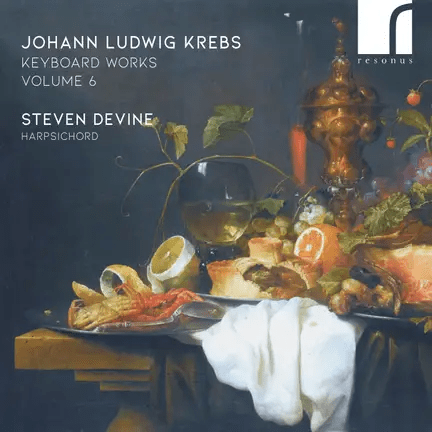
Johann Ludwig Krebs (1713-1780)
Keyboard Works, Volume 6
Steven Devine, harpsichord
Resonus Classics RES10376 (70’50)
Sechs Preambulis (Vier Pieces, Part 1, 1740)
Suite No. 5 in F Major, (Clavier-Übung, Part IV, 1746) Krebs-WV 811
Suite in A Minor ‘nach dem heutigen Gusto’ (Vier Pieces, Part 2, 1741) Krebs-WV 819
The twice-extended series of recordings of the complete harpsichord works of Johann Ludwig Krebs (Bach’s ‘favourite pupil’) has reached what now seems to be its conclusion with the release of the sixth and (we are, perhaps rashly, promised) the final volume. This disc focuses on the first two parts of the Krebs collection ‘Vier Pieces’, dating from 1740/41. Krebs had left the Leipzig Bach circle in 1737 to become organist at the Marienkirche in Zwickau. The organ was in poor condition, and Krebs’ efforts to commission a new Silbermann failed. He stayed until 1744 by which time he had married and had his first child. He also wrote a lot of music during that time, including the Vier Pieces.
The first part (Krebs-WV 813–818) contains what Krebs described as six ‘easy, well-arranged Praeambulis, according to today’s taste, for those who enjoy fine music, especially for the keyboard, for the enjoyment of the soul, and pleasant pastime…’. These well-crafted miniatures display a jaunty elegance in the gallant style. They are all titled with speed indications, apart from second (Krebs-WV 814), which is described as ‘A giusto Italiano‘., although it is in a notably different style to his beautifully melodic organ Fantasia à gusto italiano (Krebs-WV 422). The second part of the Vier Pieces, the A minor Suite ‘nach dem heutigen Gusto’ (Krebs-WV 819), concludes the recording, with its extended sequence of a Prelude and Fugue and ten dances, again demonstrating a mastery of contrapuntal technique and musical flair. Between the two Vier Pieces extracts stands the later 1746 fifth Suite from the Clavier-Übung IV (Krebs-WV 811), an example of Krebs’ musical combination of refinement and popular taste in the simpler post-Bach, post-Baroque style.
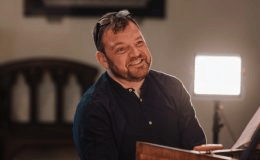
As with previous recordings in this series, Steven Devine plays a double-manual harpsichord by Colin Booth, which is based on a 1710 single-manual instrument by Johann Christof Fleischer in Hamburg. The pitch is a415Hz, and the temperament is a modified Young II, which gives a pleasant key colour to some of the more extreme sonorities. Steven Devine has an obvious affinity with Krebs’ rather jovial musical style, and plays with an attractively relaxed approach to articulation and pulse, giving a healthy sense of life to the music. He adds very effective and appropriate improvisatory elaborations and ornaments to the music.
I need to repeat the warning from my earlier reviews of this series that it only represents a part of Krebs’ keyboard music – Krebs’s extensive organ works fill another 7 full-sized CDs. Many of those compositions show a more direct Bach influence, usually to a specific Bach example that Krebs then expands, often to enormous length and complexity. That tendency is far less apparent in his harpsichord works, although there are Bach-inspired moments. The recording can be ordered here along with the earlier volumes: Vol 1 RES10287, Vol 2 RES10300, Vol 3 RES10329, Vol 4 RES10344, Vol 5 RES10357.
 Andrew Benson-Wilson : Early Music Reviews +