
Johann Sebastian Bach: ‘Marvellous are thy works’
Michael Maul
English translation by Stewart D Spencer
Hardback, 220 pages, 220x142mm, ISBN: 978-1-7391103-7-6
Jaywood Press
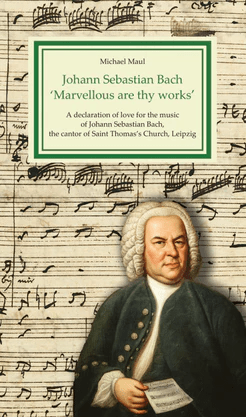
Michael Maul’s monograph, Johann Sebastian Bach: ‘ Marvellous are thy works’ has now been released in an English translation. His book aims to make Bach’s cantatas more accessible through this “passionate declaration of love for his composer-god,” aiming to inspire readers to listen anew to Bach’s works. The German edition won the 2023 Gleim Literature Prize for a work on 18th-century cultural history. Maul gives descriptions and reflections on the three Leipzig cycles of cantatas, the Matthew Passion and the B minor Mass. He also includes rather curious “personal monologues”, where he records several one-sided conversations with Bach, which he uses to promote his own observations and questions without, perhaps sensibly, allowing Bach to respond. The book comes with a Spotify playlist, accessed via a QR code, with tracks referenced throughout the book.
This is a very personal reflection on Bach and is clearly a labour of love from an avowed admirer. Although Michal Maul is a musicologist (and Artistic Director of the Leipzig Bachfest and the Bach Competition), do not expect much criticism, or even the dispassionate criticism that one might expect of an academic. I do not know if Michael Maul is a believer, but his writing suggests that he is. For example, in this extract from one of his personal monologues with “My dear Bach”, he comments that “… the restful sounds of your music make me think that there need be nothing final about death and that dying could indeed be our true reward“. That was in response to the final choral (Mit Fried und Freud ich fahr dahin) of Cantata 95, Christus, der ist mein Leben, which refers to the dying Simeon singing “in peace and joy” as he “finds his way into the afterlife”. I confess that, despite being a Bach lover and somebody who is frequently reduced to tears by music, I don’t think it would ever make me believe in the Christian notion of an afterlife. But who knows?
One minor thing that might be down to the English translation rather than the German original is that the words ‘hymn’ and ‘chorale’ seem to be used interchangeably. For example, in a discussion about one Lutheran chorale, it is referred to as a ‘chorale’ in one sentence and as a ‘hymn’ in the following sentence. I can just about work out a possible reason for this, but it might be confusing for readers. Maul does offer some reasonable explanations for some of Bach’s more unusual musical decisions, for example, in Cantata 154, setting the voice of the 12-year-old Jesus (depicting his very first words in the Bible) for a commanding bass voice.
There are several moments of musicological interest, one being a suggestion that the Matthew Passion dates from 1727 rather than 1729, which Maul bases on a sequence of 18 semiquavers from the Matthew Passion which is found on a viola part for the Sanctus, BWV 232.
There is an ‘Overview’ of Bach’s Leipzig Cantatas, giving the cantatas composed for each of the Sundays over the three years of his Leipzig Cantatas, a list of cantatas outside the Leipzig cycles, and an “Index of Bach’s works” covering the cantatas and the relevant page number. Overall, this is a book that needs to be revisited several times. It is not an easy read, and I am not sure how a newcomer to Bach would cope with it. But for Bach enthusiasts, it will be an essential book to keep beside your music system.
The English translation is published by a publishing wing of The Early Music Shop, and order details can be found here.
 Andrew Benson-Wilson : Early Music Reviews +