Mozart Birthday Concert
The Mozartists, Ian Page
Zheng Jiang, Alexander Semple
Cadogan Hall. 27 Januarys 2026
Mozart: Entr’acte from Incidental Music to Thamos, König in Ägypten, K.345
Mozart Concert Aria, “Ombra felice… Io ti lascio”, K.255
Haydn: Symphony No. 69 in C major, ‘Laudon’
Mozart: Two Entr’actes from Incidental Music to Thamos, König in Ägypten, K.345
Haydn: Three arias from Die Feuersbrunst
Mozart: Symphony from Serenade in D major, K.250, ‘Haffner’
The Mozartists‘ continued their ambitious MOZART 250 project, now entering its 12th year, with a 270th birthday concert featuring music composed during 1776. On his 20th birthday, Mozart was in Salzburg, as he would be for the whole of 1776, for the first time since he was five. By his standards, it was to prove a relatively quiet year, although it is worth remembering that he had by then already composed more than thirty symphonies, around half of his operas and all of his violin concertos! It does seem as though 1776 represented a valuable stage in his artistic development, with one writer commenting (in reference to the Haffner serenade that concluded this concert), “1776 sees the full blossoming of his rarest gifts of music and poetry.”
As well as Mozart, over the 12 years of the MOZART 250 project, more than fifty other composers have been featured. The concert focused on Mozart’s favourite contemporary, Joseph Haydn, with his ‘Laudon’ Symphony No. 69 and three arias from his comic opera Die Feuersbrunst. The Haydn arias were contrasted with Mozart’s stand-alone concert Aria, “Ombra felice… Io ti lascio” while the Laudon symphony was compared to four movements from Mozart’s ‘Haffner’ Serenade, forming a symphony, not to be confused with the better-known 1782 Haffner Symphony, composed for the same family, although that also started life as a Serenade which was later converted in a symphony. The Symphony from Serenade in D takes the first, sixth, fifth and eighth movements, omitting what is, in effect, a three-movement violin concerto and a menuetto.
Each half of the concert opened with Entr’actes from Mozart’s incidental music to the play Thamos, King of Egypt, his only venture into incidental music for the theatre. All three demonstrate remarkably innovative and dramatic music, the first with three punchy chords, seemingly a trial run for the Magic Flute, which opened the piece and reappeared in transitional moments throughout. The other two Entr’actes were similarly turbulent, with one representing a thunderstorm. Haydn usually manages to hold his own against Mozart, and his Symphony 69 in C certainly did so. What it might have lacked in intellectual or emotional depth was made up by a good-natured sense of joie de vivre, a touching sequence of sighing motifs in the Adagio and a rumbustious conclusion, supported by a vigorous bass line. A sighing motif also featured in the Andante of the concluding Mozart Symphony from the Haffner Serenade, described as “one of his earliest masterpieces, but still mysteriously neglected and undervalued”. Not, perhaps, his finest work, but certainly worth hearing.
In a change from the usual Mozartists choice of soloists, two young students from the Royal College of Music featured. The first was Chinese countertenor Jiang (a finalist at the 2025 Kathleen Ferrier Awards) singing Mozart’s only alto concert aria “Ombra felice… Io ti lascio“. It tested the lower range of his voice, and he negotiated register breaks with aplomb, although I would have preferred a less prominent vibrato. The fact that this was never intended as part of an opera made Zheng Jiang’s rather static stage presence seem appropriate.
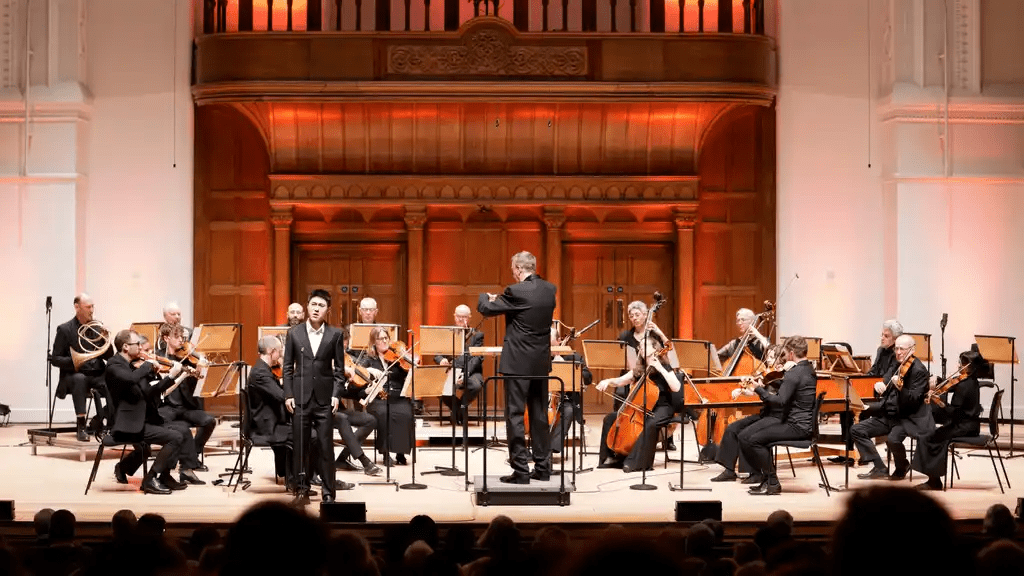
With countertenor Zheng Jiang
British baritone Alexander Semple (a former choral scholar at St John’s College, Cambridge) made more of his three arias from Haydn’s comic opera Die Feuersbrunst, all sung by the character Hanswurst (‘Hans Sausage’), a take on Arlecchino from the commedia dell’arte tradition, also used by Mozart for Papageno in the Magic Flute. Alexander Semple enjoyed the comedic elements of the three arias, particularly the last one, Da ist die Katz”, bemoaning the presence of a cat in a dark cellar.
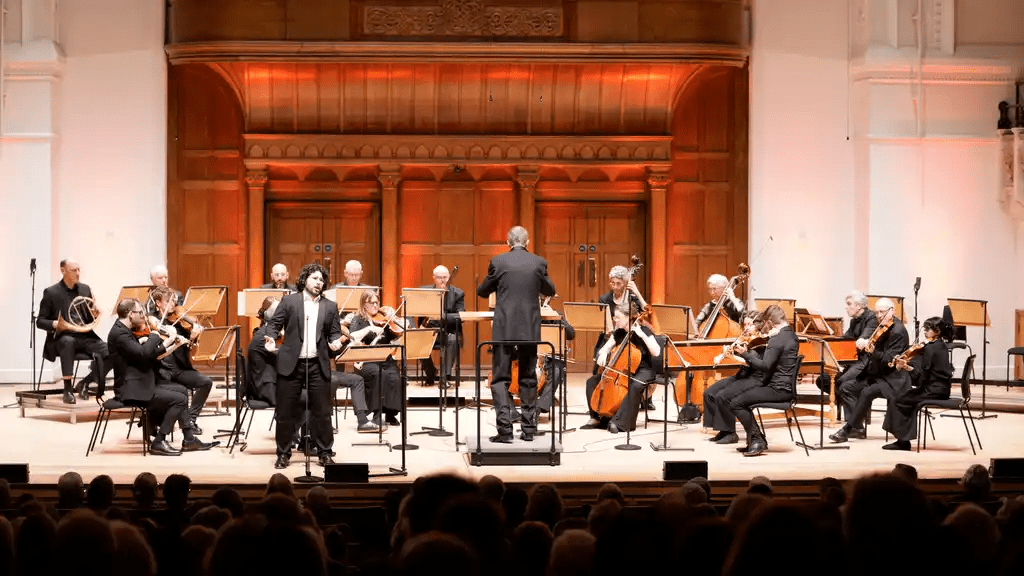
With baritone Alexander Semple
Yet another excellent concert from the ever-impressive Mozartists, thoughtfully put together and directed by Ian Page. Not perhaps the finest music, but all worth hearing. More to come in 2026. The encore was the second movement of Mozart’s Divertimento for wind sextet in B flat major, K.240.
 Andrew Benson-Wilson : Early Music Reviews +