Mozart’s World: A Little Night Music
Orchestra of the Age of Enlightenment
Kati Debretzeni, director, Katherine Spencer, clarinet
The Anvil, Basingstoke. 20 January 2026
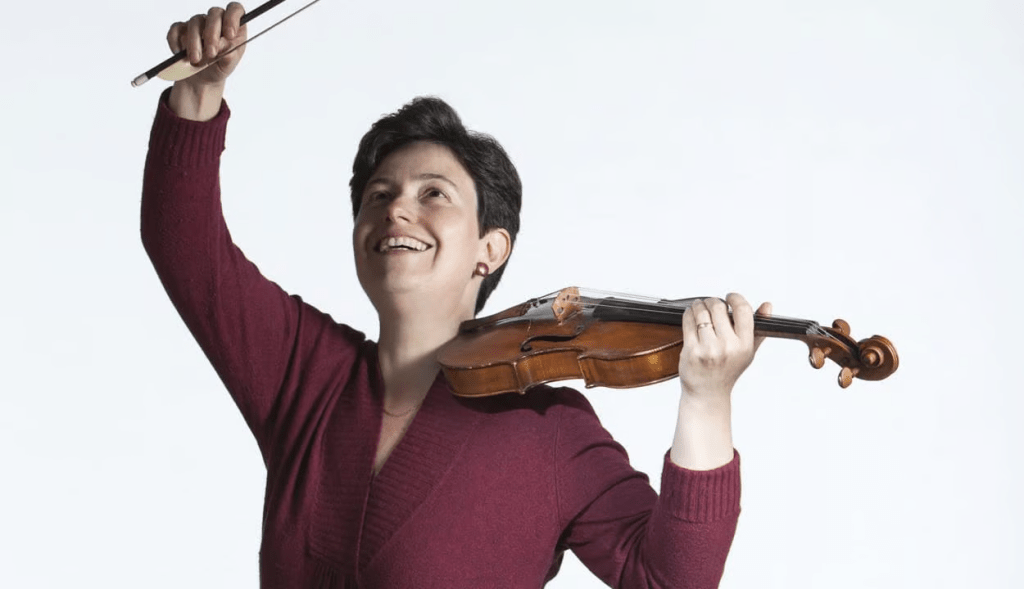
Kati Debretzeni
Juan Crisóstomo de Arriaga: Overture in F minor Op. 1 (1817)
Mozart: Clarinet concerto
Michael Haydn: Divertimento in G (1780)
Mozart: Eine kleine Nachtmusik
The Orchestra of the Age of Enlightenment is opening its 40th anniversary year with a short tour of a fascinating programme that, in inevitable OAE style, merges well-known pieces with little-known gems. They started their tour in the excellent acoustic of Basingstoke’s Anvil concert hall, a space that, although large, coped with the modest chamber-sized band with an appropriate intimacy. The three composers were linked by time, birthdays and friendship. Two of Mozart’s best-known pieces were balanced by music from his friend Michael Haydn and the extensively monikered Basque composer, Juan Crisóstomo Jacobo Antonio de Arriaga y Balzola, born in Bilbao 50 years to the day after Mozart. He was known as the ‘Spanish Mozart’ in honour of his prodigious talent, the birthdate link, and his tragically early death, just before his 20th birthday. Another link, which the concert organisers may not have noticed, is that both Arriaga and Mozart shared the same first two baptismal names (based on their birthdays being the feast of St. John Chrysostom, although Mozart’s first names of Joannes Chrysostomus didn’t last much beyond baptism.
Juan Crisóstomo de Arriaga’s Overture in F minor was composed when he was just 12. Given his age, it is a remarkably competent piece (often referred to as Nonette), with a short, dramatically dark opening in F minor before reverting to a brighter F major for the rest of the piece, which was rather skittish in nature, with its little gaps in the themes. The principal piece of the evening followed, Mozart’s Clarinet Concerto, although perhaps not as we usually hear it. Although Mozart composed it for a basset clarinet, published editions after his death rescored the piece for the normal clarinet, with the lowest notes transposed up an octave. The original manuscript is lost, but we know it was written for Anton Stadler, Mozart’s friend and the inventor ot the lower-pitched basset clarinet, and the even lower basset horn. Since the 1950s, there have been several performances with the basset clarinet, usually playing on instruments specially made for that purpose. This was another example, with the first public appearance of a new basset clarinet made by Guy Cowley for the soloist Katherine Spencer (who, for some reason, is usually known as Waffy). Rather than using Stadler’s sketch as inspiration, this example was built in the French style. A video of Katherine Spencer explaining the bassett clarinet (in a rather curious presentation style) can be found here. The photo below is a screenshot from a video, and compares it to the normal clarinet.
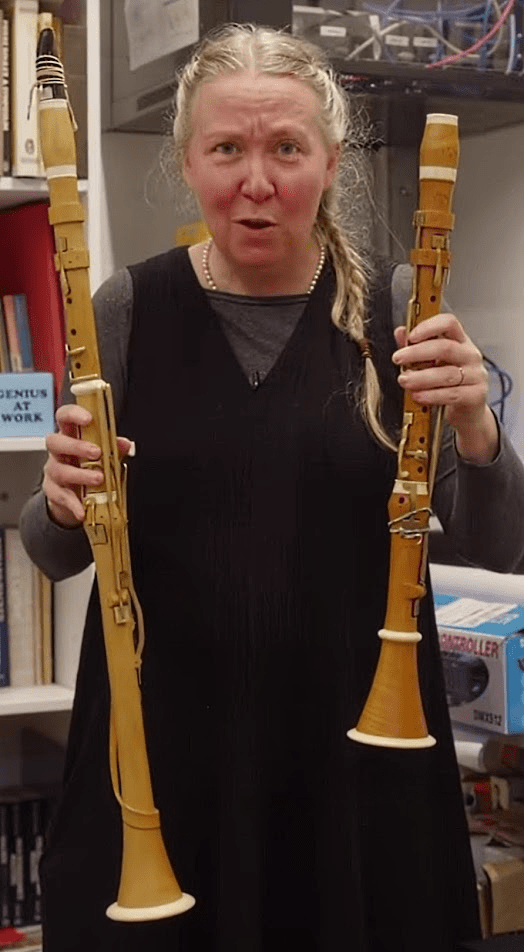
Katherine Spencer
What particularly impressed me in this performance, and indeed, the interpretation of all the pieces, was the use of rhetorical gestures, something often avoided in period performance. The subtle pauses and inflexions of pulse all suggest to me a performance by musicians, not merely readers of notes. One example of this, which worked so well in the Anvil acoustics, was the extremely low volumes – all perfectly audible, but having the effect of pulling the listener in to the music.
The second half opened with an even smaller chamber ensemble, with just five players (violin, viola, cello, flute, horn) performing Michael Haydn’s Divertimento in G, composed in 1780. This is an example of the music of Vienna society, its sequence of six short dance-related movements easy on the ear and unlikely to interrupt the social interuptions. But devoid of such social interuptions, it was a treat to actually listen to the music itself, something that also applied to the concluding Eine kleine Nachtmusik, a Seranade with a similar ‘background music’ idea as the Divertimento. Listed by Mozart in his catalogue or works as “a little night music”, it reflects the relaxed nature of the music, and the occasion for which it might have been written – probably a party.
Both halves of the concert ended with staged encores, based on windband transcriptions of Mozart operas, in this case, I think, Die Entführung aus dem Serail. Wearing masks, a bassoon and basset clarinet took the roles of a couple going through problems, the action interpreted in the first encore by an animated Sophie, an OAE staff member, who bounced onto the side stage holding up various action cards, ending in Kapow, Thwack, and RIP. Some sort of reconciliation seems to have occurred during the second half, as the second encore seemed to suggest some sort of resolution. All good fun.
As well as the principal basset clarinet soloist, other players who deserve mention are director Kati Debretzeni, Andrew Skidmore, cello, Lisa Beznosiuk, flute and Fergus Butt and Christopher Rawley, bassoons.
 Andrew Benson-Wilson : Early Music Reviews +