Medieval Carols by Candlelight
Angela Hicks
Patricia Hammond, May Robertson, Louise Anna Duggan, Jean Kelly
St Giles Camberwell, 11 December 2025

The vast church of St Giles Camberwell was packed with an enthusiastic audience for a magical concert of Medieval Carols by Candlelight given as part of a UK-wide tour arranged and directed by singer Angela Hicks with Patricia Hammond, voice, May Robertson, fiddle and voice, Jean Kelly, harp, and Louise Anna Duggan, percussion, all playing under the banner of Ancient Music Promotions. Their wide-ranging choice of music covered most of the genres of medieval music, ranging from the 12th-century mystic Hildegard von Bingen to the mid-17th-century, together with the music for a 15th-century poem set to music specially for this tour by the group’s percussionist, Louise Anna Duggan.
Although several of the pieces were known, many were new to me or were performed in inventive arrangements, some by the local musician, the late Belinda Sykes, as performed by her medieval group Joglaresa, which most of the evening’s performers had been part of. They opened with Riu, riu chiu, a Spanish villancico found in the Cancionero de Uppsala, published in 1556 in Venice. The title forms the refrain, apparently reflecting the sound of a nightingale. The first of two extracts from the 13th-century Cantigas de Santa Maria was A que por mui gran fremosura, telling the story of a dying caligrapher monk. Britain was represented by Balulalow, a 16th-century Scottish cradle song, and a traditional Welsh Carol. The first of four opportunities for communal singing (sang with varying degrees of success by the audience) came with Unto Us is Born a Son from 14th-century Germany. It was followed by Belinda Sykes’ arrangements of the Gaelic carol, Christ Child’s Lullaby.
There then came the highlight of the whole evening for me, Now Have a Good Day, composed by the group’s percussionist, Louise Anna Duggan, a beautiful setting of a 15th-century English medieval poem from a Balliol College manuscript. The verses cover the whole range of Christmas From Hallowtide till Candlemas, each closing with the catchy refrain Now have good day!, which must have immediately become an earworm for the entire audience. You can hear part ot it in a promotional video here. It really should be recorded and released as a Christmas single.
The rest of the first half included pieces from the mid-16th-century Trinity Carol Roll, the c1399 Llibre Vermell de Montserrat, more pieces from the Cantigas de Santa Maria and Piae Cantiones, ending with The Old Year Now Away is Fled, a 17th-century piece from a 1642 manuscript in the Ashmolean Library.
The interval (which, appropriately, included a raffle for a bottle of mead) was followed by the distant voice of Angela Hicks singing O vis aeternitatis by Hildegard von Bingen from way back in the choir. Unfortunately, it took a while for the audience to realise that she had started. Two communal singalong opportunities came with Of the Father’s Heart Begotten and Gaudete, sadly with little improvement in the audience’s singing. Two interesting carols were the Finnish carol Heinillä härkien kaukalon, based on the 17th-century French carol Entre le bœuf et l’âne gris, and Ecce Mundi Gaudium from the Wienhäuser Song Book (c1460), a manuscript belonging to women connected with the Devotio Moderna movement in the Netherlands and north-west Germany.
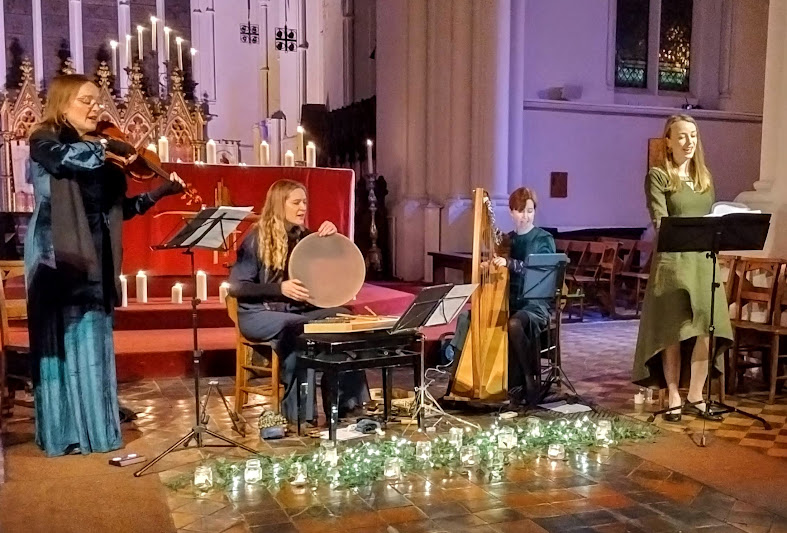
Each of the five musicians introduced the pieces and, in the case of the fiddle and percussion, explained their instruments. The fiddle turned out to be a violin, albeit furnished with appropriate gut strings. This was an excellent concert from an ambitious and clearly successful tour, and was very well received by the enthusiastic Camberwell audience. The tour continued with events in Salisbury
 Andrew Benson-Wilson : Early Music Reviews +