
Dieterich Buxtehude: Complete organ works
Urtext: Critical Source Edition
Ed. Harald Vogel
Breitkopf & Härtel. 2025

The release of the third and final volume of the Edition Breitkopf complete organ works (the choral works, in two sub-volumes) of Dieterich Buxtehude marks a considerable achievement in the complicated history of the transmission of the Lubeck master’s organ works. Edited by Harald Vogel, one of the pioneers of the modern interpretation of Buxtehude and his North German organ composer predecessors, the new edition answers many of the questions that Buxtehude interpretation has raised over the years. One of the many problems is that there are no autograph copies of any of Buxtehude’s organ pieces. We only have copies, which may or may not be based on authentic autographs. This new edition is a “pure source” edition, with no attempts to combine different transmissions or to apply editorial “corrections” to the texts.
The complete Buxtehude edition is published in five separate books covering three volumes, along with individual sets of the first and third volumes and a slipbound edition of all five books. (EB 9472: ISMN: 979-0-004-18952-8. 204 pages, 30.5 x 23 cm, 2,335g). The first two volumes include the free works; volume one (in two parts) has the pieces with notated pedal, and the second volume has the pieces for manuals only. The two parts of Volume 1 are also available as a combined set under the order number of EB 9415. The two-part third volume includes the organ chorales.
EB 9304 Vol. I/1: Free Organ Works (pedaliter) – BuxWV 136–153, 158
ISMN: 979-0-004-18768-5 (108 pages, 30.5 x 23 cm, 419g, Softbound)
EB 9305 Vol. I/2: Free Organ Works (pedaliter) – BuxWV 154–157, 159–161, App. 5
ISMN: 979-0-004-18769-2 (84 pages, 30.5 x 23 cm, 340g, Softbound)
EB 9306 Vol. II: Free Organ and Keyboard Works (manualiter) – BuxWV 162–176, 225
ISMN: 979-0-004-18770-8 (84 pages, 30.5 x 23 cm, 331g, Softbound)
EB 9470 Vol. III/1: Organ Chorales A–L – BuxWV 177–178, 180–202, 210, 218
ISMN: 979-0-004-18950-4 (96 pages, 30.5 x 23 cm, 386g, Softbound)
EB 9471: Vol. III/2: Organ Chorales M–W – BuxWV 76, 179, 203–209, 211–217, 219–224
ISMN: 979-0-004-18951-1 (108 pages, 30.5 x 23 cm, 429g Softbound)
Volumes I/1 and III/1 only contain the music, but Vols. I/2, II and III/2 also include critical reports and comprehensive texts on notation, ornamentation and other aspects of interpretation. Volume III/2 also contains detailed information on Buxtehudeʼs organs in Denmark, Sweden and Lübeck. The two books of Organ Chorales, just published, helpfully divide the large-scale chorale fantasias between them, rather than arranging them all in alphabetical order.
Breitkopf was the first publishing house to publish a Buxtehude organ work, in 1793 (Wie schön leuchtet der Morgenstern). Since then, there have been many editions, generally relating to the interpretation style of the time. This new edition is a practical source edition, based on specific single sources (historical notation transmissions) supported by Harald Vogel’s decades of experience as an organist and musicologist. The layout of the music is clear, although not overly large, with sensible page turns. This example of the second page of the large-scale choral fantasia Gelobet seist du, Jesu Christ, shows the sensible layout of the complex movement of the melodic line from the treble to the bass, with hand crossings.
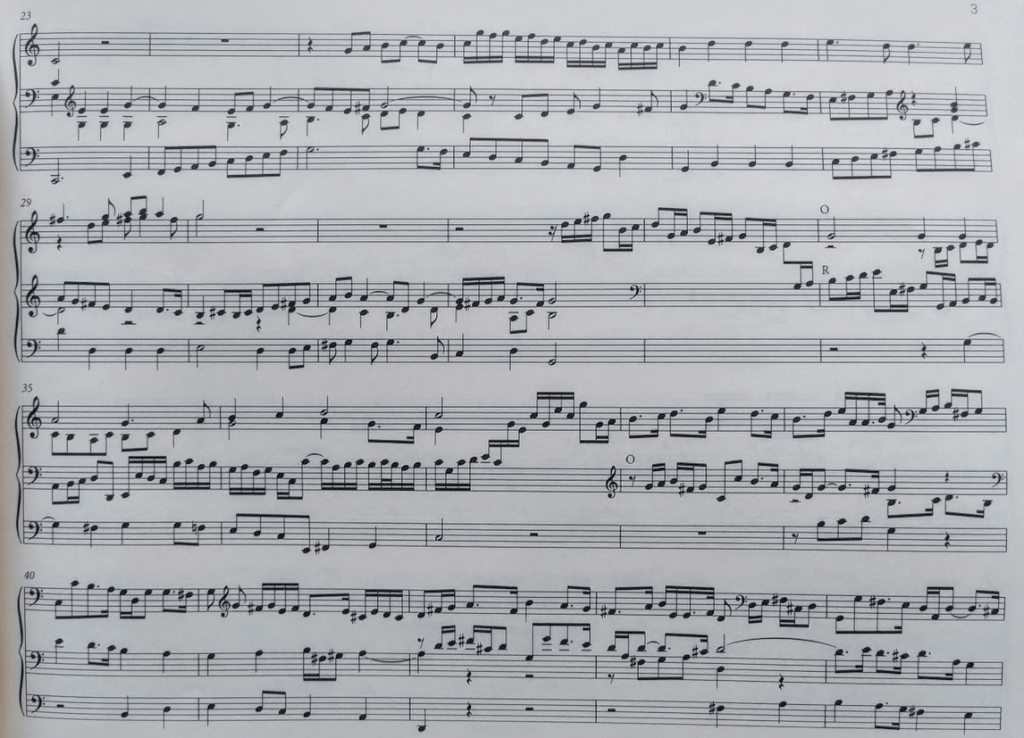
Gelobet seist du, Jesu Christ. BuxWV 188
The five volumes present the notes on two and three staves, with pedals only notated when specifically mentioned in the sources, or obviously required. Passages that cannot be performed on the manuals alone use three staves; otherwise, two staves are used. In several fugues notated on two staves, pedal playing is only required at cadenzas. This raises the question of the use of pedals in Buxtehude’s free works, and reflects some of Vogel’s previous observations on performance (many of which I encountered through performing in masterclasses with him), one of which is playing passages on the manuals alone when possible (as is often the case in fugues). Another is soloing out (usually treble) melodic lines when the texture allows a melody and accompaniment treatment.
The edition avoids unnecessary rests or the use of inappropriate modern time signatures in Baroque time structures. This is of particular relevance in the Toccata in d, BuxWV155, where there are several sections notated in four-four ‘C’ time but which are clearly rhythmically in triple time. Some editions have attempted to “correct” that, but, in doing so, have created additional notational problems. As Vogel points out in the critical notes, “The continuous C notation observed in the sources of the 17th and 18th centuries is methodically the best option for the present incompatibility of meter signature and notation. The occasional differences of meter and notation within the same basic meter (on quarters) is one of the hallmarks of Buxtehude’s free style.”
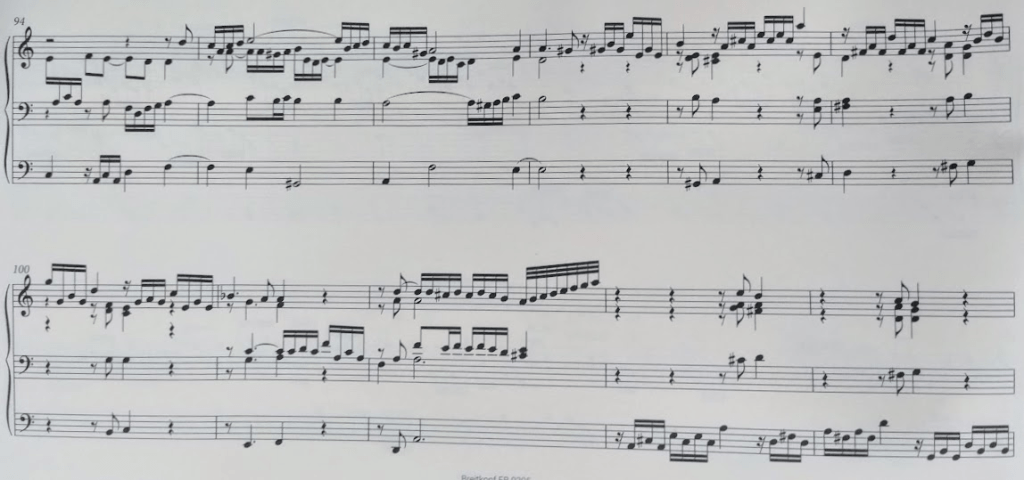
Toccata in d, BuxWV155. Triple time music notated in 4/4 ‘C’ time
The short prefaces are in German and English. The comprehensive critical notes are all in German in the published editions, but are available in English from a download link on the edition page of the Breitkopf website. The English translation for the organ chorales will be available soon. The critical notes include detailed information on the sources, and facsimiles showing how the original letter tablature can lead to transcription errors, notably in confusing the notes a, c and e, errors in octave placement, note valuation errors and errors in accidentals.
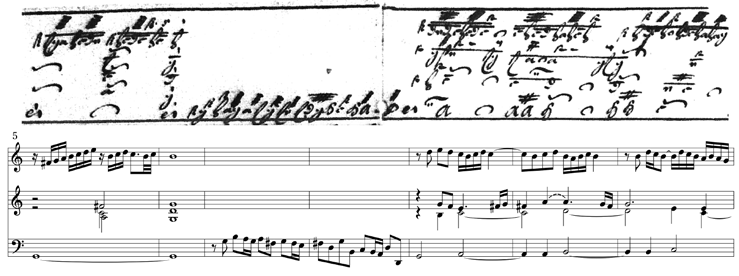
Praeludium ex G, BuxWV 147, mm. 5–11. Facsimile and transcription.
With such a source-critical edition as this, the performer is left to make their own decisions as to whether any of the notes could be affected by the possible transmission errors. That may not be as easy as merely accepting an editor’s interpretation (which in some editions is not made clear), but it rightly places responsibility for interpretation on the performer. This is an edition for those who take the performance of composers like Buxtehude seriously, reinforcing my own view that Buxtehude is a thinking man’s composer. With no idea of how most of his music was performed, very rare indications in the available scores on such matters as speed, regisrations, etc, and considerable doubt about some of the actual notes, that approach has been fundamental in the interpretation of 17th-century North German organ music over the past fifty years or so, aided by the likes of Harald Vogel. The well-known Praeludium ex G (BuxWV 149) is given in both of the two surviving versions, the key difference being in the opening pedal ostinato and the notation of the manual figuration.
This edition is based on five key manuscripts from the period up to the early 18th century containing important Buxtehude works: Codex EB1688 originated in Dresden, the Lindemann Tabulaturen includes references to Buxtehude’s teaching in Lübeck, the Berlin Manuscript [Ms]1 was probably produced in Lübeck, and the Möller Manuskript and Andreas Bach Buch, two anthologies created by JS Bach’s older brother Johann Christoph in Ohrdruf.
Past editions include the edition by Philipp Spitta (Breitkopf & Härtel, 1875), Alte Meister des Orgelspiels of 1904/1929 edited by Karl Straube, and an edition by Hermann Keller (Edition Peters, 1938). Amongst Romantic era editions was one fascinating one from France with performance instructions by Charles Tournemire (Editions Salabert) reinterpretation of Buxtehude’s organ works to meet late and post-Romantic notions of interpretation.
The availability of new sources resulted in new editions with few modern additions from Max Seiffert (Breitkopf & Härtel, 1939) and the popular edition by Josef Hedar (Hansen, 1952), based on Scandinavian Buxtehude sources. Klaus Beckmann (Breitkopf & Härtel, 1971) attempted to approximate the music text of the lost Buxtehude manuscripts, evening out many aspects of the surviving musical text to conform to debatable notions of Baroque composition. More recent critical editions by Michael Belotti (Dieterich Buxtehude, Collected Works, Vol. 15 A/B, New York, 1998) and Christoph Wolff (Vol. 17, 2016) were based on tablature-conforming notation, which, for example, avoided beaming of individual eighth and sixteenth notes and was exclusively laid out on two staves. Most of the source designations from that edition were adopted in this Vogel Breitkopf edition.
Most organists will already have several earlier editions of Buxtehude’s organ music, but this new edition is essential for a deeper understanding of the music, the nature of its transmission, together with the priceless nuggets of information in the critical analysis.
 Andrew Benson-Wilson : Early Music Reviews +