
Ricordanze: a record of Love
Music of the Biffoli-Sostegni manuscript
Musica Secreta, Laurie Stras
Lucky Music Ltd. LCKY005. 2CDs 50’28 + 51’20
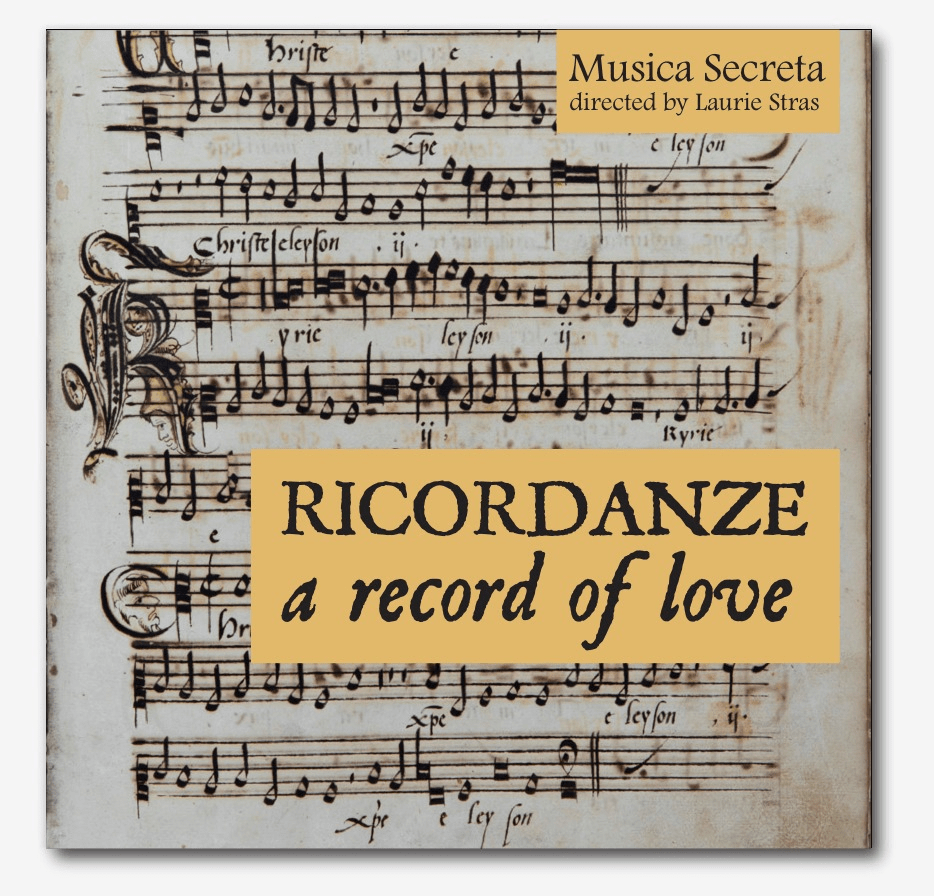
This recording from Musica Secreta is the result of serious musicological research combined with a labour of love – a fulfilling combination. Ricordanze: a record of Love is an audible culmination of a decade or more of research by Musica Secreta’s director, Laurie Stras (Emeritus Professor of Music at the University of Southampton), into the Biffoli-Sostegni manuscript (Bibliothèque du Conservatoire royal de Bruxelles, MS 27766). It dates from 1560, and is the only surviving manuscript of polyphony from a sixteenth-century convent. The title comes from the names of two nuns embossed on its binding. It belonged to San Matteo in Arcetri, a small convent community in the hills just south of Florence. It was where Suor Maria Celeste Galilei, the eldest daughter of Galileo Galilei, spent her life. Through the “haunting and extraordinary music of sixteenth-century nuns who sang their community through siege, plague, and deprivation”, the recording narrates the convent’s history, from the 1530 Siege of Florence to the final letters written by Suor Maria Celeste Galilei (a later convent choirmistress) to her father in 1634. The San Matteo is depicted in the left foreground (the red building) in Vasari’s painting of the 1530 Siege of Florence.

Vasari: Siege of Florence.
Laurie Stras comments that “The Biffoli-Sostegni manuscript has captivated me for a decade, which is how long it took me to find where it came from, to reconstruct its contents from its crumbling pages, and to understand its place in both the story of Florence and in the history of women making music. It’s a uniquely important document for both musicians and historians, but I was utterly beguiled by the strange beauty of its music, too.”

(Laurie Stras. photo: Andrew Mason)
The singers are sopranos Ailsa Campbell, Amy Carson, Victoria Couper, Yvonne Eddy, Elspeth Piggott and Kristiina Watt; mezzo-sopranos Luthien Brackett and Katharine Hawnt; and alto Caroline Trevor. They are accompanied in various combinations by Claire Williams, organ, Alison Kinder, bass viol, and Kristiina Watt, lute, and the whole is directed by Laurie Stras. They sing with clear and often forthright voices, with a noticeable differentiation in tone and timbre. It would be interesting to know how the nuns of the San Matteo sang at the time of this manuscript, but I rather doubt that they would have produced such a compelling sound, collectively or individually. Each singer is noted against each piece in the programme note, which also gives a fascinating and detailed account of the background to the music.

The recording includes two Mass settings, the Messa sopra Je le lerray composed towards the end of the 1520s when the nuns were moved into Florence as they “could hear the trumpets of the Siege of Florence and snippets of a Florentine motet that begged God for protection from plague and war”, and the Messa sopra Recordare Virgo Mater, which recalls a time in 1541 when “lightning struck the convent’s bell-gable, and the abbess ordered an annual thanksgiving mass because no one was hurt”. The recording concludes with one of the three sets of the five Vespers psalms and one of the four Magnificats, all composed in the alternatum style with alternating plainchant and polyphony.
The rest of the recording consists of tiny motets, some not much longer than a minute, many perhaps reflecting the nuns’ weekly rituals when the whole community would visit specific sites within the convent. These included the convent’s miraculous crucifix (that, apparently, restored the water supply to a dry well) on Fridays and the statue of the Blessed Virgin Mary on Saturday. There, they would all sing a hymn, a song, or a litany together. The Vespers antiphon O cruz, splendidor could well be an example of the music sung in front of the crucifix. Inevitably, there are many devotional songs to the Virgin, together with secular songs suitable for private devotion. The music is varied, ranging from simple songs to complex polyphony and includes many musically fascinating moments, for example, the hypnotic repetitive motivic patterns in Sanctus of the Messa sopra Recordare Virgo Mater.
Quite apart from the musical and historical interest, it is a delight to hear the distinctive sound female voices in what is usually such a male-dominated musical environment.
The album is a companion to an extended online essay, Music at a Florentine Convent: the Biffoli-Sostegni Manuscript and Suor Maria Celeste Galilei, due to be published by Cambridge University Press in December 2025.

(photo: Bibliothèque du Conservatoire Royal de Bruxelles)
 Andrew Benson-Wilson : Early Music Reviews +