
International Young Artist’s Presentation
Laus Polyphoniae 2025
AMUZ, Antwerp. 23 August 2025
The annual International Young Artist’s Presentation (IYAP) is a coaching and presentation scheme promoted by AMUZ (Flanders Festival Antwerp) and the Musica Impulscentrum. Its aim is to help promising young musicians “grow into tomorrow’s stars”. Six young early music ensembles are invited to three days of coaching by early music specialists before performing short programmes during public concerts on the first Saturday of the Laus Polyphoniae festival (reviewed here). Unlike many similar young artist events, it is not a competition but an informal opportunity for young musicians to develop their performing style. An invited Feedback Committee of concert promoters and others comment privately on these public performances. Scarily for me (and possibly them) my reviews are far from private, but I hope they will be equally helpful.
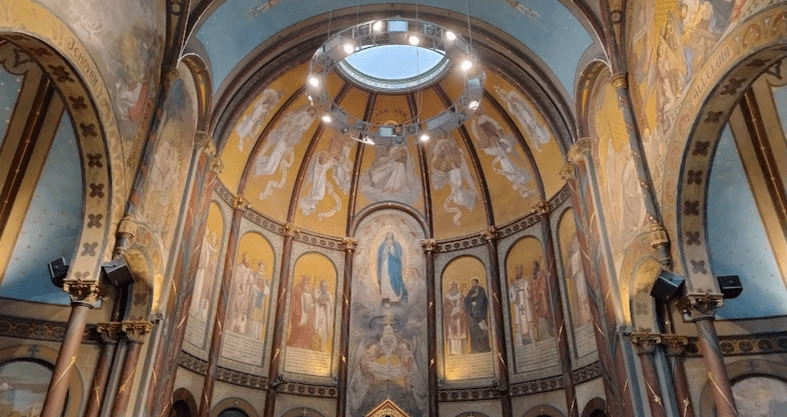
The focus of this year’s Laus Polyphoniae festival is “Ars Antiqua – Ars Nova – Ars Subtilior” with a focus on “Polyphony from the age of cathedral builders (1140-1440)”. The programmes for the IYAP groups are not tied to that remit, as was made obvious by the first pair of musicians, a clarinet and guitar duo founded in 2023, performing under the name of Café 1830 (Marguerite Neves, 19th-century clarinet, and Elodie Bruzstowski, 19th-century guitar). They met at the Paris Conservatoire and are dedicated to exploring the world of 1830s salon culture on historical instruments, music that is about as far as you can get from the festival’s opening concert of music of the Notre-Dame School c1200.

Reflecting domestic music-making in the context of a bourgeois salon, they featured arrangements of popular pieces for smaller ensembles, including a Sérénade by Iwan Müller, two Chopin Waltzes, a Sonata concertata by Paganini, and Fanny Hensel-Mendelssohn’s Schwanenlied. I particularly liked the mellow tone of the period guitar and the subdued tone of the clarinet when played quietly in a low register. I don’t know how much research Café 1830 has done into the performance practice of this genre, but I found some aspects curious, the principal one being their disconcerting pauses within pieces. It was almost as though somebody was pressing the pause button on a remote control! Sometimes these gaps were longer than the gaps between pieces, which made it tricky to follow the programme, which had changed since the programme book was published. Judging by the audience applause, it would seem that Marguerite Neves managed to speak in impressive Flemish, while Elodie Bruzstowski, helpfully for me, spoke in English.
They were followed by the Brussels-based Auroras Mestizas (Edilsa Samanez, soprano, Sophie Paeshuyse, violin, Maria Florencia Romero, violin, Jose Huamani, viola da gamba, Giorgios Kakitsis, theorbo, and Vasco da Silva Pereira, harpsichord) with their programme of Love, against divine tempests. This featured music by 18th-century European and Latin American composers, “reflecting resilience in the face of life’s dangers”. As their name suggests, Auroras Mestizas represents a dawn (Aurora) in early music, from musicians of different origins exploring links between 18th-century Latin American mixed-race musicians (Mestizos) and their European counterparts. Their concert featured music by Arcangelo Corelli, Roque Ceruti, Nicola Porpora, Alessandro Scarlatti, Jean-Marie Leclair, and José de Orejón y Aparicio.
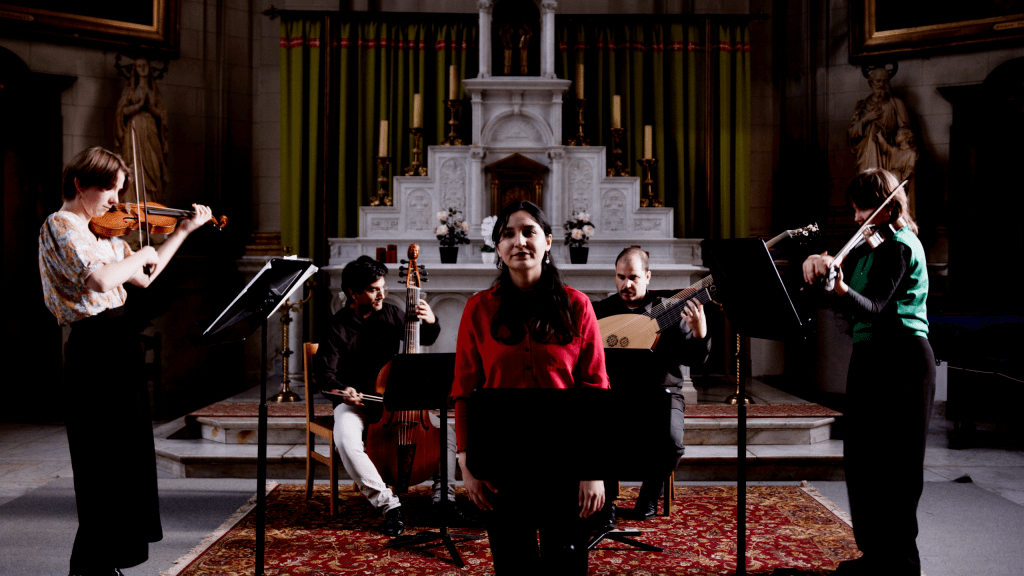
Divided by the Atlantic Ocean, Roque Ceruti was the one who moved from Italy to Peru, where he taught José de Orejón y Aparicio, who later included Italian music when maestro di capella in Lima Cathedral. The other composers were well-known in Latin America. Alternating instrumental and vocal music, the opening violin sonata by Corelli segued into a cantata by Ceruti followed by cantata movements from Scarlatti and José de Orejón y Aparicio. The two violins intertwined elegantly in the Affettuoso movement from Porpora’s Sinfonia da Camera (Op2:5) and a Sarabande by Leclair. But for me, the highlight was the excellent singing of the Peruvian soprano, Edilsa Samanez. Her engagement with the music and the audience was obvious and was accompanied by her clear and unaffected voice, focused tone, clear diction, and minimal vibrato reinforcing the accuracy of her intonation.
The male French duo Les Trouveurs (Mathias Lunghi, voice and Camile Macinenti, voice & percussion) focuses on medieval music, following their training at the Centre de musique médiévale de Paris. The duo aim to champion the medieval a cappella vocal duo repertoire, both sacred music and the secular songs of troubadours and trouvères. On this occasion, their programme, On demande mout souvent qu’est amours (“We often ask what love is”) focused on the love songs of Adam de la Halle and other trouveres. Originally from northern France, Adam de la Halle worked for the Count of Artois before settling in Naples in the French-speaking court of Charles of Anjou, King of Sicily and Naples, where he composed songs, plays, motets, and poems. Other composers represented included Machaut, Thibaut de Champagne, a Count who became king of Navarre, and the knight, Phillippe de Remi.

Their use of different stage positions added to the interest of their concert from the start, with one standing behind the other, the one behind singing a drone. Their singing was expressive, whether solo or as a duo, and well-balanced, with excellent intonation. Simple percussion effects were added towards the end, although not all of them were audible. With just two people, they are an eminently portable musical duo, an important issue in today’s musical climate.
Fortepiano Atelier (Szymon Strzelczyk and Bartlomiej Fras, violins, Natalia Reichert, viola, Matylda Adamus, cello, and Eliza Pawlowska, fortepiano) is a group of musicians based in Krakow, Poland. They concentrate on 19th-century chamber music, using historical instruments and historically informed performance practice. Their programme for this performance was Robert Schumann’s Piano Quintet in E-flat major, Op. 44 and the Allegro agitato from Stanislaw Moniuszko’s String Quartet No. 1.

They played with a well-integrated sound, the distinctive sound of the period piano being key to that sound, helped by the excellent balance between the piano and the four string instruments. They caught the rather rhapsodic mood of Schumann’s opening movement perfectly, while Eliza Pawlowska’s excellent fortepiano playing shone in the more lyrical moments and excited in the more vigorous passages. They controlled Schumann’s ebb and flow, well, notably as they approached the short concluding fugue. Fortepiano Atelier also try to seek out little-known composers, one being Stanislaw Moniuszk from Poland. He studied in Berlin before working as an organist in Vilnius and conductor at the Warsaw Opera. The Allegro agitato came from the first of two string quartets dating from 1840 toward the end of his time in Berlin. The role of the first violin was more prominent in this piece than in the more integrated Schumann.
The Amsterdam-based ensemble Pont Baroque (Alison Lau, soprano, Aysha Willis, traverso, Riccardo Casamichiela, harpsichord, Osian Jones, cello & artistic direction) gave a programme of 18th-century chamber music from the two major Italian music centres: Spanish Naples, the epicentre of vocal art, and Rome, renowned for its instrumental music. The programme features vocal and instrumental works by Alessandro Scarlatti, Leonardo Vinci, Johann Adolf Hasse and Giuseppe Capani. Scarlatti worked in both cities, first in Rome for the exiled Christina of Sweden and then in Naples for the Spanish viceroy. One of his last students was Hasse, who moved from Hamburg to Naples in 1722, moving on ot Vienna before settling in Dresden, where he made his name. Leonardo Vinci was a Neapolitan castrato and composer who also influenced Hasse. Giuseppe Capani’s music has only recently been rediscovered.
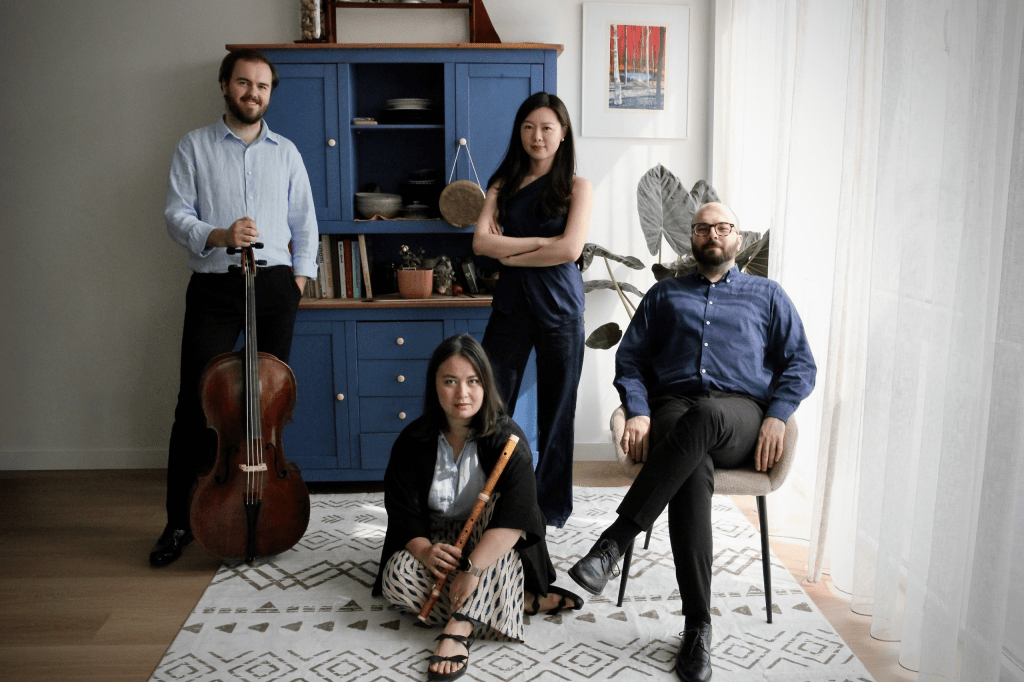
Pont Baroque were an impressive group, with an excellent singer, Alison Lau. Her expressive singing and delivery were combined with a clear and focused tone and impressive agility, notably in her well-articulated repeated note passages in the concluding cantata by Giuseppe Capani. Her simple hand gestures and stage movements were always appropriate, and she finished the Capani cantata with a little dance! Also prominent were flautist Aysha Willis, who played throughout the concert in all three cantatas and in the movements of a Flute Sonata by Leonardo Vinci which separated the cantatas, and harpsichordist Riccardo Casamichiela, whose busy continuo realisations managed to stay within the bounds of respect for the other instruments.
The final group to perform was the [H]Éros Ensemble (Sofia Pedro and Ana Parejo, sopranos, Gabriel Belkheiri Garcia del Pozon, tenor, Wessel van der Ham, bass, MengHan Wu, violin, Adriana Mendez Fernandez, viola da gamba, Xander Baker, viola da gamba, cello & violone, Giuseppe Ciraso-Calì, violone, Rafael Arjona Ruz, archlute & baroque guitar, Katerina Orfanoudaki, harpsichord). They were founded in 2022 by students from the Amsterdam and The Hague conservatories. Their programme Le Ballet d’Eros, described as “Cosmography of Love and Contempt at Court c1640”, recreated a ‘ballet de cour’ around the figure of Cupid using a selection of 17th-century multi-voiced ‘airs de cour’ by composers such as Etienne Moulinié, Jean Boyer, and Antoine de Boësset, to tell the story of two lovers – a god and a mortal.

Given the very French nature of their programme, I was surprised that they started with a piece by Michael Praetorius, but it was suitably French from then on, albeit in a slightly different order from the printed programme book. The programme concept was excellent, and it was well presented, with fine singing and instrumental playing. French is a tricky language to sing – the lack of consonants can make words indistinct. It makes for beautifully flowing lines of music, but is not so helpful when trying to pick out individual words. They made effective use of different groupings.
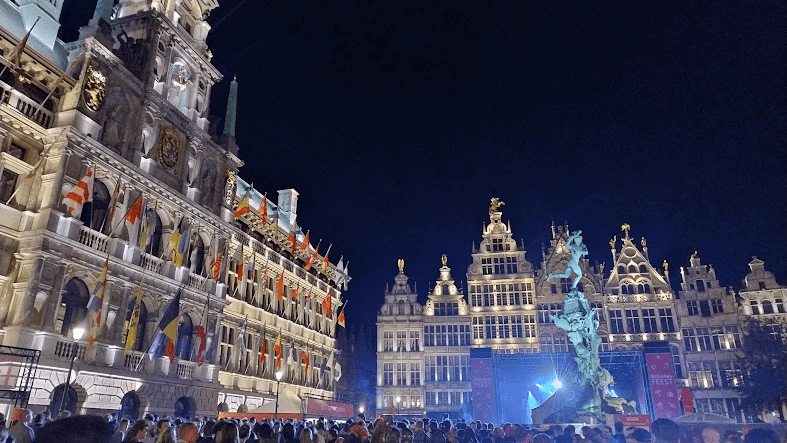
Next year’s Laus Polyphoniae 2026 is from Friday 22-31 August 2026, so the IYAP presentation will presumably be on Saturday 23 August. The six on-the-hour concerts on the first Saturday of the Laus Polyphoniae festival are an excellent introduction to the musical delights to come and an encouraging insight into the musical delights to come as the young musicians reinforce their careers. And for those whose musical tastes are wide, the opening weekend of Laus Polyphoniae coincides with the rather noisier Bollekesfeest in the city’s main squares.
 Andrew Benson-Wilson : Early Music Reviews +