The Great Toccata
Daniel Moult
Fugue State Films & RCO Cinema

I have reviewed several of the excellent films produced by Will Fraser’s award-winning Fugue State Films (see here). Their latest offering heralds a new and welcome collaboration with the Royal College of Organists in a new RCO initiative, RCO Cinema, which aims to bring “high-quality films about the organ and its music available to the widest possible audience around the world” Fugue State films on RCO Cinema will be available to watch, free, for around six to eight weeks. Future films will include pairs of films on the organ music of Olivier Messiaen and César Franck, giants of the 20th and 19th centuries. In the meantime, the first film to be offered on RCO Cinema is Fugue State Films’ The Great Toccata, featuring the distinguished English organist and teacher, Daniel Moult, Head of Organ Studies at the Royal Birmingham Conservatoire and an RCO Trustee. The film can be viewed on RCO Cinema here until the end of August 2025. If you are too late reading this to view it on RCO Cinema, streaming and box-set purchase and options are available here.
Bach’s Toccata and Fugue in D minor (BWV 565) is one of the best-known pieces of organ music. Even the most hardened hater of organ music would recognise the mordent and downward scale that opens the piece, even if only through its use in endless ghoulish film scores. But despite its fame, it is also one of the most enigmatic Bach pieces. We do not even know if Bach wrote it! There are no autograph sources, and the only copy from anywhere close to Bach’s time is an undated copy by Johannes Ringk, now in the Berlin State Library, conjectured to date from somewhere between 1730 and 1760. It was not published until 1833 in the last of three volumes of “little-known organ compositions” and the first known public performance was by Mendelssohn in 1840. More background to the piece can be found here.
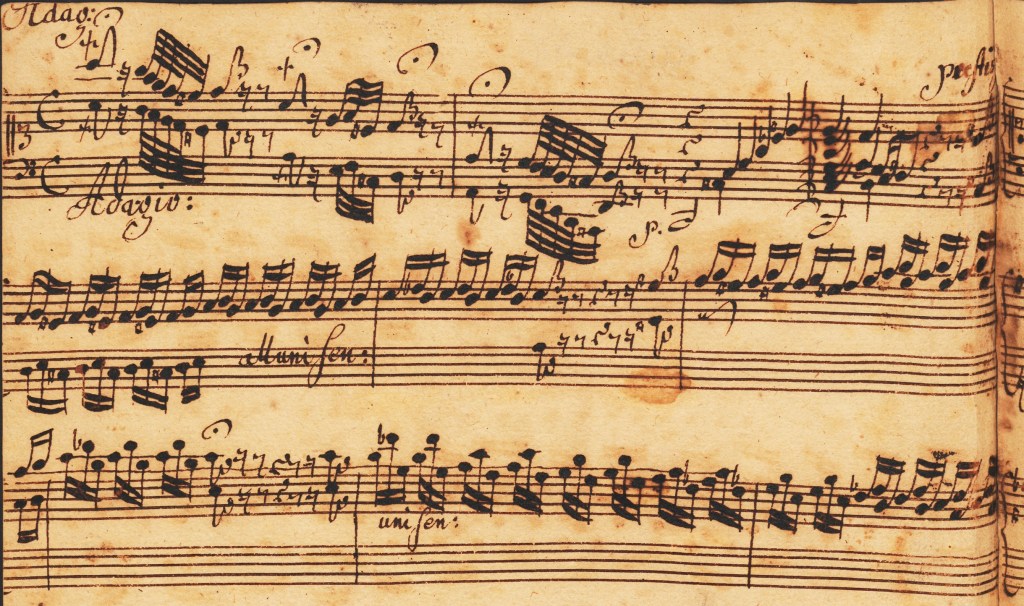
Ringk manuscript
Daniel Moult is an excellent communicator and player, and his detailed descriptions, analysis, and eventual performance are all presented in a compellingly relaxed manner. The 100-minute documentary on BWV 565 was filmed with the world-famous organ in the Groningen Martinikerk. With parts dating back to the 15th century, it came to fruition in the 18th century when it was enlarged by Arp Schnitger, his son Franz Caspar Schnitger and his successor Albertus Antonius Hinsz. The main presentation is followed by around two hours of additional filmed presentations and performances. These include the Toccata in C (BWV 566a), Prelude and Fugue in A minor (BWV 543), Prelude and Fugue in D major (BWV 532) and the Trio Sonata in G major (BWV 530). These are presented on the Martinikerk organ as well as the smaller 1733/34 Hinsz organ in the Petruskerk, Leens, a few miles (or, more accurartly, kilometres) north of Groningen.
Will Frazer’s filming is, as usual, outstanding. It includes shots taken by tiny cameras from inside the organ looking out at the organist. In so many organ recitals, you don’t even get to see the organist, let alone the expression on their face as they play, so this is a welcome innovation.
This is a very welcome addition to Will Fraser’s excellent series of films.
 Andrew Benson-Wilson : Early Music Reviews +