
Mayfair Organ Concerts – The Grosvenor Chapel
5 August 2025
Andrew Benson-Wilson
Arnolt Schlick
Tabulaturen etlicher lobgesang (1512)
Salve Regina (5 verses) 12’
(Salve regina – Ad te clamamus – Eia ergo, advocata- O pia – O dulcis Maria)
Pete quid vis 3’, Hoe losteleck 3’, Benedictus 2’30,
Primi toni 2’, Maria zart 2’30, Christe 1’30
Da pacem (3 settings) 7’
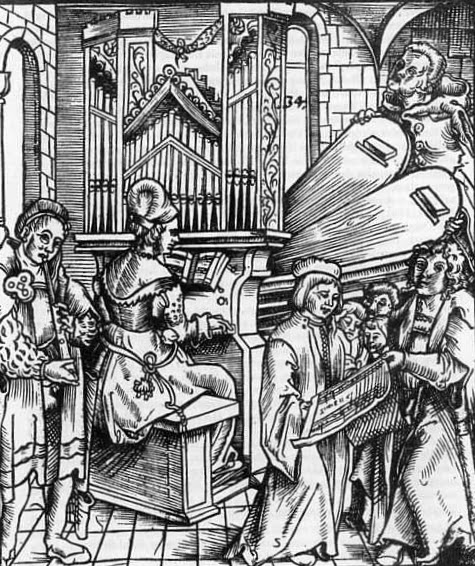
Title page of Spiegel der Orgelmacher und Organisten, 1511
Arnolt Schlick (c1455-c1525) has been described as”one of the greatest masters who have left their imprint on the history of organ music“. He was one of the most important members of the influential group of German late Renaissance organ composers, known as the Colourists. Others include Conrad Paumann and Paul Hofhaimer. Schlick lived and worked in the important university city of Heidelberg. In his late 20s, he was appointed court organist to the Palatinate Elector. In 1486 he played the organ for the coronation of the Habsburg Maximilian I as the King of the Romans. In 1511, he published the Spiegel der Orgelmacher und Organisten, the first German treatise on organ building and performance. The following year he published the Tabulaturen etlicher lobgesang und lidlein uff die orgeln un lauten (Tablatures of Several Canticles and Songs for the Organ and Lute). The collection shows the early development of keyboard music. Conveniently, the organ pieces fit into the length of a lunchtime recital.

Title page of Tabulaturen etlicher lobgesang, 1512
The large-scale Salve Regina may have been composed in Heidelberg in 1511 for the marriage of Schlick’s patron, Elector Ludwig V to Sibylle von Bayern. It has nine verses, the odd-numbered ones played on the organ, the rest chanted. The chant is heard in long notes in each verse, first in the tenor, then the bass, soprano, alto and bass. It opens with a striking 11 note scale up and down above the first four notes of the chant. The fourth verses opens with a 12-note scale in the pedal, followed by a double pedaling. It has been described as “one of the truly great masterpieces of organ art … It still breathes the strict spirit of the Middle Ages, which brought forth so many wonderful works, but new forces are already at work that lend this composition a novel fulness of expression and sound”.

Original score of the opening of the Salve Regina
Pete quid vis (‘Ask for what you want’) is a piece of unknown, but possibly secular origin. It features a range of imitative treatments of a single rising theme. It has three pauses, another 12 note pedal scale, followed by a series of triple-time rhythmic twists.
Hoe losteleck (‘How beautiful’) is probably based on a Dutch song relating Christ’s cross to the spring. It is one of the first examples of the use of fore-imitation, a technique frequently used by Bach in his chorale preludes.
Benedictus has been described as “the first organ ricercar” because of its use of fugal imitation at the start. It is possible an ornamented arrangement of a vocal piece.
The title of the Primi toni merely indicates the Dorian mode, but not the theme. It may be a prelude of sacred origin. The outer polyphonic voices frequently move in tenths.
Maria zart (‘Maria tender, of noble being’) is a beautiful setting of a German religious song, famously used by Jacob Obrecht in his Missa Maria zart. Schlick divides the melody into thirteen sections, each treated imitatively.
Christe is loosely constructed, with no obvious theme. It uses imitation throughout, starting with an extended two-voice section before the pedal is introduced.
The three settings of the Da pacem antiphon chant for peace were probably not intended for liturgical use, but as a sequence for solo organ. The first setting has the cantus firmus in the highest part with the two lower voices foreshadowing the chant. The second setting has four voices, with the chant in the tenor. The other three voices are independent, with a melodic treble line. The low-pitched, but powerful third setting is also in four voices, with the chant melody in the bass and a melodic treble line.
© Andrew Benson-Wilson 2025
Andrew Benson-Wilson specialises in the performance of early music. His playing is informed by his experience of historic organs, an understanding of period performance techniques and by several internationally renowned teachers. He has recorded the complete organ works of Thomas Tallis. One of his Tallis CDs, with plainchant verses sung by Chapelle du Roi, was Gramophone Magazine’s ‘Record of the Month’. The Organists’ Review commented that his “understanding of the historic organ is thorough, and the beautifully articulated, contoured result here is sufficient reason for hearing this disk. He is a player of authority in this period of keyboard music.”
Andrew’s recitals have ranged from the enormous 1642 Festorgel organ in Klosterneburg Abbey and the famous 1562 Ebert organ in the Innsbruck Hofkirche, to a tiny 1668 chamber organ in a medieval castle in Croatia and the 1723 ‘Bach’ organ in Störmthall, Leipzig. One reviewer wrote that his recital in London’s St John’s, Smith Square was “one of the most rewarding organ recitals heard in London in years, an enthralling experience”. Recent recitals have included Christ Church Spitalfields and a special Handel concert in St George’s, Hanover Square for The Handel Friends.
Andrew’s little book, The Performance of Early Organ Music, is a required text in a number of Universities. He is also a reviewer, formally with Early Music Review and now reviewing on his own website:http://www.andrewbensonwilson.org. He is an elected member of The Royal Society of Musicians of Great Britain, and the Council of the National Early Music Association.
Andrew’s next London recitals are on Monday 8 September at Christ Church, Spitalfields, 7.30 with music by John Stanley, and on Sunday 19 October, 3pm at St Laurence Whitchurch with Byrd to Blow, a programme of 17th-century Engish music for the 30th anniversary of Andrew’s opening recital on the Goetze & Gwynne ‘Handel’ organ.
 Andrew Benson-Wilson : Early Music Reviews +