
Bach: The Art of Fugue
on Bach’s Original Instruments
Collegium Musicum ’23
OUTHERE/RAMEE RAM2406. 82’41

Bach left many unanswered questions with his monumental Art of Fugue, one of which was which instruments they were intended to be played on – if, indeed, they were intended to be played at all. It was presented in open score, with a separate line for each line of music. This was common practice for many decades for music intended for scholarly or didactic purposes, particularly for organists. Samual Scheidt, for example, used the same format in his 1624 Tabulatura Nova, asking organists to copy the music into their own preferred format for performance. The instruments chosen for this interpretation by Collegium Musicum ’23 are very special: two 1729 violins and a viola by Johann Christian Hoffmann from the Leipzig Thomaskirche’s own collection of instruments of Bach’s time. The anonymous cello is from 18th-century Central Germany from the same collection. They are all usually displayed behind glass in the side room of the church.
This special link between the music and Bach himself makes this a particularly important recording. The playing adds to the value of the recording, which is being released during the 2025 Bachfest. Although the instruments sound fine to me, according to the extensive liner notes on the instruments by Veit Heller of the Leipzig Museum of Musical Instruments, there is a plan to restore them to their original form and sound. The performers are Nadja Zwiener and Anna Dmitrieva, violins, Magdalena Schenk-Bader, viola, Joseph Crouch, cello, with Hedwig Ohse, violin Anna Reisener, cello, playing on some tracks.

The recording opens with a transcription for organ of the short chorale Was Gott tut, das ist wohlgetan which concludes the first part of the cantata Die Elenden sollen essen (BWV 75) that Bach wrote for his Leipzig inauguration. This uses the same melody as the organ chorale prelude Wenn wir in höchsten Nöten sein (Vor deinen Th ron tret’ ich hiermit), which CPE Bach added at the end of the incomplete final fugue in the first edition of The Art of Fugue, with the unlikely suggestion that Bach dictated it on his deathbed, having left the incomplete Fuga a 3 Soggetti, which fizzles out shortly after the musical notation for B-A-C-H is heard as a fugue subject. The organ chosen for both organ solos is the very appropriate 1723 Hildebrandt organ in Störmthal, a village just south of Leipzig. It is an organ I know well, having given recitals there during past Leipzig Bachfests. Bach gave the inauguration recital, accompanied by some of the choir from St Thomas’s with Anna Magdalena as soloist.
The organ pieces are played by Johannes Lang, currently Bach’s successor at the Thomaskirche. His clever transcription for organ of the chorale Was Gott tut, das ist wohlgetan seems to have far too many notes for one person to play on a single manual organ, but with the help of the solo treble Cornet stop, he manages it well. I still can’t decide whether it makes an appropriate prelude to the first Contrapunctus of the Art of Fugue, the bustling texture and the powerful organ making for a very sharp contrast with the gentle fugue subject, played on solo violin.
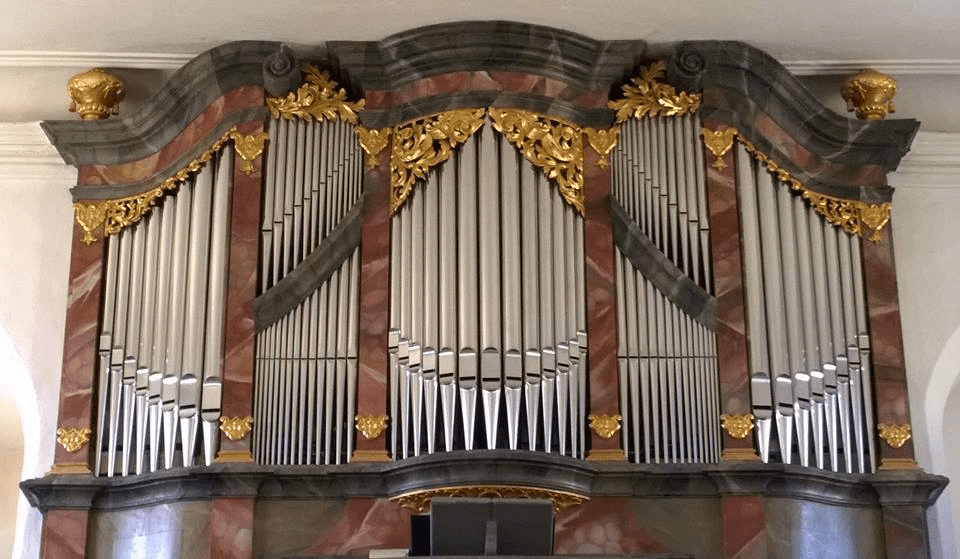
photo: ABW
Quite apart from the use of the very special string instruments, the use of a matching set of instruments is an excellent choice for the textures of the Art of Fugue. Unlike an organ performance, where the temptation to vary the sound of each section is too much for most organists, listening to a unified sound helps the listener to appreciate the contrapuntal complexity of the music. The Leipzig-based Collegium Musicum ’23 are a relatively new group, formed by Nadja Zwiener (well known in the UK as the concertmaster of The English Concert) and Johannes Lang with a flexible cast of players. Their playing is superb, giving life to what, on paper, can appear to be rather dry academic fugal lines. On the basis of this recording, they have a very promising future, both in their home city and throughout the world.
 Andrew Benson-Wilson : Early Music Reviews +