
Rune & Ensemble Gamut!
St Mary’s Church, Rotherhithe
Sunday 1 June 2025
There is medieval music, and there is medieval music, as demonstrated by this double-bill concert in the 18th-century riverside church of St Mary, Rotherhithe, a church known to organists for its 1764 John Byfield organ. The medieval music in the first half came from Rune, a recently formed London-based group of five musicians, but on this occasion, four: Angela Hicks, soprano & harp, Daniel Thomson, tenor, May Robertson, vielle, and Daniel Scott, recorders. Their name originates from the Old English ‘rūn’, meaning a mystical spell-song, and reflects their fascination with music from 700 years ago. Their programme was based on stories from the 14th-century Decameron, described in the concert flyer as “portraying various aspects of human nature and experience through some of the most beautiful music of the time”.

Photo: Ben Tomlin
Their refreshingly relaxed performance opened with a meditative prayer, followed by music from the allegorical Roman de Fauvel, an early 14th-century French satirical verse romance in the Ars Nova style of late medieval France. Later pieces were based on the legends of Orpheus and Apollo, ending with a piece from Lucca representing ‘togetherness in music’. The most impressive moments came when one of the two impressive singers was paired with a single accompanying instrument, usually the vielle or harp. Less successful were several pieces for two vocal lines when the accompanying instruments merely followed the two vocal lines, rather than adopting the more usual medieval technique of heterophony, where more than one performer plays more or less the same melody, but with each adopting their own distinctive style of ornamentation or elaboration. There were also occasional balance problems, usually involving the recorder player playing the smaller and more audible members of the recorder family too loudly during his frequent melodic interventions. The low-pitched recorder (I can never remember the correct name) was a far more successful consort instrument. The vielle player, in contrast, was rather too modest in her use of improvised elaborations and twiddles, often merely taking the role of a drone.
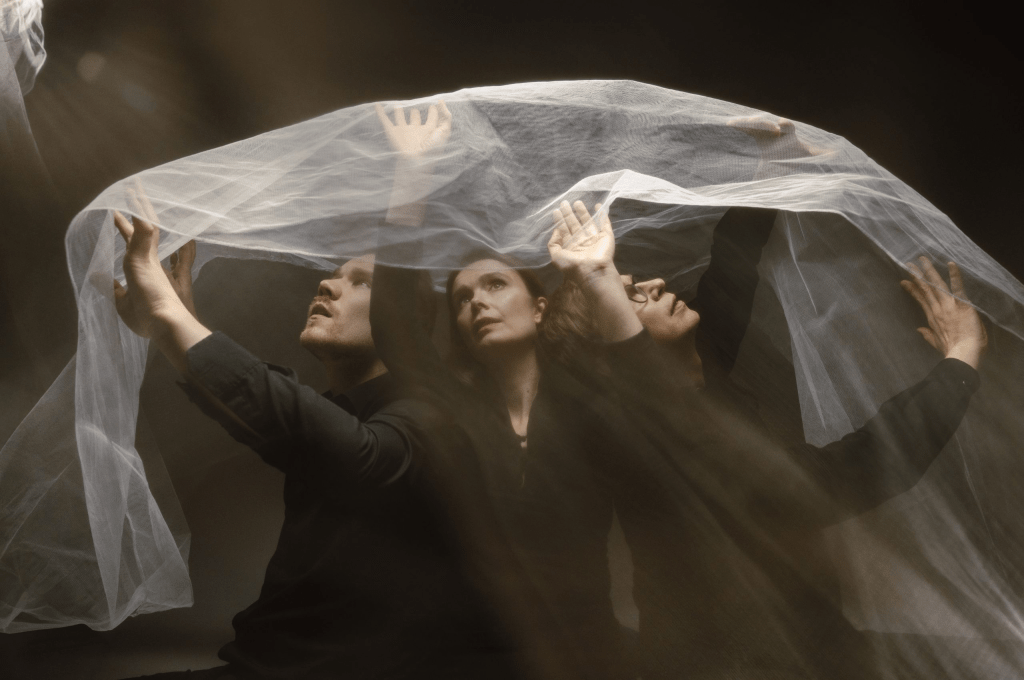
Photo: Anna-Maria Viksten
Following the interval, it was the turn of the Finnish group Ensemble Gamut!, Aino Peltomaa vocals and percussion, Ilkka Heinonen, jouhikko, and Juho Myllylä, recorders, the latter two also using electronics. They offered an alternative approach to medieval music to the more authentic Rune. They are currently touring the release of their third CD, Mi. Their music was described as “refreshing, soothing, intriguing and enlightening” as they “daringly rearrange elements from medieval music and Finnish folk songs, intertwining improvisation and electronic soundscapes . . . exploring the boundary between the living and the non-living, asking what is alive and what has already faded into extinction”. One focus of this concert was the endangered flowers of the Arctic, with little pouches of edible Arctic flowers on sale alongside their new CD.
Their principal instruments were interesting, even if they didn’t bear much relation to medieval instruments. The Jouhikko is a Finnish version of the bowed harp or lyre. It is traditionally a three-stringed instrument, although the version used in this concert had (I think) six strings, was bowed with what looked like a violin bow (held in a viol hand position), had what looked like a modern violin bridge, and was plugged into a loudspeaker. The most prominent recorder was what I think is called a Paetzold bass Recorder, a very modern and remarkably versatile re-interpretation of more traditional bass recorders. As well as providing low percussion sounds, there seemed to be an added device that produced high-pitched whistles.
I must say that the link with medieval music rather escaped me, although the CD titles include references to Hildegard von Bingen and Bridgettine chant. These might have been an inspiration but their music, whatever its origins, soon became subsumed into a novel and inventively improvisatory style. Pieces usually started quietly but soon ventured into what seemed to be a free-form improvisation, using a wide range of vocal and other techniques, many electronic. Examples include a frame of little bells hit, almost inaudibly, with a drumstick, what seemed to be the sound of crumpled paper, and scraping noises from the jouhikko/lyre.
Unfortunately, the organiser of the concert did not provide any programme notes, other than the advertising flyer for a whole series of concerts, so the performers introduced the pieces themselves. Particularly with the Finnish groups, it was not always clear what a piece was all about. Towards the end, there was one extraordinary piece when the jouhikko player got very angry.
Another one of several curiosities from the organiser came when she walked down the central aisle during a piece, sat in the front row and started videoing and photographing the performers on her mobile phone. One of these phone videos, of Ensemble Gamut!, can be viewed here. It includes the jouhikko/lyre and the large bass recorder, and a novel percussion sound created by rolling three small balls in a frame drum, all topped by the distinctive voice of Aino Peltomaa. It is worth comparing with this video of Run during the first half.
 Andrew Benson-Wilson : Early Music Reviews +