
Sense & Musicality
The love story of Jane Austen and Music
Penelope Appleyard, Jonathan Delbridge
Newbury Spring Festival
Shaw House, Newbury. 13 May 2025
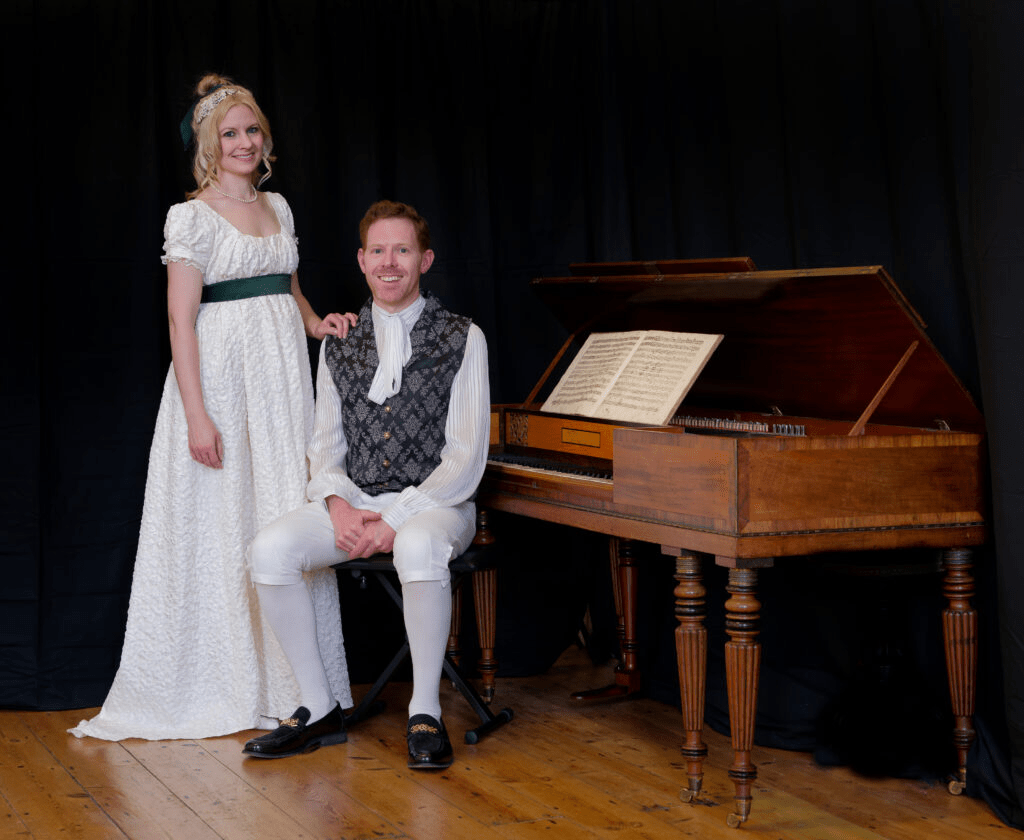
In the 250th anniversary year of Jane Austen’s birth in Steventon, near Basingstoke, much attention has been paid to her writings and the aspects of her own life that her books reveal. One part of her life that can be overlooked is her love of and interest in music. One example of the quest to explore Jane Austen’s musical interests came with a performance of Sense & Musicality: “The love story of Jane Austen and Music” given by soprano Penelope Appleyard and Jonathan Delbridge, playing his own 1814 Broadwood square piano, in the Hall of Shaw House, Newbury, not far from her birthplace.

Presented as ‘head v heart’, this semi-theatrical performance used a setting based on Jane Austen’s own drawing room at Chawton where, incidentally, this programme was presented a few days earlier. It included extracts from her writings to explore her relationship with music, emotion and romance. It included music that Jane played and sang herself (several from scores in Jane’s own hand from the Austen family’s music albums), along with music and composers mentioned in her novels and pieces from the soundtracks of screen adaptations, including the acclaimed 1995 BBC series, Pride & Prejudice.

The 1814 Broadwood square piano was a particularly apt accompanimental instrument. Jane mentions Broadwood pianos in Emma and purchased one herself in 1810. Its beautifully delicate and precise tone was ideal for the domestic setting, and the acoustic of the performing space. A remarkable range of volumes was produced by the different figuratons of the various sections of the lid, ranging from just about audible with all the lids closed, to prominent with the entire lid lifted, notably during one of the showpieces, the Storm Rondo by Daniel Steibelt (1765-1823), a virtuosic piece thought to be the ‘grand concerto’ played by Marianne Dashwood (in chapter 24 of Sense and Sensibility) to drown out her sister Lucy’s secret conversation with Elinor. This was enacted with Penelope Appleyard quickly reciting the text of the conversation – the text was provided in the programme, as the piano, as intended, covered up the speech!
Another highlight was ‘Ode to Pity’, a brand new composition by Donna McKevitt commissioned especially for this programme. It is a musical setting of Austen’s teenage poem, written when she was just 17. It seems to gently mock the overblown 18th-century literary conventions by using antiquated language that portrays very little.
Ever musing I delight to tread
The Paths of honour and the Myrtle Grove
Whilst the pale Moon her beams doth shed
On disappointed Love.
While Philomel on airy hawthorn Bush
Sings sweet and Melancholy, And the thrush
Converses with the Dove.
Gently brawling down the turnpike road,
Sweetly noisy falls the Silent Stream—
The Moon emerges from behind a Cloud
And darts upon the Myrtle Grove her beam.
Ah! then what Lovely Scenes appear,
The hut, the Cot, the Grot, and Chapel queer,
And eke the Abbey too a mouldering heap,
Conceal’d by aged pines her head doth rear
And quite invisible doth take a peep.
Donna McKevitt’s impressive music reflected folk music of the time in a style that Jane Austen might recognise – except, perhaps, for a few hints of the Scottish rhythmic twangs of Maxwell Davies. The wide-ranging melody caught the faux-expressiveness of Jane’s poem.
Although there seems to be a reference to her “hating Italian singing”, Jane was particularly fond of Che faro senza Euridice from Gluck’s Orfeo ed Euridice, labelling it as “a favourite song”. Her aunt remembered Jane singing Que j’aime a voir les hirondelles, a French ditty by Francois Devienne (1759-1803), in the Austen family collection. It tells a sad story about two swallows, lamenting that if one becomes trapped in a cage by a cruel child, both will die of broken hearts. In contrast, we heard Soldier’s Adieu by Charles Dibdin (1745-1814), a patriotic song of the Napoleonic wars, with its echoing bugle calls.
For anybody wishing to explore further, Jane Austen’s personal music collection has been digitized by the University of Southampton.

 Andrew Benson-Wilson : Early Music Reviews +