Beethoven: Hero/Rebel
Orchestra of the Age of Enlightenment
Maxim Emelyanychev conductor, Vilde Frang violin
Queen Elizabeth Hall. 27 February 2025
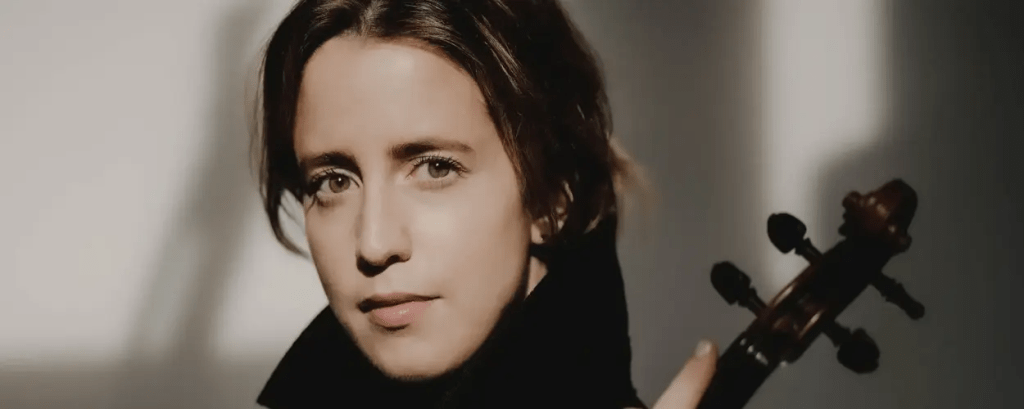
Vilde Frang. Photo credit: Marco Borggreve
Beethoven: Violin Concerto, Symphony No.3 (Eroica)
Responding to the question “What does it mean to be a hero or a rebel?”, the Orchestra of the Age of Enlightenment featured two of Beethoven’s works that they suggest represent his rebellious spirit and heroism. As Beethoven faced his struggles of increasing deafness, Napoleon’s campaign to free Europe from tyrannous monarchies had given him hope. But when Napoleon declared himself Emperor, the composer famously scratched out the dedication from the cover page of the Symphony’s manuscript, reportedly declaring: ‘So he is no more than a common mortal! Now he, too, will tread underfoot all the rights of man and indulge only his ambition.”
The Eroica (3rd) Symphony and Violin Concerto both rebelled against contemporary ideas of what a symphony or concerto should be, not least in their length and their technical and musical complexities. Generally hailed as the first ‘Romantic’ symphony, the Eroica was composed between the autumn of 1804 and the following spring and was given a first private performance in June 1804 in the palace of Beethoven’s patron, Prince Lobkowitz. It was followed by the first public performance in April 1805 in Vienna’s Theater an der Wien. The reviews were, at best, mixed, with one commentator referring to “strange modulations and violent transitions and abundant scratchings in the bass“, and that length “exhausts even connoisseurs, becoming unbearable to the mere amateur“. Its London premiere was in March 1807.
The Violin Concerto was composed in 1806 for violinist Franz Clement, and first performed in December 1806 in the Theater an der Wien during a benefit concert for Clement, who apparently had to sight-read some of the just-completed score. A typically complex concert programme also seems to have included one of Clements party tricks, played his violin on one string with the violin held upside down. The performance by Vilde Frang was outstanding – one of the finest I have heard. The delicacy of her violin tone and her ability to merge into the orchestral sound was coupled with her astonishing ability to play at the very edge of audibility and yet fill the Queen Elizabeth Hall with the most intense emotion was unforgettable. Helped by conductor Maxim Emelyanychev, she accented Beethoven’s orchestral pauses and rests, adding an air of mystery to the overall experience. Of the orchestral players, timpanist Adrian Bending deserves a mention for his contribution to one of Vilde Frang’s cadenzas and his choice of sticks recreating the sound of Beethoven’s time.

Photo: OAE
It was always going to be difficult to follow such an extraordinary performance but sadly Maxim Emelyanychev fluffed it from the very start of the Eroica. Bouncing onto the stage like an over-keen schoolboy he started the distinctive opening two chords while the audience’s applause was in full flow, not only obscuring one of the most dramatic symphonic openings but destroying what should have been the mood before hearing the dramatic opening of a momentous piece, I am afraid that I didn’t really recover that bizarre opening, so will concentrate this review on the superb performance of Vilde Frang plus a mention to some more key OAE players, clarinettists Katherine Spencer and Sarah Thurlow (sometimes playing en chamade) and horn players Richard Bayliss, David Bentley and the famous Eroica ‘third horn’ Nicholas Benz who had the controversial “early entry” in the first movement recapitulation – a lovely bit of rebelliousness from Beethoven.
 Andrew Benson-Wilson : Early Music Reviews +