Viennese Virtuosity: Symphonies by Mozart, Haydn and friends
Academy of Ancient Music, Laurence Cummings
Milton Court, 14 November 2024
Wanhal: Symphony in D major, Bryan D17
Mozart: Symphony No 36, Linz
Dittersdorf: Symphony No 4 from Symphonies after Ovid’s Metamorphosis
Haydn: Symphony No 80
The Academy of Ancient Music (AAM) and Laurence Cummings continue their Transformation series of 2024/5 concerts with a concert of symphonies by Johann Baptist Wanhal, Wolfgang Amadeus Mozart, Carl Ditters von Dittersdorf and Joseph Hadyn. It was based on an occasion around 1784 when they played as a string quartet during a social gathering in Vienna. The story comes from an 1826 publication by a singer friend of Mozart, who noted that “… the players were tolerable, not one of them excelled on the instrument he played; but there was a little science among them, which I dare say will be acknowledged when I name them: The First Violin: HAYDN, Second Violin: BARON DITTERSDORF, Violoncello: VANHALL, Viola: MOZART“.
Although they might (apparently) not have excelled on their instruments (despite “a little science”, whatever that meant), all excelled at composition, as this evening demonstrated. All four of the symphonies performed were composed between 1781 and 1784, which gave a useful focus on the relative development of the four composers and their music at that time. Haydn was in his early 50’s, Wanhal and Dittersdorf were seven years younger and Mozart was 24 years younger than Hadyn and 17 years younger than the other two.
Johann Baptist Wanhal (1739-1813) was born to a Bohemian peasant family where his musical talent was spotted by local teachers who taught him the organ, singing and a range of wind and string instruments. After building a local career as an organist and choir director while learning German with a view to moving to Vienna, which he did aged 20 with the help of the local countess. He was soon adopted by various aristocrats, including Count Ladislaus Erdödy, spending time in the Count’s castle in Varaždin, Croatia. I noticed a painting of Wanhal on the walls of Erdödy’s Stari Grad castle in Varaždin on my way to give a recital on the little chamber organ in an upper room of the castle several years ago. More of his background can be found here and here.
His Symphony in D is one of the last of his 77 symphonies. The opening is a stately Andante molto which morphes into a martial Allegro moderato. Unfortunately, the programme note omitted the Allegro moderato title, so the trumpet fanfares were probably rather confusing to the audience. A lyrical second theme adds balance to the movement. The central Adagio molto features an elegant flute solo with a plaintive little cadenza, played beautifully by Rachel Brown. The Finale crescendos over repeated bass notes, with several unison passages, typical of the era.
For a little-known composer to be followed by one of Mozart best-known symphonies is so often the kiss of death for the former, but Wanhal certainly held his own against the Linz Symphony (K425), apparently composed in less than six day while stopping of in Linz on his way from Salzburg to Vienna, Clearly influenced by Wanhal Symphony in D, not least in the slow opening and copying Wanhal’s opening theme for his second movement Andante. The concluding Presto was apparently marked to be played “as fast as possible” but, curiously for Lawrence Cummings, the more restrained made perfect sense to me, balancing the pace of the previous three movements.
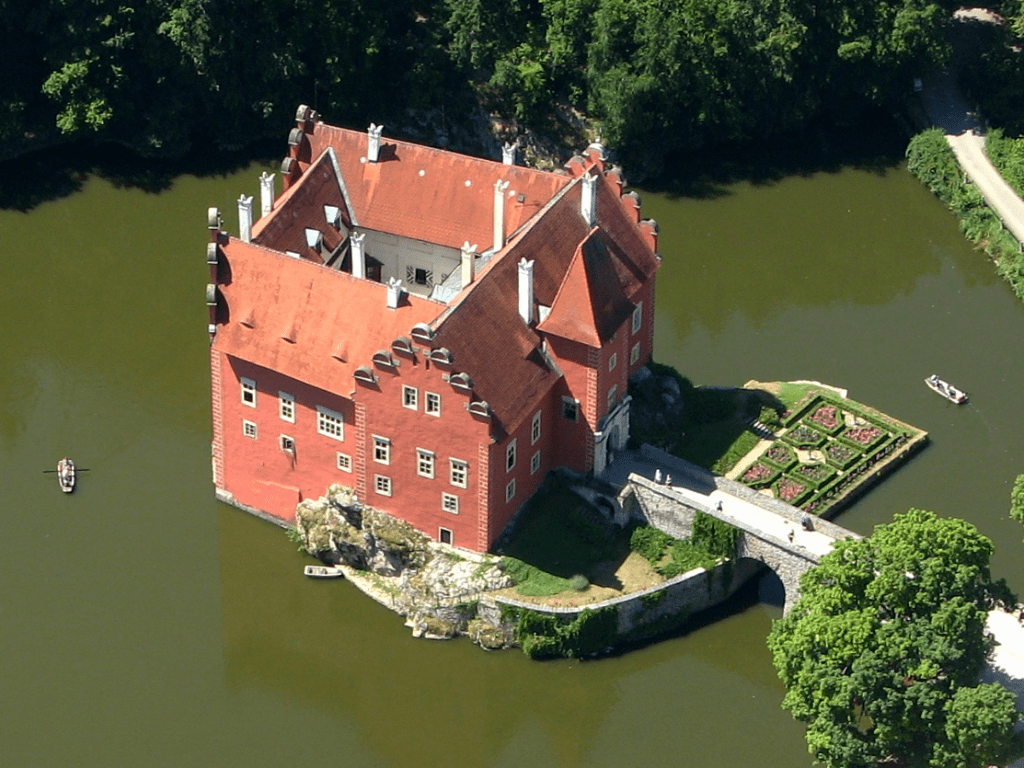
Born Carl Ditters in 1739 near Vienna the son of a military tailor who had retired to a post with Vienna’s National Theatre, Dittersdorf (as he was to become) was taken under the wing of a local prince and, later, the Austrian Empress he became director of the National Theatre orchestra. Passing through several court appointments to various big-wigs, he was eventually persuaded to stay as court composer to the prince bishop of Breslau by being appointed governor of Johannesburg, one of the bishop’s towns, a post that required a noble title, therefore giving on the slightly silly moniker of Ditters von Dittersdorf. Despite being the same age as Wanhal, Dittersdorf was his teacher. After many years in Johannesburg he fell out with the prince bishop and was thrown out of his governor’s palace, but was offered a spare castle of a local baron, the still existing Červená Lhota Castle, pictured below.
Dittersdorf’s Symphony No 4 from his Symphonies after Ovid’s Metamorphosisis. It has the title The Rescue of Andomea by Perseus. The theme of each of the four movements was introduced by Lawrence Cummings. The opening Adagio con molto had an oboe solo that opened with an extended crescendo on a single note but, unfortunately, it stayed at the higher volume more or less throughout, the forceful and slightly harsh tone in marked contrast to the exquisitely nuanced sotto voce playing of the strings. I am not convinced that this was one of Dittersdorf’s finest pieces, the slightly plodding thematic and melodic structure dragging things down a bit.
The evening concluded with Haydn’s Symphony No 80. It was composed at a time when Haydn had been released from his ban on publishing music outside of the Esterházy domain. It was published in London and Venice. It follows the traditional four-movement Vienna structure and, in the opening movement, reflects elements of the dramatic Sturm und Drang style with snatches of a courtly dance enclosed by a more turbulent texture. The Finale is quirky, with a confusing syncopated rhythm that makes it difficult to pick up the beat – the main theme starts and continues on an off-beat.
 Andrew Benson-Wilson : Early Music Reviews +