International Young Artist’s Presentation
Laus Polyphoniae 2024
AMUZ, Antwerp. 24 August 2024
The International Young Artist’s Presentation (IYAP) is an annual coaching and presentation scheme promoted by AMUZ (Flanders Festival Antwerp) and the Musica Impulscentrum to help promising young musicians “grow into tomorrow’s stars”. Six young early music ensembles are invited to three days of coaching by international early music specialists before performing short programmes during public concerts on the first Saturday of the Laus Polyphoniae festival (reviewed here). Unlike most similar young artist events, it is not a competition but an informal opportunity for young musicians to develop their performing style. An invited Feedback Committee of concert promoters and others comment privately on their public performances. Scarily for me, and possibly them, these reviews are far from private, but I hope will be equally helpful.
The first group to appear were Coloquio 6 (Carolina Guiducci & Sergio Sánchez Martín, clarinets, Pablo Traine & Janire de Paz Rivas, natural horns, and William Gough & Francisco Javier Sánchez Castillo, bassoons), a wind sextet exploring music from the 18th and 19th centuries using period instruments. They met at the Royal Conservatory of Music in The Hague, their name based on the Spanish word for ‘conversation’. The programme of Music for Wind Instruments by Mozart and Beethoven included their own arrangement of Mozart’s Ouverture to Die Zauberflöte together with extracts from Mozart’s Serenade KV 375 and Beethoven’s Sextet in E-flat major, Op.71.
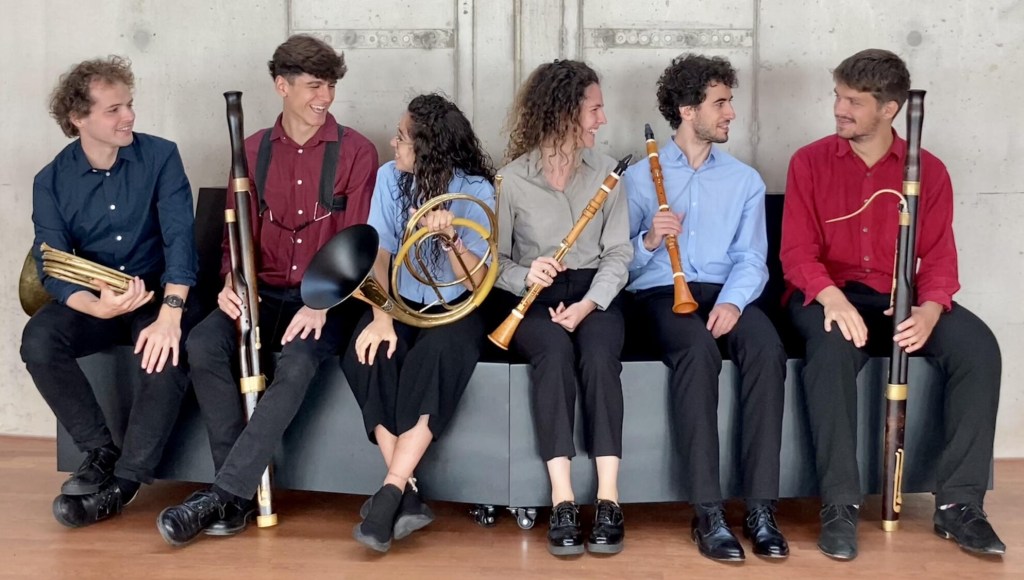
They opened with three of the five movements of Mozart’s Serenade in E flat, a reordering of the printed programme. The Die Zauberflöte Ouverture was supported by a video animation of the opera’s story by visual artist Dax Niesten – a nice touch, adding an extra dimension to the music. Beethoven was influenced by Mozart’s music for wind ensemble, as demonstrated in the Sextet in E-flat, an early work but not published until 1710, well after its 1796 composition, hence a chronologically confusing Opus number. They played the last two movements, the jovial Rondo-Allegro making for a well-judged conclusion to their recital. The two clarinet players swapped positions part way through, giving Carolina Guiducci the chance to demonstrate how to moderate the volume of the treble instrument to avoid being too dominant in democratic six-part texture. I liked the interaction between the players, notably the instrumental pairs – it is always endearing to see the players relating to each other, the music, and the audience.
They were followed by Concussio Chordis (Francesca Lorenzetti, viol, and Tyler Stewart, cello). They were founded in 2022 and focus on music for bass string instruments from the late Renaissance to the end of the 18th century. Their programme, Une Soirée à Versailles, explored the early 18th-century battle for supremacy between the viol and cello when the viol was at its pinnacle of success in France, while the cello was finding favour in Italy.

This was a cleverly conceived and presented programme contrasting two instruments, and two musicians, with very different styles. The contest between the music of the two countries, not just the instruments, was at its height in France. Hence Couperin’s musical attempt to unite the two styles with his Les goûts-réunis which opened the concert. Each player then introduced and promoted their own instrument and played music that highlighted each of them, announcing that there would be a vote for the favourite instrument at the end. The cello was introduced as “anything you can do, I can do better, but with fewer strings”. But, if anything, Jean Barrière’s 4th Cello Sonata demonstrated the versatility of the viol in providing a chordal accompaniment, although the Aria amoroso showed the cello’s ability to maintain an Italian cantabile. Marin Marais’ Suite d’un goût étranger featured extraordinary expressiveness, not only from the viol but also from Francesca Lorenzetti. The vote turned out to be as much a contest between the two performers as the two bass string instruments. The viol won the show of hands unanimously, although a sizeable number of the lovely Antwerp audience had already voted for the cello.
The Brussels-based Fluctus Ensemble (Katerina Blížkovská, mezzo-soprano, Joan Casabona I Amat, traverso, Clémence Schiltz, viol and Stan Geudens, theorbo) was founded in early 2023. Their programme, En vous aimant, featured vocal and instrumental music from the French chamber repertoire of around 1700 based on the ‘pain and affliction’ evoked by love, elements that were key to the airs de cour by composers such as Lambert, Campra, Marais, Ballard and de Montéclair. They used a theorbo rather than a harpsichord for harmonic support for the melodies to emphasise the intimacy of these works.

The theorbo turned out to be excellent as an accompaniment instrument, enhancing the intimate mood of the other instruments. An introductory Prelude for flute and theorbo by Boismortier segued into Ballard’s J’avois cry qu’en vous Aimant. Mezzo Katerina Blížkovská impressed with her expressive and pure-toned voice, integrating her ornaments well into the natural flow of the music. I have often written in reviews that it is the responsibility of performers to indicate to the audience if and when to applaud, something that Fluctus Ensemble did perfectly at the end of this piece. Sadly that didn’t stop one member of the audience from starting to applaud and, unusually in the circumstances, continuing to applaud until others eventually joined in, disrupting both the flow and the subdued mood of the concert. The instrumental pieces were excellent, notably a delightful Couperin Prelude for viola da gamba and theorbo and a thoughtful performance of Marais’ Les voix humaines for solo theorbo.
The pseudonym ensemble (Liane Sadler, traverse flutes, Maya Webne-Behrman, violin, Stephen Moran, viol, and Gabriel Smallwood, harpsichord & organ) are all graduates of the Schola Cantorum Basiliensis. Their programme, Broken Colours, focussed on early 17th-century instrumental music ‘in stile moderno’ by composers such as Castello, Marini and Merula, together with pieces by Palestrina, Falconieri, and Rossi. Publications indicated that this music could be performed ‘con ogni sorte di strumente musicale’ (by any combination of musical instruments), evidenced in this performance by the use of traverso flutes and a viola da gamba alongside the more traditional violin and keyboards.

One problem with music of this era, composed in the multi-section stylus phantasticus manner with lots of short contrasting passages, is that it can be hard (at least to me) to work out when one piece ends and the next starts. I managed to segue all three of the first pieces together, only a distinctive Castello cadence alerting me to the fact that I wasn’t still listening to Rossi! I liked hearing the text of Palestrina’s Pulchra es amica me before it was performed with Rognini’s and their own diminutions. Some agile harpsichord playing was evident in Merula’s lively Ballo detto Eccardo, with its syncopated rhythms. A more successful segue came at the end with Marini’s La Foscarini Sonata a 3 ‘Con il Tremolo’ which melted successfully into Falconieri’s Ciaconna. Their improvised ornaments and embellishments throughout their concert were impressive ly integrated.
Olympe Ensemble (Eduardo Gaspar Polo Baader, traverso, Julia Hernández Sánchez, violin,| Belén Sancho Zorrilla, viola, Sara Vicioso Usero, cello) focuses on chamber music for traverso and strings from the second half of the 18th century and the early 19th century, particularly music composed around the time of the French Revolution. Their programme, The Traverso in Classicism, included two pieces composed 20 years apart (1777 and 1799), a period of major changes in European politics, society and music. Mozart’s Mannheim Flute Quartet in D, KV285 was followed by the Flute Quartet in G, Op.66/4 by the Parisian flautist and bassoonist François Devienne, a composer noted for raising the musical standard of compositions for wind instruments in France.
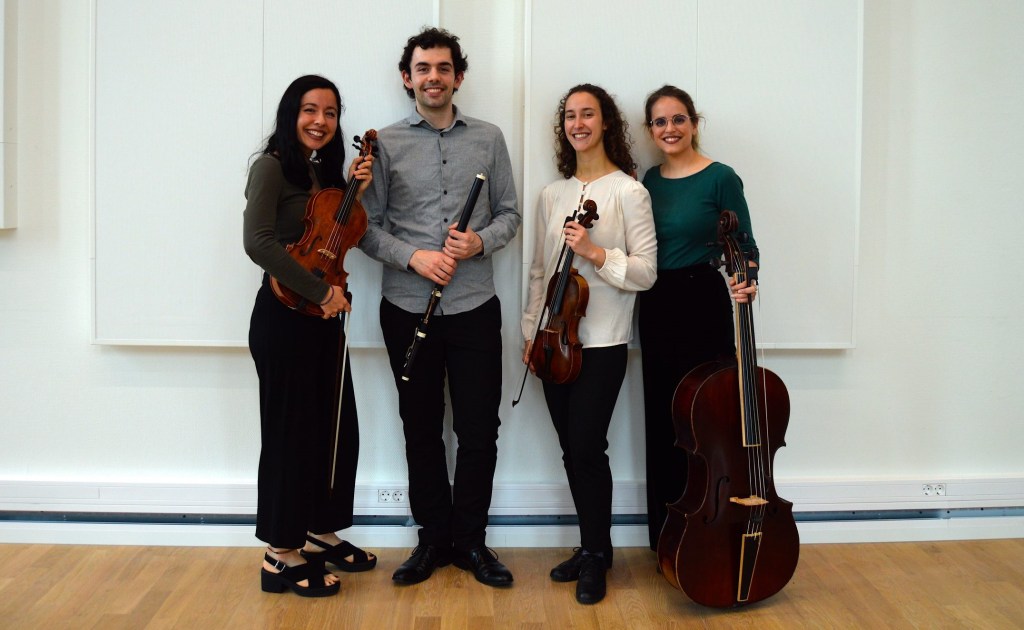
Unfortunately, the audience was still settling down when they started playing, although they might not have been aware of this from the stage. Mozart’s elegant music summarised the Classical era style while Devienne pointed towards the forthcoming Romantic era. Its powerful unison opening gave way to a more elegiac mood, the concluding Rondo being particularly attractive, with its prominent solo moments for the violin and viola interspersed between the return of the Rondo theme. The Mozart Adagio was a delight with its accompaniment of plucked strings. Both pieces, perhaps inevitably, sounded more like a ‘flute and accompaniment’ rather than a true quartet structure where each instrument is treated equally, although this may have been normal for this period.
The final group of the day were Entrebescant (Beatriz Peña Rey, voice & hurdy-gurdy, Alaia Belaunzaran Arruebarrena, Roman harp & alboka, Livia Camprubí Bueno, fiddle, and Pablo Fernández Cantalapiedra, voice, recorder & percussion) with their programme El Cantar del Destierro: the Song of Exile. It commemorated the 975th anniversary of the birth of El Cid, Spain’s national hero, with music from the Codex Las Huelgas, Gregorian chant, and traditional songs and dances from Andalusia, Aragon and Castile, all places El Cid travelled through during his exile, the story of which was projected (in English) onto a screen.

They also started playing while the audience was settling down, but this might have been deliberate as the tuning-up of the hurdy-gurdy and harp morphed into the first piece. The vocal pieces were sung by two of the musicians with the imposing voice of Pablo Fernández Cantalapiedra taking the role of El Cid and Beatriz Peña Rey generally acting as the singing narrator. It was a very effective way of presenting the music, even for those who just about remember the 1961 film although, perhaps inevitably, the music dated from well after El Cid’s death. The Cantigas de Santa Maria, dating from the time of Alfonso the Wise of Castile were probably being the closest in time. The hurdy-gurdy made limited but effective use of the buzzy “trompette” sound, and the wide variety of percussion instruments were also used moderately. One instrument new to me made a brief appearance – the alboka (pictured below), “a single-reed woodwind instrument from the Basque country, consisting of a single reed, two small diameter melody pipes with finger holes and a bell traditionally made from animal horn and a reed cap of animal horn around the reed”.

I gather the videos were made of all the performances which will eventually appear on the AMUZ YouTube channel, although at the time of writing I can’t find any of them.
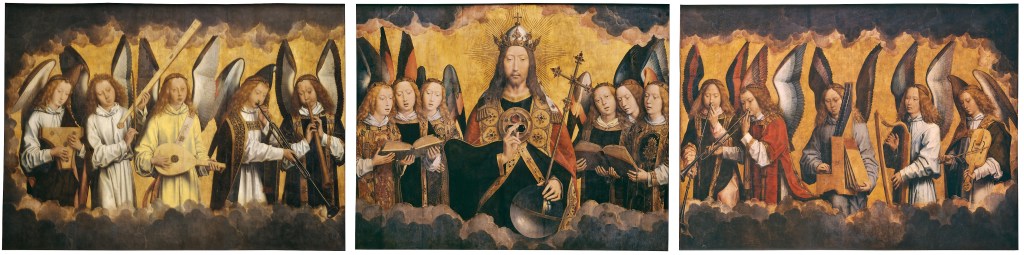
Next year’s Laus Polyphoniae festival is from 22-31 August 2025, so the IYAP presentation will presumably be on Saturday 23 August. In the meantime, I leave you with the three surviving bits of Hans Memling’s exquisite God the Father with Singing and Music-making Angels, now visible again after the long-awaited reopening of the Royal Museum of Fine Arts of Antwerp.
 Andrew Benson-Wilson : Early Music Reviews +