Sing Joyfully
The Renaissance Singers at 80
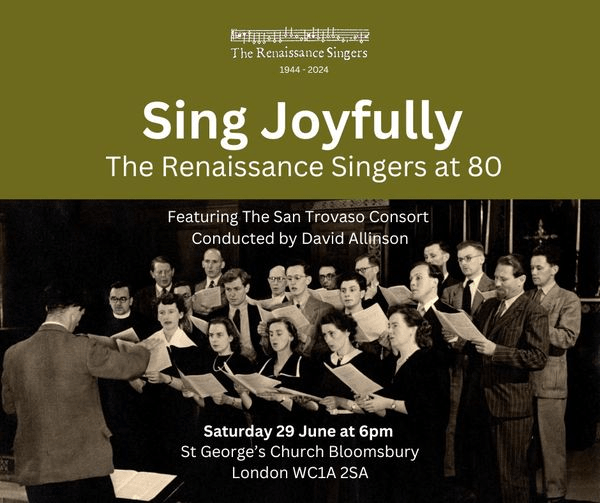
Renaissance Singers, The San Trovaso Consort, David Allinson
St. George’s Bloomsbury. 29 June 2024
Robert Fayrfax: Magnificat ‘Regale’ a5
Giovanni Pierluigi da Palestrina: Super flumina Babylonis a4
Jacobus Clemens: Ego flos campi a7
Orlando Lassus: Missa Puisque j’ay perdu a4, Kyrie and Agnus Dei
Heinrich Isaac: Virgo Prudentissima a6
Thomas Luis de Victoria: Four Mairan Antiphons
Alma redemptoris mater a8; Ave regina caelorum a8; Salve regina a8; Ave Maria a8
Mikolaj Zielenski: Magnificat a12
In July 1944, a newly formed choir gave its first concert as V2 bombs fell on London. Founded by Michael Howard, The Renaissance Singers was seen as the performing wing of the Renaissance Society and were motivated by a love of Renaissance vocal music. They aimed to recover lost masterpieces and share them with new audiences. At the time, the repertoire was unfamiliar, and there were few if any performing additions. Early audience members included Ralph Vaughan William, who became their second President. Under its current Musical Director David Allinson it is now one of the UK’s leading amateur chamber choirs specialising in early music, pioneering neglected composers, bringing original programmes to new audiences, and collaborating with top-flight musicians in a year-round programme of concerts and workshops.
My links with The Renaissance Singers go back to July 1998 when I joined in, and reviewed (for Early Music Review), an open day at St Pancras Church. They worked on a range of pieces, including Tallis’s Spem in alium, under the direction of Edward Wickham, musical director from 1995 to 2005, and guest conductors from the choir’s past. Another workshop followed in March 2000 and, in October 2001, I joined them as organ soloist for the first concert of the travelling Wingfield Organ (a reconstructed medieval organ) during the Tudely Festival at All Saints Tudely. I also recall David Allinson’s first concert as musical director in 2010 in an imaginative Valentine’s Day concert with the title Love and Chocolate. My review noted that “David Allinson directed with evident (and justifiable) pride and enjoyment”. I have always been impressed with their performances – some more recent reviews can be read here.
The first half of this 80th-anniversary concert featured music associated with the choir’s history. The powerful opening Magnificat ‘Regale’ by Robert Fayrfax immediately demonstrated the outstanding quality of the choir’s singers, their well-balanced and clean-toned voices projecting well into the big acoustic of St. George’s Bloomsbury, one of Nicholas Hacksmoor’s architectural masterpieces. The interplay between the voices in the different vocal groupings and the contrast between tiny musical motifs and lengthy melismas was well judged. This piece featured on an early HMV recording and BBC broadcast accompanied, as was the fashion of the day, by clarinets and trombones.

The choir moved into a mixed-voice format for Palestrina’s Super flumina Babylonis, giving a different aural perspective. This was performed at their first concert in 1944 and has been a regular returner ever since. A perfect miniature in five linked sections, expressing the sorrow of the text, notably with some sensuous suspensions during the final phrase. A feature of the following Ego flos campi a7 by Jacobus Clemens was the excellent control of the choir’s dynamics by David Allinson. Given the nickname of ‘the scampi song’ by the choir, it was particularly popular with them during the 1990s.
The Kyrie and Agnus Dei from Orlando Lassus’s spectacular Missa Puisque j’ay perdu a4 followed, the subdued Agnus Dei being particularly attractive. The first half ended with Heinrich Isaac’s Virgo Prudentissima a6, a song of praise to the Virgin Mary and Emperor Maximillian I in equal measure. The opening section highlighted the excellent choir sopranos in high bell-like passages. This piece was included in the ‘Doodlebug concert’ in St Peter’s, Eaton Square, given a week after the first V1 rocket attack on London had killed 120 people in the nearby Guards Chapel. Air-raid sirens sounded just after the start of the concert, and a V1 rocket exploded close by during the singing of the Gloria and a second following during the Sanctus. But, according to a note on the concert programme, what upset the stoical and brave singers most was that the ppp final chord of the Agnus was interrupted by the all-clear sirens.
The audience was noticeably reduced after the interval as the choir was augmented by around 20 former members of the choir together with the cornets and sackbuts of the eight-strong The San Trovaso Consort (led by Michael Mullen) to perform more ambitious polychoral pieces. Thomas Luis de Victoria has long been a favourite of the choir and their current musical director Dr David Allinson. The Four Mairan Antiphons (Alma redemptoris mater a8; Ave regina caelorum a8; Salve regina a8; Ave Maria a8) reflected the problems of providing scores for choir members in the early days, ranging from hand-written copies made from public library stock to the early days of typesetting and publishing.

Spanning the full width of the church, the enlarged forces made a magnificent sound, presumably, given the logistics involved, on rather limited rehearsal time. David Allinson’s love of the music was particularly evident in these four contrasting pieces – he really appears to physically embody the music and transmits his enthusiasm effectively to the singers. The final piece was from a composer I don’t recall hearing before, the Polish Mikolaj Zielenski (c1560-c1620). His Magnificat a12 was published in Italy in 1611 along with all his other known pieces. Adding an extra four voices to the more usual eight-part pieces results in a gorgeous blast of sound, the high sopranos in choir one once again on magnificent form. A fitting conclusion to a special occasion.
Performance photos based on originals by David Wilson
 Andrew Benson-Wilson : Early Music Reviews +